How to Build and Strengthen Your Glutes: An Evidence-Based Guide to the Body's Most Underrated Muscle Group
How to build stronger glutes with evidence, not aesthetics: why sitting leaves them underactive (gluteal amnesia), an EMG-ranked exercise table, the activation-to-hypertrophy progression, weekly volume targets, and how to train glutes without aggravating your lower back.

SensAI Team
11 min read
Get a training plan that adapts to your recovery — free on iOS

How to Build and Strengthen Your Glutes: An Evidence-Based Guide to the Body’s Most Underrated Muscle Group
Your gluteus maximus is the single largest muscle in your body — and most people sitting down to read this can barely fire it on command. That paradox is the whole story. The biggest engine you own is also the one most likely to be idling, and the bill comes due as lower-back pain, slumped posture, and knees that cave inward when you squat or run.
The fix is not more squats. It’s a sequence: wake the muscle up, then load it heavy, then pile on volume to grow it. Activation, then compound strength, then hip-thrust hypertrophy — in that order.
This guide walks the whole chain: what your three glute muscles actually do, why sitting switches them off, the best exercises ranked by the EMG data, the progression that builds them, how much weekly volume you need, and how to train glutes without lighting up your lower back.
Meet Your Glutes: Three Muscles, Not One
Your “glutes” are three distinct muscles, and treating them as one lump is why most training misses two of them entirely. Think of it as a powertrain: one big engine, plus a suspension system that keeps you level when you’re on one leg.
The gluteus maximus is the largest and most superficial muscle of the body, and it is the primary extensor and external rotator of the hip.1 It’s the engine — the thing that drives you up out of a squat, propels you forward in a sprint, and snaps your hips through at the top of a deadlift.
The gluteus medius and gluteus minimus sit underneath and to the side. Anatomically, they are the major hip abductors, and their less obvious but critical job is controlling the pelvis in the frontal plane — keeping your hips level when you stand or step onto one leg.2
Here’s what each one does for you:
- Gluteus maximus (the engine): hip extension and external rotation. Powers squats, deadlifts, hip thrusts, sprinting, and stair climbing.
- Gluteus medius (the suspension): hip abduction and frontal-plane pelvic stability. Stops your pelvis dropping on the unsupported side every time you take a step (the anti-Trendelenburg job).
- Gluteus minimus (the deep stabilizer): assists abduction and works with the medius to fine-tune hip and pelvic control.
Most people train the engine occasionally and ignore the suspension completely. That imbalance shows up downstream — as a knee that collapses inward, a hip that drops when you run, and a lower back doing work the glutes should be doing.
Why Your Glutes Stopped Firing (Gluteal Amnesia and Lower-Cross Syndrome)
If you sit for most of the day, there’s a good chance your glutes have gone quiet — a pattern lifters nicknamed “gluteal amnesia,” or dead butt syndrome. The muscle isn’t gone. It’s just stopped showing up to work on time.
The proposed mechanism is straightforward. Sit for eight hours and your hip flexors — the muscles on the front of your hip — spend all day in a shortened position and grow tight. Czech neurologist Vladimir Janda described how this front-back imbalance, which he called lower-crossed syndrome, pairs tight hip flexors and lower-back muscles with lengthened, under-active glutes and abdominals, tilting the pelvis forward.3
A fair caveat: the strict “reciprocal inhibition” version of Janda’s model — tight hip flexors directly switching off the glutes — has never been cleanly validated, and you’ll see clinicians argue about it. But you don’t need the full theory to be true to act on the part that is well-supported: gluteal weakness travels with lower-back pain. In a case-control study, people with chronic low-back pain had measurably weaker gluteus medius muscles than healthy controls.4
The downstream cost of weak, quiet glutes:
- Lumbar compensation and lower-back pain. When the glutes don’t extend the hip, the lower back picks up the slack.
- Anterior pelvic tilt and poor posture. A forward-tilted pelvis exaggerates the lower-back curve and pushes the belly forward.
- Knee valgus and hip drop. Weak medius lets the knee cave in and the pelvis sag on one leg during running, squatting, and stairs.
Quick self-screen — your glutes may need work if:
- You sit more than six hours a day and rarely train hip extension directly.
- You “can’t feel” your glutes working during squats or bridges — you feel it mostly in your quads or lower back.
- One hip drops or your knee caves inward when you do a single-leg squat or step-up.
- You get lower-back tightness after walking, running, or standing for long stretches.
- You’ve had recurring lower-back niggles with no structural diagnosis.
This is one place where memory matters more than any single workout. SensAI’s AI coach holds onto the things you flag — a cranky lower back, a “can’t feel my glutes” note from a session — and keeps programming around them across weeks instead of forgetting by Tuesday. If you’re working through back issues, pair this with our lower-back pain protocol, and if posture is the driver, the posture correction guide and a dedicated hip mobility routine address the tight-front half of the equation.
The Best Glute Exercises, Ranked by EMG (Comparison Table)
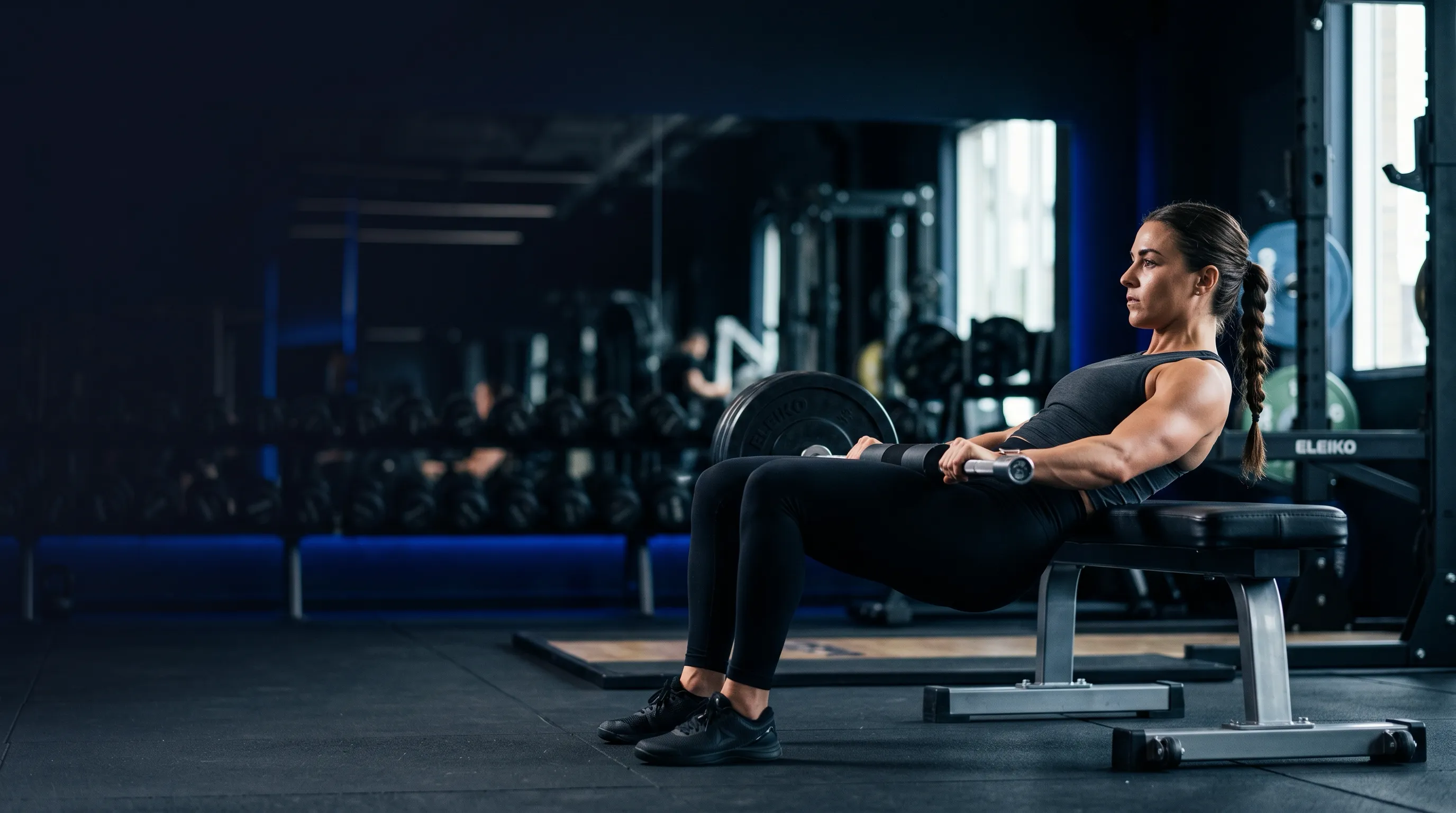
If you want the highest gluteus maximus activation per rep, the barbell hip thrust wins — it produces far more glute activity than the back squat at a matched load. In a controlled EMG study led by sports scientist Bret Contreras, PhD, CSCS — whose hip-thrust research reshaped how coaches think about glute training — the hip thrust generated roughly 70% mean and 172% peak gluteus maximus activation versus about 29% mean and 85% peak for the back squat.5 That’s not a small edge; that’s the hip thrust loading the glute through the exact range where it’s strongest.
The table below ranks the major options by what the electromyography literature shows. “Relative glute EMG” is a qualitative read across studies, not a single head-to-head number, because EMG protocols differ between labs.
| Exercise | Targets (max / medius) | Relative glute EMG | Best for | Notes |
|---|---|---|---|---|
| Barbell hip thrust | Maximus | Highest max activation5 | Strength & hypertrophy | Loads the glute hardest at full hip extension |
| Single-leg hip thrust | Maximus | High, unilateral | Activation & asymmetry | Bodyweight option; exposes a weak side |
| Glute bridge | Maximus | High, low-load6 | Activation | Floor-based, joint-friendly, great warm-up |
| Bulgarian split squat | Maximus | High, unilateral7 | Strength & hypertrophy | Strong single-leg builder; demands balance |
| Back squat | Maximus | Strong but below hip thrust5 | Strength | Great overall, less glute-specific at matched load |
| Deadlift / RDL | Maximus | High in hip extension7 | Posterior-chain strength | Shares load with hamstrings and lower back |
| Step-up | Maximus | High in hip extension7 | Strength & unilateral | Higher steps bias the glutes more |
| Lateral band walk | Medius | High medius activation8 | Medius activation | Cheap, portable, ideal pre-workout |
| Clamshell / side-lying abduction | Medius / minimus | High medius & minimus9 | Medius activation | Targets the suspension system the maximus work misses |
The hip-thrust-vs-squat answer, plainly: if your goal is maximum glute development, the hip thrust beats the squat for direct gluteus maximus activation.5 But the squat builds total lower-body strength the hip thrust can’t match. Do both — squat for the foundation, hip thrust to bias the glutes. Our squat technique guide covers getting the most glute out of every rep.
Don’t forget the suspension. None of the big bilateral lifts adequately train the gluteus medius and minimus. Targeted abduction work does: side-lying abduction and side planks with abduction produce some of the highest medius activation recorded, and clamshells and band walks reliably light up the medius and minimus segments.89 If your knee caves or your hip drops, this is the missing piece — and it’s the same frontal-plane stability that protects the knee in posterior-chain work like our hamstring strengthening guide covers.
How to Actually Build Glutes: The Activation → Load → Hypertrophy Progression
Building glutes is a three-phase sequence, and skipping straight to heavy loading is why so many people grind through squats with nothing to show for it. You have to teach the muscle to fire before you ask it to move serious weight.
Phase 1 — Activation (the wake-up call). Spend 5–10 minutes before your main work switching the glutes on.
- Glute bridges: 2 sets of 15, squeezing hard at the top.
- Lateral band walks: 2 sets of 15 steps each direction.
- Clamshells: 2 sets of 15 per side.
The goal here is the mind-muscle connection — deliberately feeling the target muscle work. That’s not gym-bro folklore: in an 8-week trial, lifters who focused internally on the working muscle grew their biceps roughly twice as much as those who focused on the outcome (12.4% vs 6.9% thickness gain).10 Learn to feel the glute, and every later rep does more.
Phase 2 — Loaded compound strength. Once the glutes fire on demand, load them. Train in the 5–10 rep range and add weight over time — progressive overload, the increase in mechanical tension on the muscle, is the primary driver of growth.11
- Barbell hip thrust: 3–4 sets of 6–10.
- Squat (back or front): 3 sets of 5–8 — see the squat guide for setup.
- Romanian deadlift: 3 sets of 8.
- Bulgarian split squat: 3 sets of 8 per leg.
Phase 3 — Hypertrophy (grow what you woke up). To add size, push volume up and chase tension through a full range.
- Hip thrust: 4 sets of 10–15, pausing and squeezing at lockout.
- Glute bridge or single-leg hip thrust: 3 sets of 15–20.
- Controlled tempo — a slow lowering phase keeps tension on the muscle, not the momentum.
SensAI builds this activation-to-hypertrophy ladder around your actual equipment and schedule rather than handing you a generic template, and its guided tracker highlights the worked muscle group on each exercise so you can see — and feel — that the glutes are the ones doing the job, not your quads or lower back.
How Often Should You Train Glutes? Volume and Frequency
Aim for roughly 10–20 hard sets per week for the glutes, split across 2–3 sessions. That range comes from the resistance-training dose-response work of hypertrophy researcher Brad Schoenfeld, PhD, CSCS (CUNY Lehman College): in his meta-analysis, muscle growth scaled with weekly set volume, with higher volumes generally producing more hypertrophy up to a point.12
Frequency mostly matters as a way to fit that volume in. When weekly sets are held equal, training a muscle two or three times a week isn’t clearly better than once for growth — a meta-analysis on training frequency found no significant hypertrophy advantage once volume was matched.13 But spreading 10–20 hard sets across two or three sessions is how most people actually accumulate that volume with quality reps, instead of grinding through one punishing session where the final sets turn to junk.
Glutes tolerate relatively high frequency because the gluteus maximus is built for endurance and recovers well. The catch is that your posterior chain shares the load — heavy hip thrusts, deadlifts, and squats also tax your lower back and hamstrings, and those tissues set the real recovery ceiling. Pile on junk volume past what you can recover from and you stall both.
SensAI keeps your weekly glute volume inside evidence-based guardrails and regenerates the next week from what you actually performed and recovered from — so the volume climbs when you’re absorbing it and backs off when the posterior chain is fried, instead of mechanically adding sets you can’t recover from.
Training Glutes Without Wrecking Your Lower Back
Strong glutes are one of the best things you can do for your lower back, because every rep of hip extension they handle is a rep your lumbar spine doesn’t. When the glutes are weak or quiet, the lower-back muscles compensate — the same pattern that tracks with chronic low-back pain.4
So if your back is sensitive, bias toward spine-sparing movers that load the glute without loading the spine:
- Glute bridges and hip thrusts keep the spine in a stable, supported position while the hips do the work.
- Side-lying abduction and clamshells build the medius with essentially no spinal load.9
- Step-ups let you train hip extension one leg at a time at a fraction of the bilateral load.
Form cues that keep the work in the glutes and off the back:
- Posterior pelvic tilt at the top. At hip-thrust lockout, tuck the pelvis under and squeeze — don’t arch.
- Ribs down. Keep the rib cage stacked over the pelvis; don’t flare and crank the lower back.
- Drive through your heels. This recruits the glutes and hamstrings rather than the quads and lumbar erectors.
- Don’t hyperextend the lumbar spine. “Lockout” means full hip extension, not back-bending.
See a professional if you have pain that radiates down the leg, numbness or tingling, or any back pain following trauma — train around a diagnosis, not through an unknown one. Our lower-back pain guide has the full phase-by-phase protocol.
This is where remembering the constraint pays off. When you’ve flagged a lower-back issue, SensAI’s coach keeps your loading spine-sparing and will swap an aggravating movement mid-workout — tell it “this is bugging my back,” and it trades the loaded movement for a glute bridge or abduction variant in the same slot, without you having to redesign the session.
Coaching the Progression: Where Data Helps
The hard part of building glutes was never the exercises. It’s the sequencing: activation before load, overload that climbs without outrunning recovery, and weekly hip-thrust volume planned with your posterior-chain recovery in view.
That last piece is where your recovery data earns its keep. Heart-rate variability, resting heart rate, and sleep quality are reasonable windows into whether your system is ready for a hard session or still paying off the last one. Stack a heavy hip-thrust day on top of poor recovery and you get fatigue, not growth.
SensAI receives Apple Watch data directly and compatible Garmin, Oura, and WHOOP metrics through HealthKit. Aggregated HRV and sleep trends inform a daily readiness summary and the next weekly program regeneration. The app does not reschedule heavy sessions automatically; if you want today’s workout changed, you ask the coach in chat.
Honest framing: none of this requires an app. You can run the activation-load-hypertrophy progression with a notebook and an honest read of how you feel. What the data adds is context for sequencing and recovery, the two places where well-intentioned glute programs quietly fall apart.
The Bottom Line
Your glutes are the most powerful muscles you own and, for most desk-bound people, the most neglected. Building them is a sequence, not a single exercise: wake the muscle up, load it heavy, then grow it with volume — and don’t ignore the medius doing the frontal-plane stabilizing the big lifts skip.
Start here: 5 minutes of activation (bridges, band walks, clamshells) before training, one heavy hip-thrust movement, and one gluteus medius movement, 2–3 times a week, adding load as it gets easier.
Do that consistently and the payoff compounds: bigger glutes, a calmer lower back, and a more stable stride. The exercises are simple. Sequencing them and using recovery context to shape the next week is the part most people get wrong, and the part SensAI is built to take off your plate.
References
Footnotes
-
Neumann DA. “Kinesiology of the hip: a focus on muscular actions.” Journal of Orthopaedic & Sports Physical Therapy, 2010. PMID: 20118525. https://pubmed.ncbi.nlm.nih.gov/20118525/ ↩
-
Flack NA, Nicholson HD, Woodley SJ. “A review of the anatomy of the hip abductor muscles, gluteus medius, gluteus minimus, and tensor fascia lata.” Clinical Anatomy, 2012. PMID: 22109658. https://pubmed.ncbi.nlm.nih.gov/22109658/ ↩
-
Page P, Frank C, Lardner R. “Assessment and Treatment of Muscle Imbalance: The Janda Approach.” Human Kinetics, 2010. https://us.humankinetics.com/products/assessment-and-treatment-of-muscle-imbalance-the-janda-approach ↩
-
Cooper NA, Scavo KM, Strickland KJ, Tipayamongkol N, Nicholson JD, Bewyer DC, Sluka KA. “Prevalence of gluteus medius weakness in people with chronic low back pain compared to healthy controls.” European Spine Journal, 2016. PMID: 26006705. https://pubmed.ncbi.nlm.nih.gov/26006705/ ↩ ↩2
-
Contreras B, Vigotsky AD, Schoenfeld BJ, Beardsley C, Cronin J. “A Comparison of Gluteus Maximus, Biceps Femoris, and Vastus Lateralis Electromyographic Activity in the Back Squat and Barbell Hip Thrust Exercises.” Journal of Applied Biomechanics, 2015. PMID: 26214739. https://pubmed.ncbi.nlm.nih.gov/26214739/ ↩ ↩2 ↩3 ↩4
-
Boren K, Conrey C, Le Coguic J, Paprocki L, Voight M, Robinson TK. “Electromyographic analysis of gluteus medius and gluteus maximus during rehabilitation exercises.” International Journal of Sports Physical Therapy, 2011. PMID: 22034614. https://pubmed.ncbi.nlm.nih.gov/22034614/ ↩
-
Macadam P, Feser EH. “Examination of Gluteus Maximus Electromyographic Excitation Associated with Dynamic Hip Extension During Body Weight Exercise: A Systematic Review.” International Journal of Sports Physical Therapy, 2019. PMID: 30746289. https://pubmed.ncbi.nlm.nih.gov/30746289/ ↩ ↩2 ↩3
-
Macadam P, Cronin J, Contreras B. “An Examination of the Gluteal Muscle Activity Associated with Dynamic Hip Abduction and Hip External Rotation Exercise: A Systematic Review.” International Journal of Sports Physical Therapy, 2015. PMID: 26491608. https://pubmed.ncbi.nlm.nih.gov/26491608/ ↩ ↩2
-
Moore D, Semciw AI, Pizzari T. “A Systematic Review and Meta-Analysis of Common Therapeutic Exercises That Generate Highest Muscle Activity in the Gluteus Medius and Gluteus Minimus Segments.” International Journal of Sports Physical Therapy, 2020. PMID: 33344003. https://pubmed.ncbi.nlm.nih.gov/33344003/ ↩ ↩2 ↩3
-
Schoenfeld BJ, Vigotsky A, Contreras B, Golden S, Alto A, Larson R, Winkelman N, Paoli A. “Differential effects of attentional focus strategies during long-term resistance training.” European Journal of Sport Science, 2018. PMID: 29533715. https://pubmed.ncbi.nlm.nih.gov/29533715/ ↩
-
Schoenfeld BJ. “The mechanisms of muscle hypertrophy and their application to resistance training.” Journal of Strength and Conditioning Research, 2010. PMID: 20847704. https://pubmed.ncbi.nlm.nih.gov/20847704/ ↩
-
Schoenfeld BJ, Ogborn D, Krieger JW. “Dose-response relationship between weekly resistance training volume and increases in muscle mass: A systematic review and meta-analysis.” Journal of Sports Sciences, 2017. PMID: 27433992. https://pubmed.ncbi.nlm.nih.gov/27433992/ ↩
-
Schoenfeld BJ, Grgic J, Krieger J. “How many times per week should a muscle be trained to maximize muscle hypertrophy? A systematic review and meta-analysis of studies examining the effects of resistance training frequency.” Journal of Sports Sciences, 2019. PMID: 30558493. https://pubmed.ncbi.nlm.nih.gov/30558493/ ↩