Lower Back Pain Exercises: Research-Based Options for Relief and Long-Term Activity
Research-based lower back pain exercise options for early symptom management, stabilization, and long-term activity, with safety guidance and adaptable sample doses.

SensAI Team
12 min read
Get a training plan that adapts to your recovery — free on iOS

Lower back pain does not follow one fixed timeline. The three stages in this guide, early symptom management (often days 1–14), capacity building (often weeks 3–8), and ongoing activity, are a practical way to organize options rather than a diagnostic protocol. Reviews support several exercise approaches for chronic non-specific low back pain, including motor-control, stabilization, aerobic, and resistance exercise.12 Prevention trials suggest that ongoing exercise can reduce the likelihood of another episode, though no single routine works best for everyone.3
An estimated 619 million people worldwide experienced low back pain in 2020, making it the leading cause of years lived with disability globally.4 And once you’ve had one episode, the odds of another are high — prospective cohort data shows approximately 69% of people experience a recurrence within 12 months.5
This guide offers adaptable examples for non-specific low back pain, a broad clinical category used when no specific cause has been identified. The sets, reps, frequencies, and progression checks are starting points, not individualized treatment. New bladder or bowel dysfunction, numbness in the saddle area, or progressive leg weakness can signal a medical emergency and need urgent evaluation. Pain after significant trauma, fever, unexplained weight loss, severe night pain, or new radiating numbness or tingling also warrants prompt healthcare assessment before exercise.
Why Most “Back Pain Exercise” Advice Fails
Non-specific low back pain is not a single condition, and symptom response can change over time. An exercise that feels tolerable early may not suit everyone, while later strength work may need a slower introduction for some people. Generic advice such as “strengthen your core” ignores those differences.
Exercise has adjustable variables, including type, intensity, frequency, duration, and progression timing. A 2025 network meta-analysis by Zhao et al. examined how combinations of those variables related to outcomes in adults with chronic low back pain.2 The findings support matching exercise to the person’s needs and tolerance rather than assuming one fixed dose.
A 2025 study in PeerJ assessed the readability, quality, and reliability of AI chatbot responses to common low back pain questions and found that answers scored low across all three dimensions.6 The information is technically available everywhere. The problem is that most of it lacks the specificity and phase-awareness that makes exercise prescription actually work.
SensAI can remember a lower-back constraint that you report, generate a plan around it, and let you request an exercise swap through chat. It does not diagnose the pain, determine a recovery phase, or modify a workout as medical treatment on its own.
The 2025 Evidence: What Systematic Reviews Actually Found
Three major reviews in the past two years have reshaped what we know about exercise for low back pain.
A 2025 systematic review and meta-analysis in BMC Musculoskeletal Disorders evaluated six exercise categories across 42 studies and reported pain improvements across the included approaches.1 Subgroup findings suggested that shorter, more frequent sessions may be useful in some chronic low-back-pain programs, but study heterogeneity prevents treating one schedule as universally optimal.
A 2025 network meta-analysis by Zhao et al. in Frontiers in Public Health went further, ranking how specific prescription variables — exercise type, duration, frequency, and intervention period — interact to produce better outcomes for chronic low back pain.2 This matters because it shifts the conversation from “which exercise?” to “which exercise, at what dose, for how long?”
The Cochrane review by Hayden et al., the most comprehensive synthesis available, concluded that exercise therapy reduces pain and improves function in chronic low back pain with small to moderate effect sizes compared to minimal intervention.7 The effect is real, but it’s not magic — consistency and appropriate progression matter more than any single exercise.
The synthesis supports a menu rather than a winner: motor-control and stabilization work, resistance training, and aerobic activity can all help. The appropriate choice depends on symptoms, preferences, capabilities, and whether the goal is pain relief, function, confidence, or general fitness.
Stuart McGill, PhD, Distinguished Professor Emeritus at the University of Waterloo and one of the most cited spine biomechanics researchers in the field, has spent decades quantifying how specific exercises load the spine. His work on the “Big 3” stabilization exercises — the curl-up, side plank, and bird-dog — demonstrates that these movements activate the core musculature while minimizing compressive forces on the lumbar spine.8
Jaap van Dieën, PhD, at Vrije Universiteit Amsterdam, has described divergent motor-control responses in people with low back pain, including tighter and looser control strategies.9 These are research patterns, not self-diagnoses, and they do not establish a single corrective exercise. They reinforce the need to individualize movement and loading.
Phase 1: Early Symptom Management (Often Days 1–14)
An early goal is to maintain tolerable movement and normal activity where possible. The UK’s NICE guideline encourages people to continue normal activities with advice tailored to their needs and capabilities.10 Short periods of rest may be appropriate, but prolonged bed rest is generally not the default.
Walking. A sample starting dose is 10–20 minutes, 2–3 times per day, at a comfortable pace. Some people need shorter bouts. Walking is one accessible way to maintain activity, but it is not the only acceptable option.
Cat-Cow. A sample dose is 10 repetitions, 2 times per day. On hands and knees, slowly alternate between arching your back (cow) and rounding it (cat). Stay within a comfortable range and stop if symptoms spread or worsen.
Pelvic Tilts. A sample dose is 10–15 repetitions, 2–3 times per day. Lying on your back with knees bent, gently flatten your lower back against the floor by tilting your pelvis. Hold for 3–5 seconds if comfortable.
Knee-to-Chest. A sample dose is a 30-second hold for 2 sets per side. Lying on your back, bring one knee toward your chest only until you feel a comfortable stretch. This position feels relieving for some people and provocative for others; it does not decompress or treat a disc in a way you can confirm from sensation alone.
What to modify in this phase: temporarily reduce any loaded flexion, heavy lifting, or end-range rotation that clearly aggravates symptoms. These movements are not permanently banned, and symptom response matters more than a universal list.
Possible progression checkpoint: consider adding more strength work when a 20-minute walk and the selected movements do not produce a meaningful symptom increase during or afterward. This is an example, not a validated gate. For more on gentle movement between hard training sessions, see our guide on active recovery exercises.
Phase 2: Capacity and Control (Often Weeks 3–8)
As symptoms allow, you can add muscular endurance, strength, and movement-control work. These qualities may improve function, but they do not guarantee that pain will not recur.
McGill’s Big 3 are one possible group of exercises in this phase. Stuart McGill’s research measured muscle activation and three-dimensional spine position during variations of the curl-up, side plank, and bird-dog.8 That biomechanical work explains how the exercises load the trunk; it does not prove that everyone with back pain needs this exact sequence.
Modified Curl-Up. One knee bent, hands under the lumbar spine to maintain neutral curve. Lift head and shoulders slightly — this is not a crunch. Use a descending pyramid: 6 reps, rest, 4 reps, rest, 2 reps. Progress to 8-6-4 as endurance improves.
Side Plank. Start from knees if needed, progress to feet. Hold for time using the same descending pyramid: 6 seconds, rest, 4 seconds, rest, 2 seconds. Progress to longer holds (10-8-6) as capacity builds. This targets the quadratus lumborum and obliques — critical lateral stabilizers.
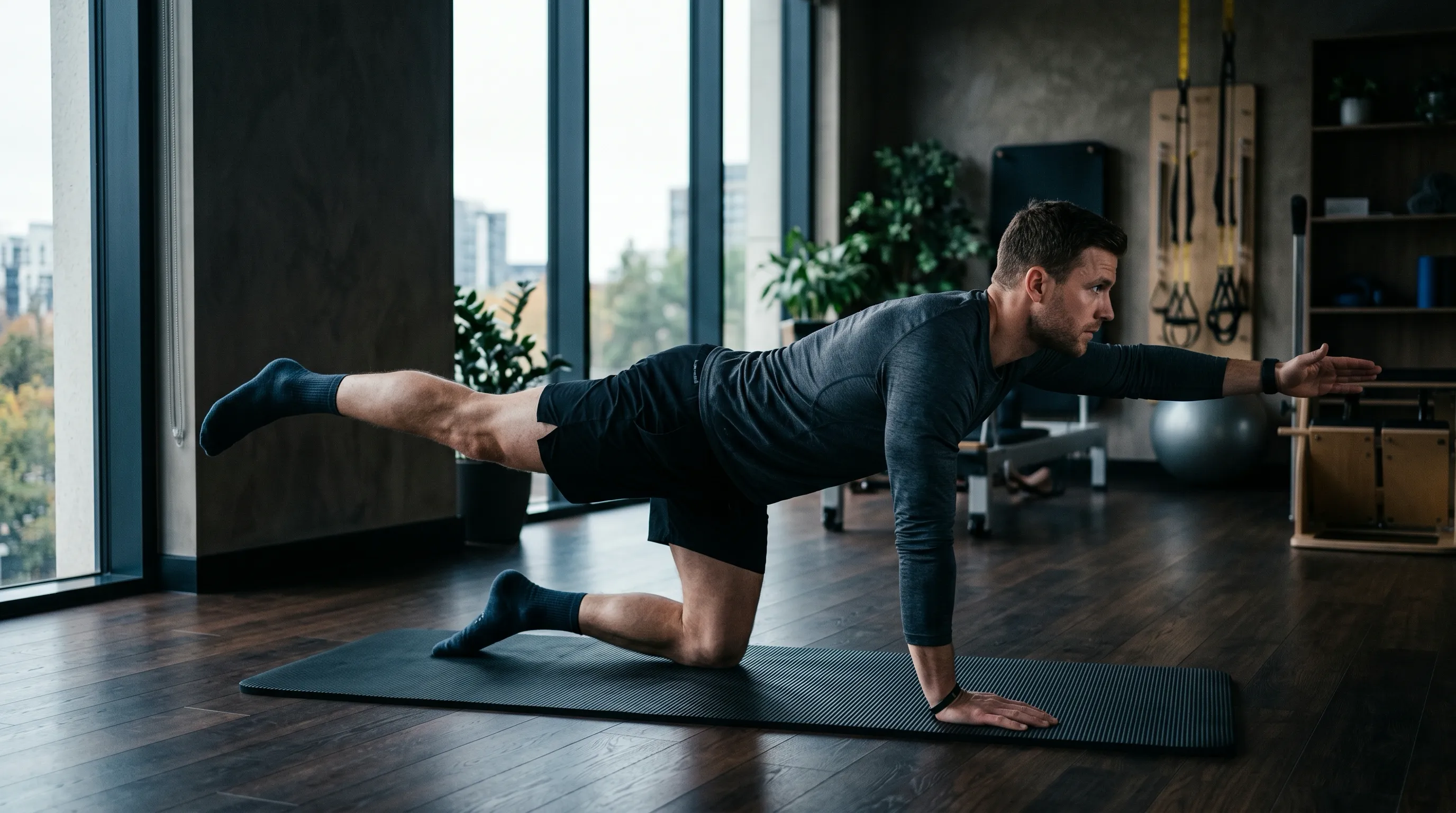
Bird-Dog. On hands and knees, extend opposite arm and leg while keeping the spine neutral. Descending pyramid: 6 reps per side, 4 reps, 2 reps. The key is to prevent rotation — imagine balancing a glass of water on your lower back.
Dead Bug. 8–12 repetitions per side, 2–3 sets. Lying on your back, extend opposite arm and leg while pressing your lower back into the floor. This trains anti-extension and deep core activation.
Glute Bridge. 10–15 repetitions, 2–3 sets. Lying on your back with knees bent, drive hips toward the ceiling. Consider a single-leg variation once you can complete 15 controlled reps and it remains comfortable. The bridge trains hip extension; it does not identify glute weakness as the cause of pain.
Sample frequency: Up to daily for short, low-fatigue practice, then 4–5 times per week as other training returns. Reduce frequency if symptoms or fatigue accumulate.
With SensAI, you can report which exercises feel comfortable or aggravating, and the coach can remember that constraint across sessions. If bird-dogs feel fine but dead bugs do not, tell the coach and request a programming change. The app cannot determine the medical reason for the difference.
Phase 2 Dosing Reference
| Exercise | Sets x Reps | Rest | Frequency | Progression Trigger |
|---|---|---|---|---|
| Modified Curl-Up | Pyramid: 6-4-2 → 8-6-4 | 10–15s between sets | Daily → 4–5x/week | No pain, good form at top pyramid |
| Side Plank | Pyramid: 6s-4s-2s → 10s-8s-6s | 10–15s between sets | Daily → 4–5x/week | Hold with straight body line |
| Bird-Dog | Pyramid: 6-4-2 → 8-6-4/side | 10–15s between sets | Daily → 4–5x/week | No trunk rotation during movement |
| Dead Bug | 2–3 x 8–12/side | 30–60s | Daily → 4–5x/week | Low back stays flat throughout |
| Glute Bridge | 2–3 x 10–15 | 30–60s | Daily → 4–5x/week | Progress to single-leg |
Phase 3: Ongoing Strength and Activity
Once you tolerate regular activity, resistance training can be one part of a long-term plan. Steffens et al.’s 2016 meta-analysis in JAMA Internal Medicine pooled 21 randomized trials with more than 30,000 participants. Exercise alone was associated with an approximately 35% lower risk of a future low-back-pain episode, while exercise plus education was associated with roughly 45% lower risk in the included prevention trials.3 These pooled effects do not guarantee prevention for an individual.
This phase is about building the strength that keeps your back resilient under real-world demands.
Hip Hinge Patterns. Romanian deadlifts, kettlebell deadlifts, or a hip hinge with a band can train hip-dominant lifting. Start light, prioritize control, and progress gradually. No single movement skill determines back health.
Loaded Carries. Farmer’s walks, suitcase carries, or front-loaded carries. These train the entire trunk to stabilize under load while moving, which mimics the demands of daily life far better than any plank.
Squat Variations. Goblet squats, barbell back squats, or split squats. Choose the variation that allows you to maintain a neutral spine throughout the full range of motion. For guidance on proper technique, see our exercise form and safety guide.
Row Variations. Cable rows, dumbbell rows, or inverted rows. These strengthen the posterior chain — upper back, lats, rear deltoids — which supports spinal posture and offsets the effects of prolonged sitting.
Sample frequency: Resistance training 2–3 times per week plus walking or another tolerated aerobic activity on most days. Adjust the amount to current capacity, preferences, and symptom response.
Sample Weekly Template
| Day | Activity | Focus |
|---|---|---|
| Monday | Strength training (40–50 min) | Squat, row, loaded carry, Big 3 as warm-up |
| Tuesday | Walk 30+ min | Low intensity, recovery |
| Wednesday | Strength training (40–50 min) | Hip hinge, overhead press, glute bridge, Big 3 |
| Thursday | Walk 30+ min or flexibility work | Mobility and recovery |
| Friday | Strength training (40–50 min) | Squat variation, row variation, farmer’s walk |
| Saturday | Walk or active recovery | Easy movement |
| Sunday | Rest | Full rest |
For more detail on finding the right balance between training days and rest days, see our guide on workout frequency and rest. And for guidance on building strength training into your long-term health plan, our strength training after 30 guide covers the minimum effective dose the research supports.
SensAI receives Apple Watch data directly through HealthKit; compatible Garmin, Oura, and WHOOP data also flow through HealthKit. It summarizes HRV, sleep, resting-heart-rate, and workout context and uses actual performance and recovery when regenerating the next weekly plan. It does not diagnose a back flare or automatically scale today’s intensity and volume. You can request a change through chat.
The Dosing Table: Exercise Prescription by Phase
| Phase | Goal | Key Exercises | Sets x Reps | Frequency | Duration | Progression Trigger |
|---|---|---|---|---|---|---|
| 1: Acute (Days 1–14) | Pain reduction, gentle movement | Walking, cat-cow, pelvic tilts, knee-to-chest | See above | 2–3x/day | 10–20 min/session | Pain-free 20-min walk |
| 2: Stabilization (Weeks 3–8) | Core endurance, motor control | Big 3, dead bug, glute bridge | Pyramids + 2–3 sets | Daily → 4–5x/week | 20–30 min/session | Pyramid top set without compensation |
| 3: Prevention (Ongoing) | Strength, resilience | Hip hinge, squat, row, carry | 3 x 8–12 | 2–3x/week | 40–50 min/session | Progressive overload as tolerated |
What Makes It Worse: Exercises to Modify or Avoid
No exercise is permanently banned. Some movements may be poorly tolerated during a flare, so use symptom response and professional guidance to decide what to modify temporarily.
Loaded spinal flexion — sit-ups, crunches, and toe touches with weight — can be provocative during some back-pain episodes. McGill’s work measured spinal motion, muscle activation, and loading in laboratory settings.8 Laboratory biomechanics do not prove that spinal flexion injures a person, so modify the movement according to symptoms and professional guidance rather than treating it as permanently harmful.
End-range rotation under load — such as a heavy Russian twist — may aggravate symptoms for some people. Modify by reducing load or range of motion if needed.
Heavy deadlifts before rebuilding tolerance — the hip hinge can be useful long term, but a sudden return to heavy loading may be poorly tolerated. Start with a load and range you can control, then progress according to symptoms and capacity.
The key distinction is current tolerance, not permanent harm. Sit-ups are not inherently dangerous for a healthy back, but they may be a poor choice when they clearly aggravate a current episode.
With SensAI, you can swap exercises mid-workout using quick-action chips or a natural language request to the AI coach. If a programmed exercise doesn’t feel right, tap “swap” and the app suggests an alternative that trains the same muscle groups without the problematic movement pattern.
When to See a Professional
Many cases of lower back pain are classified as non-specific, meaning a clinician has not identified one specific condition that explains the symptoms. Guidelines commonly encourage continued activity and consider exercise programs selected around a person’s needs, preferences, and capabilities.1011
But knowing when you’re not in that majority matters.
Seek emergency evaluation for new bladder or bowel dysfunction, numbness in the saddle area, or rapidly progressive weakness in one or both legs. Seek prompt healthcare assessment for pain after significant trauma, fever, unexplained weight loss, severe or progressive night pain, or new radiating numbness, tingling, or weakness.
See a provider if pain persists beyond 6–8 weeks, worsens, or meaningfully limits function despite self-management. NICE advises against routine imaging in non-specialist care. Imaging is generally considered in a specialist setting only when the result is likely to change management.10
Consider a physical therapist even for non-specific back pain if you’re unsure about exercise form or aren’t progressing as expected. A qualified PT can assess movement, function, loading tolerance, and symptom behavior in context rather than assigning a research phenotype from one self-test.9
The exercise examples in this guide are educational content for non-specific low back pain. They are not a substitute for individualized medical advice. When in doubt, get assessed.
References
Footnotes
-
Cheng M, Tian Y, Ye Q, Li J, Xie L, Ding F. “Evaluating the effectiveness of six exercise interventions for low back pain: a systematic review and meta-analysis.” BMC Musculoskeletal Disorders, 2025. https://pubmed.ncbi.nlm.nih.gov/40312680/ ↩ ↩2
-
Zhao K, Zhang P, Li H, Li L. “Exercise prescription for improving chronic low back pain in adults: a network meta-analysis.” Frontiers in Public Health, 2025. https://pubmed.ncbi.nlm.nih.gov/40520315/ ↩ ↩2 ↩3
-
Steffens D, Maher CG, Pereira LSM, et al. “Prevention of Low Back Pain: A Systematic Review and Meta-analysis.” JAMA Internal Medicine, 2016. https://pubmed.ncbi.nlm.nih.gov/26752509/ ↩ ↩2
-
GBD 2021 Low Back Pain Collaborators. “Global, regional, and national burden of low back pain, 1990–2020, its attributable risk factors, and projections to 2050: a systematic analysis of the Global Burden of Disease Study 2021.” The Lancet Rheumatology, 2023. https://pubmed.ncbi.nlm.nih.gov/37273833/ ↩
-
da Silva T, Mills K, Brown BT, et al. “Recurrence of low back pain is common: a prospective inception cohort study.” Journal of Physiotherapy, 2019. https://pubmed.ncbi.nlm.nih.gov/31208917/ ↩
-
Ozduran E, Hancı V, Erkin Y, Özbek İC, Abdulkerimov V. “Assessing the readability, quality and reliability of responses produced by ChatGPT, Gemini, and Perplexity regarding most frequently asked keywords about low back pain.” PeerJ, 2025. https://pubmed.ncbi.nlm.nih.gov/39866564/ ↩
-
Hayden JA, Ellis J, Ogilvie R, et al. “Exercise therapy for chronic low back pain.” Cochrane Database of Systematic Reviews, 2021. https://pubmed.ncbi.nlm.nih.gov/34580864/ ↩
-
McGill SM, Karpowicz A. “Exercises for spine stabilization: motion/motor patterns, stability progressions, and clinical technique.” Archives of Physical Medicine and Rehabilitation, 2009. https://pubmed.ncbi.nlm.nih.gov/19154838/ ↩ ↩2 ↩3
-
van Dieën JH, Reeves NP, Kawchuk G, van Dillen LR, Hodges PW. “Motor Control Changes in Low Back Pain: Divergence in Presentations and Mechanisms.” Journal of Orthopaedic & Sports Physical Therapy, 2019. https://pubmed.ncbi.nlm.nih.gov/29895230/ ↩ ↩2
-
National Institute for Health and Care Excellence. “Low back pain and sciatica in over 16s: assessment and management.” NICE Guideline NG59, 2016 (updated 2020). https://www.nice.org.uk/guidance/ng59 ↩ ↩2 ↩3
-
Gordon R, Bloxham S. “A Systematic Review of the Effects of Exercise and Physical Activity on Non-Specific Chronic Low Back Pain.” Healthcare, 2016. https://pubmed.ncbi.nlm.nih.gov/27417610/ ↩