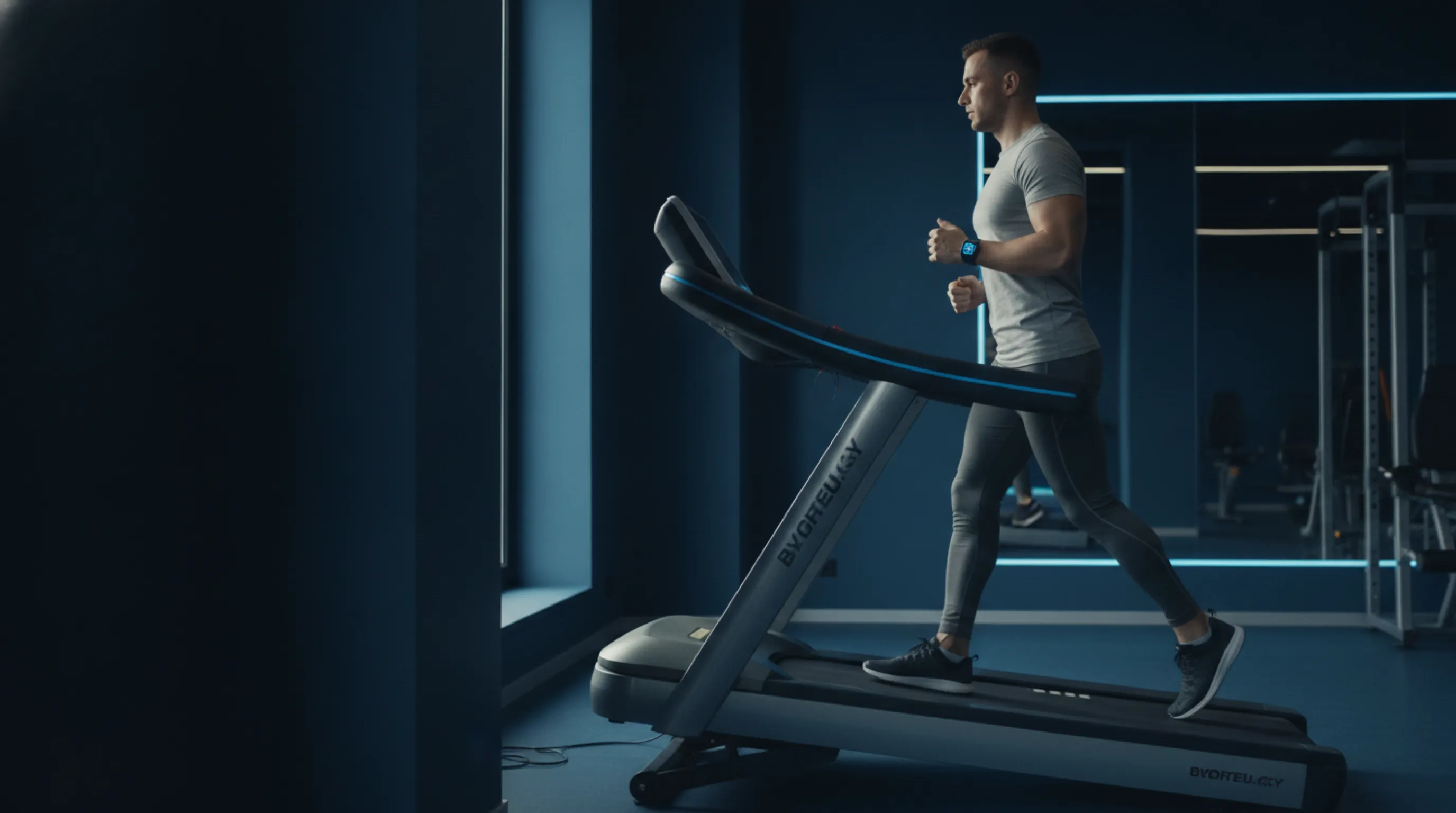
The 12-3-30 Workout: Does the Viral Incline Treadmill Walk Actually Work?
12-3-30 is 30 minutes at 3 mph on a 12% incline. It can be a useful moderate-to-vigorous workout, but measured effort varies widely and handrail support lowers the demand.

SensAI Team
12 min read
Get a training plan that adapts to your recovery — free on iOS

The short answer: Yes, 12-3-30 can work as a repeatable cardio session. A steep incline raises the demand far above level walking, but the familiar ~8-MET estimate comes from an equation. In a small 2025 laboratory study, measured effort averaged 5.5 METs and varied from 2.7 to 8.1 METs.1 Your fitness, gait, treadmill, and use of the handrails all change the result.
The most common mistake is choosing a setting so hard that you have to support your weight on the handrails. We’ll get to that.
The honest bottom line
- Do 12-3-30 if: you want lower-impact cardio that can still be hard enough to matter, you’re returning to exercise, or you dislike running. It avoids running’s flight phase, but it still loads your calves, Achilles tendons, feet, hips, and back.
- Modify it if: 3 mph at 12% has you gasping or gripping the rails for dear life. That’s not “doing it wrong” — it means the prescription is too hard for you today. Drop the incline to 6–8% and build up.
- Skip or adapt it if: a steep sustained incline aggravates an Achilles, calf, foot, knee, hip, or lower-back problem. It can improve aerobic fitness, especially in less-trained people, but it is not a substitute for resistance training or a complete endurance program.
What is 12-3-30, exactly?
The formula is in the name: 12% incline, 3 miles per hour, 30 minutes. Set the treadmill, walk, done.
It wasn’t designed in a lab. Fitness influencer Lauren Giraldo landed on it through trial and error around 2019 — 12 was the highest incline on her gym’s treadmill, 3 mph felt like a brisk-but-doable walk, and 30 minutes came from her grandmother’s advice to move for half an hour a day.2 She posted it, and the format spread widely on social media.
That origin story matters for one reason: the numbers are arbitrary. There’s nothing sacred about 12, 3, or 30. What makes the workout effective is the principle underneath it — incline — and that principle is very much backed by physiology.
The science: why incline changes everything
Here’s the part that gets lost in the “it’s just walking” dismissals. Walking on a steep grade is not a slightly harder version of flat walking. It’s a different intensity category.
Plug 12-3-30 into the American College of Sports Medicine walking equation and you get an oxygen-demand estimate of roughly 29 mL/kg/min — about 8.3 METs. The same equation puts a 3 mph level walk around 3.3 METs.3 That calculation is useful for planning, but it is not a direct measurement of every person doing this specific workout.
A direct laboratory test of 12-3-30 complicates the tidy equation. In an ACE-supported 2025 study, 17 healthy adults completed the full session without touching the rails. Their measured effort averaged 5.5 METs, with individual values from 2.7 to 8.1 METs, and averaged 47.4% of heart-rate reserve.1 In other words, the same treadmill prescription ranged from light-to-moderate for some participants to vigorous for others.
Why does grade cost so much? Two reasons, both measured directly:
- You’re lifting your body against gravity. Stanford researchers led by Amy Silder and Scott Delp showed that the metabolic cost of incline walking scales with the mechanical work of raising your center of mass step after step — work that’s simply absent on flat ground.4
- You recruit far more muscle. Rodger Kram’s biomechanics lab at the University of Colorado Boulder measured leg-muscle activation across grades and speeds, and found that walking uphill sharply increases activation of the glutes, hamstrings, and calves compared with level walking.5 That’s why 12-3-30 leaves your posterior chain — not just your lungs — feeling the work.
| At 3 mph | Flat (0% incline, equation) | 12-3-30 |
|---|---|---|
| Estimated or measured intensity | ~3.3 METs | ~8.3 METs by equation; 5.5 METs measured average1 |
| Oxygen demand | ~11.5 mL/kg/min estimated | ~29 mL/kg/min estimated |
| Classification | Light–moderate | Moderate on average, with a light-to-vigorous range1 |
| Gross calories (155 lb / 30 min) | ~122 kcal estimated | ~305 kcal by equation; measured study average was ~221 kcal at 148 lb1 |
Gross calories include the energy you would have used at rest. For a 155 lb person, the equation produces about 305 gross calories and about 268 calories above resting expenditure. Real devices and treadmills will differ. Treat the number as an estimate, not a food budget. The session can still make a meaningful contribution alongside your daily NEAT and step count.
Is it actually cardio? Read your heart rate, not the hype
12-3-30 may put you in Zone 2, Zone 3, or Zone 4. The measured 2025 study found a broad response despite every participant using the same speed, incline, and duration.1 That variability is the point: the settings do not determine your physiological zone by themselves.
But intensity is personal. A fit 25-year-old might cruise 12-3-30 in Zone 2; a deconditioned beginner might redline in Zone 4 within five minutes. The incline is fixed, but your response to it isn’t — which is exactly why “just do 12-3-30” is incomplete advice without a way to see where you actually land.
This is where a wearable can add context. SensAI’s workout tracker provides a Zone 0–5 breakdown after a logged session. Apple Watch connects directly; compatible Garmin, Oura, and WHOOP data can flow through HealthKit. Wrist heart-rate estimates still have limitations, so use breathing, perceived effort, and symptoms alongside the number. If you want to understand what the zones mean and how to calibrate them, start with our Zone 2 training guide.
One nuance worth naming: peak fat oxidation per minute occurs at a moderate intensity — around 64% of VO2max, in the upper Zone 2 range — as Asker Jeukendrup’s group at the University of Birmingham established with their “Fatmax” work.6 Push above that and you burn proportionally more carbohydrate. So if 12-3-30 sends you into Zone 4, you’re burning more total calories but a smaller fraction from fat. For weight loss this barely matters — total energy expenditure and your overall deficit are what move the scale — but it’s why 12-3-30 and easy Zone 2 walks do different jobs, and why pairing them beats doing either alone.
The one mistake that can lower the workout demand
Here it is: gripping the handrails.
When you hold on, you can transfer part of your bodyweight to your arms while the belt keeps moving. Researchers led by John Porcari at the University of Wisconsin–La Crosse measured this in 10 healthy adults aged 38–60. During three five-minute stages set at 75%, 85%, and 95% of each person’s ventilatory-threshold workload, gripping the rails reduced oxygen uptake by roughly 15–21% compared with free arm swing.7 That study was not a test of 12-3-30, but it shows why support changes the dose.
That is not a rounding error, but it also does not let us calculate one universal calorie penalty for 12-3-30. The amount depends on how much weight you transfer to the rails.
Use the rails for a two-second balance check if you need it. Then let go. If you can’t let go, the incline or speed is too high — lower it until you can walk hands-free, and you’ll get more out of an “easier” setting than a steeper one you’re hanging off of.
Does 12-3-30 actually deliver results?
For the outcomes most people care about, the evidence base for incline walking and brisk walking generally is strong:
- Weight management. The energy expenditure is real, even though the exact calorie number varies. 12-3-30 cannot outrun a sustained energy surplus, but it can be one repeatable activity inside a broader weight-management plan.
- Longevity and metabolic health. The walking-and-steps literature is remarkably consistent. Harvard epidemiologist I-Min Lee found mortality benefits emerging at just ~4,400 steps a day and plateauing near 7,500 in older women.8 The largest pooled analysis to date — 15 international cohorts in The Lancet Public Health — confirmed steep mortality-risk reductions up to roughly 8,000–10,000 steps a day across adults.9 A 30-minute 12-3-30 session adds a big, brisk chunk to that daily total.
- It contributes to the activity target. Federal guidelines call for 150–300 minutes of moderate activity, 75–150 minutes of vigorous activity, or an equivalent combination each week.10 Count each session according to your actual effort rather than assuming every 12-3-30 workout is vigorous.
The single biggest predictor of whether any of this happens, though, isn’t the protocol — it’s whether you keep doing it.
Why the “walk” framing is a feature, not a weakness
Exercise psychologist Panteleimon Ekkekakis has spent two decades documenting a stubborn pattern: people feel worse during exercise above their ventilatory threshold, and how you feel during a workout predicts whether you come back to it.11 Brutal sessions win the day and lose the month.
Incline walking is quietly clever here. It can deliver a substantial cardiovascular load while feeling more approachable than running — no flight phase, no sprinting, and a low coordination barrier. You can watch a show. At a sustainable setting, you may be able to hold a breathy conversation. For a lot of people, that is the difference between a routine that survives and one that dies in week two.
Lower impact is the other half of the durability story, but “lower” does not mean “load-free.” Walking usually creates less impact than running, while a 12% grade increases the work done by the calves, Achilles tendons, glutes, and hamstrings.45 Start below the viral prescription if pain, balance, or form changes.
How to actually do it (and how to scale it)
Don’t start at 12-3-30 if it’s out of reach. Start where you can hold the pace hands-free and build.
- Warm up 3–5 minutes at a flat, easy pace. A proper warm-up matters more on an incline, where your calves and Achilles take real load from step one.
- Set a sustainable incline. Beginners: 5–8%. Intermediate: 8–10%. Advanced: the full 12%.
- Set a speed you can hold without the rails. 3 mph is the target; 2.5 mph is a perfectly good starting point.
- Walk 20–30 minutes. Build duration before you build incline.
- Cool down 3–5 minutes flat and easy.
A useful no-gadget intensity cue: cadence. Around 100 steps per minute corresponds to moderate intensity for most adults — a handy backup when you want to gauge effort by feel.12 On an incline, though, you’ll hit vigorous intensity at a lower cadence than you would on flat ground, so let your breathing and heart rate lead.
Frequency: Start with 2–3 sessions a week and adjust from your response. A fitter person may tolerate more; a beginner may need less. Alternate demanding sessions with easier work and recovery.
SensAI can generate a weekly program that includes strength, running, flexibility, yoga, and active recovery or mobility, then regenerate the next week from completed work and aggregated recovery context. It does not automatically rewrite today’s session from one HRV value. During a workout, you can request a change through quick actions or natural language. If you’re weighing steady incline walking against harder interval work, our HIIT vs. Zone 2 breakdown covers how to split your week between them.
What 12-3-30 can’t do
It is not a substitute for resistance training. Incline walking recruits the posterior chain more than flat walking and may improve local muscular endurance, but it does not provide the progressive loading or full movement coverage of a strength program. If body composition is the goal, pair cardio with lifting and adequate protein. Our body recomposition guide shows how the pieces fit together.
It is not guaranteed to maximize your aerobic ceiling. A demanding incline walk can improve aerobic fitness, especially if you are starting from a lower baseline. More-trained people may eventually need faster, longer, or interval work to keep progressing.
And it isn’t the only “right” cardio. It’s one excellent, sustainable option. The best workout remains the one you’ll still be doing in six months — and 12-3-30’s staying power is exactly why it went from one influencer’s treadmill hack to a genuinely useful tool. SensAI can build your full week around whichever cardio you’ll actually repeat, then adapt it as your fitness climbs.
Frequently asked questions
Does 12-3-30 burn fat? It uses energy and can contribute to fat loss inside a sustained caloric deficit. The ACSM equation estimates about 305 gross calories for a 155 lb person, while a small measured study averaged about 221 gross calories in participants averaging 148 lb.1 Neither number is universal.
Is 12-3-30 good for beginners? The concept is, but the exact numbers often aren’t. Many beginners can’t sustain 12% at 3 mph without gripping the rails, which defeats the purpose.7 Start at 5–8% incline and build up — the incline is a dial, not a fixed rule.
How many days a week should I do it? Start with 2–3 and adjust. Count the workout as moderate or vigorous from your actual response, and leave room for strength training, easier aerobic work, and recovery.101
Is holding the handrails really that bad? Rail support lowers the demand. In one 10-person treadmill study, gripping reduced oxygen uptake by roughly 15–21% versus free arm swing across the tested stages.7 Use the rails for safety when needed; if continuous support is necessary, lower the incline or speed.
Can I lose weight with just 12-3-30? It helps, but weight loss is driven by your overall diet and total activity. 12-3-30 is a repeatable, joint-friendly calorie block that makes a deficit easier to hit — combined with nutrition and some strength work, it’s a real contributor, not a standalone solution.
References
Footnotes
-
Bryant CX, Green DJ. “ACE-Supported Research: The 12-3-30 Workout: Putting a Viral Workout to the Test.” ACE Certified, March 2025. https://contentcdn.eacefitness.com/March2025/12-3-30_Workout.pdf ↩ ↩2 ↩3 ↩4 ↩5 ↩6 ↩7 ↩8
-
Good Morning America. “What to know about the TikTok-famous ‘12-3-30’ treadmill workout.” 2022. https://www.goodmorningamerica.com/wellness/story/tiktok-famous-12-30-treadmill-workout-82600185 ↩
-
Ainsworth BE et al. “2011 Compendium of Physical Activities: A Second Update of Codes and MET Values.” Medicine & Science in Sports & Exercise, 2011. https://pubmed.ncbi.nlm.nih.gov/21681120/ ↩
-
Silder A, Besier T, Delp SL. “Predicting the Metabolic Cost of Incline Walking from Muscle Activity and Walking Mechanics.” Journal of Biomechanics, 2012. https://pubmed.ncbi.nlm.nih.gov/22578744/ ↩ ↩2
-
Franz JR, Kram R. “The Effects of Grade and Speed on Leg Muscle Activations during Walking.” Gait & Posture, 2012. https://pubmed.ncbi.nlm.nih.gov/21962846/ ↩ ↩2
-
Achten J, Gleeson M, Jeukendrup AE. “Determination of the Exercise Intensity That Elicits Maximal Fat Oxidation.” Medicine & Science in Sports & Exercise, 2002. https://pubmed.ncbi.nlm.nih.gov/11782653/ ↩
-
Berling J, Foster C, Gibson M, Doberstein S, Porcari J. “The Effect of Handrail Support on Oxygen Uptake during Steady-State Treadmill Exercise.” Journal of Cardiopulmonary Rehabilitation, 2006. https://pubmed.ncbi.nlm.nih.gov/17135860/ ↩ ↩2 ↩3
-
Lee I-Min et al. “Association of Step Volume and Intensity with All-Cause Mortality in Older Women.” JAMA Internal Medicine, 2019. https://pubmed.ncbi.nlm.nih.gov/31141585/ ↩
-
Paluch AE et al. “Daily Steps and All-Cause Mortality: A Meta-Analysis of 15 International Cohorts.” The Lancet Public Health, 2022. https://pubmed.ncbi.nlm.nih.gov/35247352/ ↩
-
Piercy KL et al. “The Physical Activity Guidelines for Americans.” JAMA, 2018. https://pubmed.ncbi.nlm.nih.gov/30418471/ ↩ ↩2
-
Ekkekakis P, Parfitt G, Petruzzello SJ. “The Pleasure and Displeasure People Feel When They Exercise at Different Intensities.” Sports Medicine, 2011. https://pubmed.ncbi.nlm.nih.gov/21780850/ ↩
-
Tudor-Locke C et al. “How Fast Is Fast Enough? Walking Cadence (Steps/Min) as a Practical Estimate of Intensity in Adults: A Narrative Review.” British Journal of Sports Medicine, 2018. https://pubmed.ncbi.nlm.nih.gov/29858465/ ↩