Hip Mobility Exercises: A Research-Backed Routine to Unlock Tight Hips From Sitting All Day
Evidence-based hip mobility protocol with specific dosing — 6 exercises targeting both hip flexor tightness and gluteal inhibition from prolonged sitting. Desk-break micro-routines to full sessions, with a 4-week progression.

SensAI Team
12 min read
Get a training plan that adapts to your recovery — free on iOS

Six exercises. Three tiers — a desk break, a daily session, and a full protocol. Four weeks to measurably better hip mobility, backed by dosing data from clinical practice guidelines and randomized controlled trials.12
But here is the part most hip mobility content leaves out: stretching alone will not fix tight hips from sitting. The problem is two-sided. Your hip flexors shorten adaptively from hours in a chair, and your glutes gradually stop firing because of it.3 Fix one without the other and the tightness comes back within days. This routine addresses both — lengthening what is short and reactivating what has gone dormant.
Why Sitting Tightens Your Hips: The Biomechanics
Prolonged sitting holds your hip flexors — primarily the iliopsoas — in a shortened position for hours at a time. This is not neutral. A 2020 study found that prolonged sitting combined with physical inactivity is associated with reduced hip extension range of motion and altered lumbopelvic mechanics.4 The tissue adapts to its most frequent position. Sit for 6 to 8 hours a day — which NHANES data shows is common among US adults — and the hip flexors gradually develop passive stiffness in their shortened range.5
That stiffness cascades. Vladimir Janda, the Czech physician who defined lower crossed syndrome in the 1980s, described a predictable pattern: tight hip flexors and lumbar extensors paired with inhibited glutes and deep abdominals. The tight flexors do not just limit extension — they reflexively suppress their antagonists through reciprocal inhibition.6
Mills and colleagues tested this directly. Female soccer players with restricted hip flexor length showed significantly less gluteus maximus activation and a lower glute-to-hamstring co-activation ratio during squatting, compared to players with normal hip flexor length.3 The tight group was not weaker in force output — they just recruited the wrong muscles to produce it.
This is why your lower back hurts after long days at a desk. The glutes are not doing their job, the hamstrings compensate, the pelvis tilts forward, and the lumbar spine absorbs forces it was never meant to handle alone. Stretching your hip flexors addresses half the equation. Reactivating your glutes addresses the other half.
SensAI can include both sides in your weekly program: Flexibility sessions to restore range of motion and Active Recovery workouts with targeted glute activation. Weekly regeneration uses completed performance and aggregated recovery trends, and you can ask the LLM coach to add or move mobility work.
The Dosing Table: Hip Mobility by Goal
Not everyone needs a 20-minute hip routine. The evidence supports different dosing for different goals:
| Goal | Exercises | Sets / Reps | Frequency | Total Time |
|---|---|---|---|---|
| Desk break | 2 (exercises 1 + 4) | 2 x 30s stretch + 2 x 10 bridges | 2-3x/day | 4-6 min |
| Daily maintenance | 3 stretches + 3 activation | 2 sets each | 1x/day | 10-12 min |
| Full session | All 6 exercises | 3 sets each | 3-5x/week | 18-22 min |
The minimum effective stretch duration is 30 seconds for 2 sets per muscle group — this was the threshold for acute range-of-motion gains established by the 2025 Delphi consensus of 20 international stretching researchers.1 For lasting flexibility changes, the dose climbs. A 2025 meta-regression of 189 studies in Sports Medicine found that chronic static stretching improvements were maximized around 4 minutes per session and 10 minutes per week per muscle group.2
Timeline expectations: Noticeable improvements in 2 to 3 weeks of consistent practice. Measurable changes in hip extension range of motion by week 4. Sustained improvements — the kind that stick even if you miss a few days — by week 8.27
The 6-Exercise Hip Mobility Protocol
This protocol alternates between stretching and activation. Exercises 1 through 3 lengthen the restricted tissues. Exercises 4 through 6 wake up the muscles that sitting has suppressed. The order matters — stretch first, then activate in the newly available range.
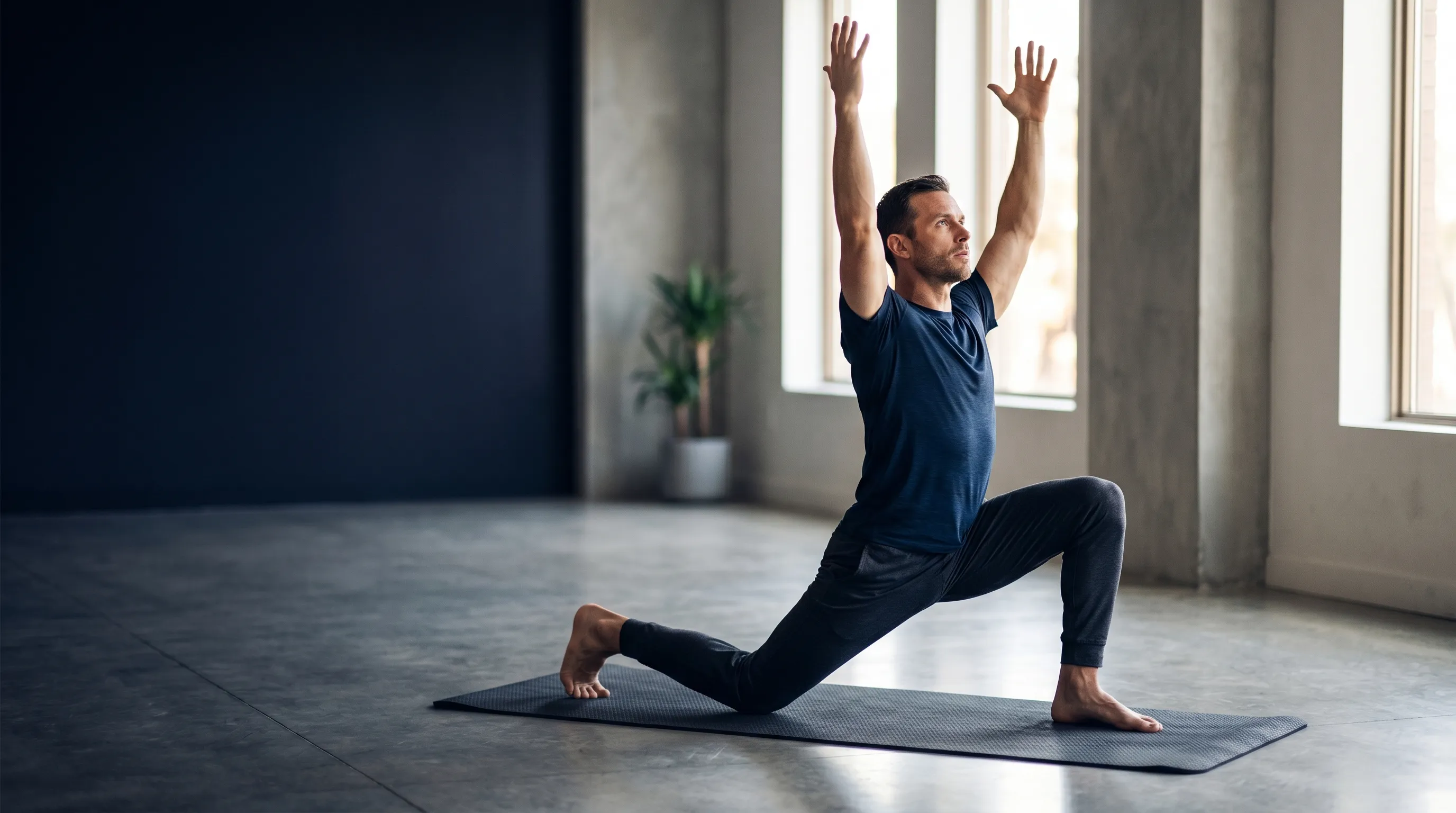
1. Half-Kneeling Hip Flexor Stretch
Kneel on one knee with the opposite foot forward, knee at 90 degrees. Before you lean forward, tuck your pelvis — squeeze the glute of the back leg and draw your belt buckle upward. Then shift your hips forward gently while maintaining the tuck. You should feel the stretch deep in the front of the hip of the kneeling leg, not in your lower back.
Dosing: 30-45 seconds per side, 2-3 sets. Breathe slowly through the nose.
The posterior pelvic tilt cue is critical. Without it, most people just extend through their lumbar spine and feel nothing in the hip flexors. Ehresman and colleagues found that a daily lunge-and-reach stretch — structurally similar to this position — produced a mean 5.9-degree improvement in hip flexor length over six weeks, along with significantly improved gluteal power.8
2. 90/90 Hip Rotation
Sit on the floor with both knees bent at 90 degrees — one leg in front (external rotation) and one behind (internal rotation). Sit tall and hold for 30 seconds. Then rotate to the opposite side, switching which hip is internally and externally rotated.
Dosing: 30 seconds per position, 2 sets per side. Move slowly between transitions.
This exercise addresses both internal and external hip rotation in a single position — two ranges that seated postures neglect simultaneously. The 2025 JOSPT clinical practice guideline on hip pain and mobility deficits recommends exercise therapy including flexibility work targeting hip joint mobility as part of the management approach.9
3. Supine Figure-4 Stretch
Lie on your back. Cross one ankle over the opposite knee. Reach through and pull the uncrossed leg toward your chest until you feel a deep stretch in the outer hip and glute of the crossed leg. Keep your head on the floor and breathe.
Dosing: 30-45 seconds per side, 2-3 sets. Exhale and gently deepen on each breath.
This is a beginner-friendly version of pigeon pose — same target muscles, far less demand on the knee. If you practice yoga, you will recognize the stretch. If you do not, this is a more accessible entry point for the same external rotators and deep hip muscles.
4. Glute Bridge with Hold
Lie on your back, knees bent, feet flat on the floor hip-width apart. Drive through your heels to lift your hips until your body forms a straight line from knees to shoulders. Squeeze your glutes hard at the top and hold for 3 seconds. Lower slowly.
Dosing: 10-15 reps with a 3-second squeeze at the top, 2-3 sets.
The glute bridge is not a stretch — it is a pattern reset. Reiman and colleagues reviewed the EMG literature on gluteal activation during rehabilitation exercises and identified the bridge as an effective exercise for gluteus maximus recruitment, particularly as an early-stage activation exercise before progressing to more demanding movements.10 The 3-second isometric hold at the top is key. It forces conscious glute engagement rather than allowing the hamstrings to dominate the movement.
5. Side-Lying Clamshell
Lie on your side with hips and knees bent at roughly 45 degrees, feet together. Keeping your feet in contact, open the top knee like a clamshell while keeping your pelvis still. Do not roll backward. Pause briefly at the top, then lower with control.
Dosing: 12-15 reps per side, 2-3 sets. Add a light resistance band above the knees in weeks 3 to 4.
Dr. David Selkowitz and colleagues at the University of Southern California used fine-wire EMG electrodes to measure muscle activity during 11 hip exercises and found that the clamshell had the highest gluteal-to-tensor fascia latae muscle activation index among the exercises tested.11 In plain language: the clamshell lights up the right muscles without over-recruiting the wrong ones. Distefano and colleagues confirmed that side-lying hip abduction — structurally related to the clamshell — produced the highest gluteus medius activation among the therapeutic exercises they tested.12
6. Reverse Lunge with Overhead Reach
Step one foot backward into a lunge. As you lower, reach both arms overhead and slightly toward the side of the front leg. You should feel a stretch through the hip flexor of the back leg and the lateral trunk, while your front-leg glute works to stabilize. Push through the front heel to return to standing.
Dosing: 8-10 reps per side, 2 sets. Controlled tempo — 2 seconds down, 1 second up.
This exercise integrates everything the previous five addressed. It dynamically stretches the hip flexors under load while demanding glute activation, hip stability, and trunk control in a single movement. The overhead reach adds a lateral trunk stretch component that further lengthens the anterior chain. Use this as the bridge between your mobility work and your strength training.
The 4-Week Progression
Do not jump to the full protocol on day one. Build the habit first, then build the volume.
Week 1: Desk breaks only. Exercises 1 (hip flexor stretch) and 4 (glute bridge), 2 sets of 30 seconds (stretch) or 10 reps (bridge), 2-3 times per day. Total investment: 4 to 6 minutes per session. The goal is frequency, not duration. Three brief sessions throughout a workday are more effective for countering seated posture than one long session in the evening.1
Week 2: Add a transitional daily session. Keep your desk breaks. Add exercises 2 (90/90) and 5 (clamshell) to create one 10-minute daily session, ideally in the morning or after work. Week 3 expands it to the full six-exercise maintenance dose.
Week 3: Full 6-exercise protocol. All six exercises, 2 sets each, once daily. Total time: approximately 15 minutes. If something feels restricted, spend more time there rather than rushing through.
Week 4: Volume up. Increase to 3 sets. Train the full protocol 4-5 times per week. Add a resistance band to the clamshells. Keep the 3-second pause at the top of every glute bridge.
Progress checkpoints: By week 4, test two things. First, can you hold a deep bodyweight squat for 30 seconds with heels flat on the floor? Second, can you hold the half-kneeling hip flexor stretch with a full pelvic tuck without your lower back arching? If both are improving, the protocol is working. Thomas and colleagues found that stretching frequency of 5 or more sessions per week was positively associated with range-of-motion improvements — consistency matters more than intensity.7
SensAI can build this kind of progression into your weekly program. Program regeneration uses completed performance and aggregated recovery trends when adjusting volume and exercise selection, while the LLM coach can change the mobility work when you ask. It can sit alongside your strength, flexibility, and active recovery sessions.
When Tight Hips Are Actually Something Else
Most hip tightness from sitting responds to the protocol above within 2 to 3 weeks. If yours does not, pay attention to the quality of the sensation.
Pinching or catching at the front of the hip — especially during deep flexion — may indicate femoroacetabular impingement (FAI), a bony or labral issue that stretching cannot fix and may aggravate. This requires imaging and a physiotherapy evaluation, not more mobility work.
Sharp groin pain or pain that radiates into the inner thigh follows a different mechanism than muscular tightness. Adductor strains, hip labral tears, and inguinal pathology all present this way. Stretching through sharp pain is not productive.
No improvement after 2 to 3 weeks of consistent daily practice — meaning you genuinely did the work 5 or more days per week — warrants a professional evaluation. The 2025 JOSPT clinical practice guidelines recommend clinician-guided assessment when exercise therapy alone does not produce expected improvements.9
These warning signs are clinical guidance, not an app diagnosis. SensAI is not a diagnostic tool. You can tell the LLM coach about pain, injuries, or stalled progress so its memory retains the constraint and it can modify training when you ask, but persistent symptoms still require evaluation from a qualified professional. Our active recovery guide explains what low-intensity recovery work can and cannot address.
Building Hip Mobility Into Your Training Week
Hip mobility work does not need its own dedicated session every day — though it can be one. Here is how to layer it into the training you are already doing:
Pre-strength warm-up (5 minutes): Exercises 1, 4, and 6 — the hip flexor stretch, glute bridge, and reverse lunge with reach. This combination opens the hips and primes the glutes before squats, deadlifts, or lunges. Unlike prolonged static stretching before lifting, which can reduce force output, this sequence uses short holds and activation work that prepare rather than impair.1
Active recovery days: Run the full 6-exercise protocol as your main session. This pairs naturally with active recovery programming on days between hard training. Low-intensity hip work promotes blood flow without adding training stress.
For runners: Prioritize exercises 1 (hip flexor stretch) and 5 (clamshell). Running demands hip extension and frontal-plane stability — exactly the ranges that sitting compromises and these two exercises restore.
For yoga practitioners: This routine complements yin and hatha practice. The glute activation exercises (4, 5, 6) fill a gap that most yoga sequences do not prioritize. Yoga opens the hips passively; this protocol ensures the muscles around the joint can actively control the new range.
For the full-body approach: Pair this hip routine with the evidence-based full-body stretching protocol on dedicated flexibility days. The two programs share the half-kneeling hip flexor stretch — do it once, not twice.
SensAI generates Flexibility and Active Recovery sessions with guided set-by-set tracking and exercise illustrations so you know exactly what each movement looks like. Weekly regeneration uses completed performance and aggregated recovery trends from HealthKit. If you want hip mobility added, removed, or moved, ask the LLM coach in chat and it can change the program at your request.
References
Footnotes
-
Warneke K, et al. “Practical recommendations on stretching exercise: A Delphi consensus statement of international research experts.” Journal of Sport and Health Science, 2025; 14(6):101067. https://pubmed.ncbi.nlm.nih.gov/40513717/ ↩ ↩2 ↩3 ↩4
-
Ingram LA, Tomkinson GR, d’Unienville NMA, Gower B, Gleadhill S, Boyle T, Bennett H. “Optimising the Dose of Static Stretching to Improve Flexibility: A Systematic Review, Meta-analysis and Multivariate Meta-regression.” Sports Medicine, 2025; 55(3):597-617. https://pubmed.ncbi.nlm.nih.gov/39614059/ ↩ ↩2 ↩3
-
Mills M, Frank B, Goto S, Blackburn T, Cates S, Clark M, Aguilar A, Fava N, Padua D. “Effect of Restricted Hip Flexor Muscle Length on Hip Extensor Muscle Activity and Lower Extremity Biomechanics in College-Aged Female Soccer Players.” International Journal of Sports Physical Therapy, 2015; 10(7):946-954. https://pubmed.ncbi.nlm.nih.gov/26673683/ ↩ ↩2
-
Boukabache A, Preece SJ, Brookes N. “Prolonged sitting and physical inactivity are associated with limited hip extension: a cross-sectional study.” Musculoskeletal Science and Practice, 2021; 51:102282. https://pubmed.ncbi.nlm.nih.gov/33188982/ ↩
-
Yang L, Cao C, Kantor ED, Nguyen LH, Zheng X, Park Y, Giovannucci EL, Matthews CE, Colditz GA, Cao Y. “Trends in Sedentary Behavior Among the US Population, 2001-2016.” JAMA, 2019; 321(16):1587-1597. https://pubmed.ncbi.nlm.nih.gov/31012934/ ↩
-
Janda V. “Muscles and Motor Control in Cervicogenic Disorders.” In: Grant R, ed. Physical Therapy of the Cervical and Thoracic Spine. Churchill Livingstone, 1994. ↩
-
Thomas E, Bianco A, Paoli A, Palma A. “The Relation Between Stretching Typology and Stretching Duration: The Effects on Range of Motion.” International Journal of Sports Medicine, 2018; 39(4):243-254. https://pubmed.ncbi.nlm.nih.gov/29506306/ ↩ ↩2
-
Ehresman BA, Lehecka BJ, Hiser D, Koster L, Wietharn J. “Improved Hip Flexibility and Gluteal Function Following a Daily Lunge-and-Reach Stretching Intervention.” International Journal of Sports Physical Therapy, 2025. https://pubmed.ncbi.nlm.nih.gov/40469644/ ↩
-
Koc TA Jr, Cibulka M, Enseki KR, Gentile JT, MacDonald CW, Kollmorgen RC, Martin RL. “Hip Pain and Mobility Deficits — Hip Osteoarthritis: Revision 2025.” Journal of Orthopaedic & Sports Physical Therapy, 2025; 55(11):CPG1-CPG31. https://pubmed.ncbi.nlm.nih.gov/41165671/ ↩ ↩2
-
Reiman MP, Bolgla LA, Loudon JK. “A literature review of studies evaluating gluteus maximus and gluteus medius activation during rehabilitation exercises.” Physiotherapy Theory and Practice, 2012; 28(4):257-268. https://pubmed.ncbi.nlm.nih.gov/22007858/ ↩
-
Selkowitz DM, Beneck GJ, Powers CM. “Which exercises target the gluteal muscles while minimizing activation of the tensor fascia lata? Electromyographic assessment using fine-wire electrodes.” Journal of Orthopaedic & Sports Physical Therapy, 2013; 43(2):54-64. https://pubmed.ncbi.nlm.nih.gov/23160432/ ↩
-
Distefano LJ, Blackburn JT, Marshall SW, Padua DA. “Gluteal muscle activation during common therapeutic exercises.” Journal of Orthopaedic & Sports Physical Therapy, 2009; 39(7):532-540. https://pubmed.ncbi.nlm.nih.gov/19574661/ ↩