The Evolution of Fitness Technology
From pedometers to LLM-powered coaching: how wearables, health-data integration, and conversational AI are changing personalized training in 2026.

SensAI Team
12 min read
Get a training plan that adapts to your recovery — free on iOS

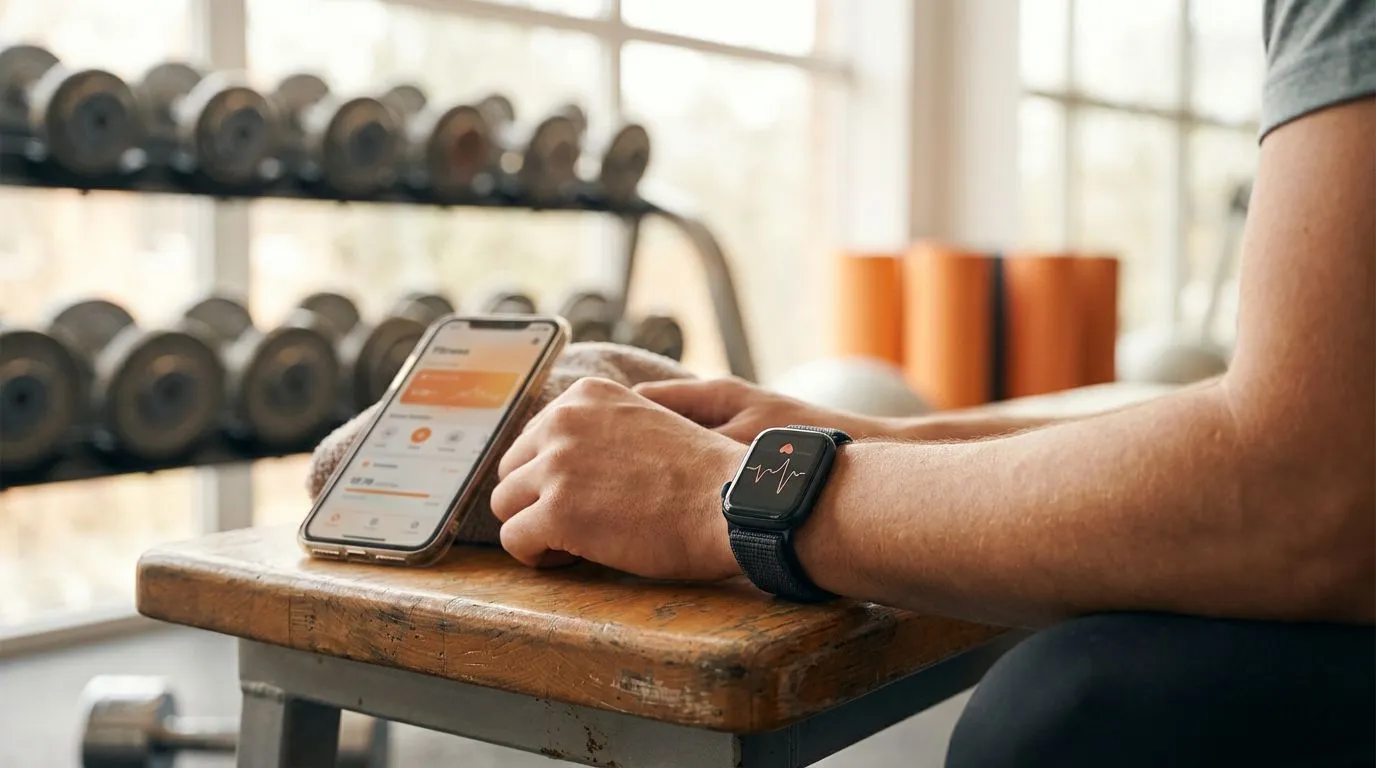
The pedometer clipped to a waistband counted steps. Today’s watch can estimate sleep, record heart rate, and share workouts with a phone. The important change is not that a device now knows exactly what your body needs — it does not — but that more personal context can inform a training conversation.
Platforms like SensAI combine Apple Health data with an LLM coach, generated workout programming, and a detailed tracker. SensAI produces daily recovery summaries and regenerates the program weekly from actual performance and recovery context. It does not silently rewrite every session in real time from one wearable reading.
This guide traces the shift from basic hardware to connected coaching, separates shipping products from 2026 concepts, and explains where the technology remains uncertain.
The Evolution of Fitness Technology
Fitness technology began with simple measurement. Mechanical pedometers offered one useful number: steps. More specialized athletes later adopted chest-strap heart-rate monitors, cycle computers, and GPS watches, while smartphones made logging and sharing broadly accessible.
A practical timeline:
- 1960s–1980s: mechanical pedometers, stopwatches, and laboratory testing
- 1990s: consumer heart-rate monitors bring live cardiovascular feedback into training
- 2000s: GPS watches add outdoor distance, pace, routes, and elevation
- 2007–2012: smartphones become a platform for workout logs, nutrition apps, and social fitness
- 2013–2018: mainstream wearables expand 24-hour activity, heart-rate, and sleep estimates
- 2019–present: connected platforms combine wearable summaries, training history, and conversational software
The American College of Sports Medicine ranked wearable technology as the number-one fitness trend for 2026. Its worldwide survey drew responses from 2,000 clinicians, researchers, and fitness professionals, and ACSM reported that nearly half of U.S. adults own a fitness tracker or smartwatch.1
That popularity should not be confused with clinical precision. Consumer devices estimate many metrics from optical sensors, motion, user input, and proprietary models. Their value often comes from consistent tracking and useful trends, not from perfectly measuring sleep stages, calories, illness, or readiness.
What LLM-Powered Personalization Changes
A fixed program assumes the planned schedule remains appropriate. A context-aware system can instead discuss completed work, available equipment, recovery trends, goals, constraints, and what the user reports today.
SensAI’s “AI” means large language models — conversational systems like ChatGPT or Claude — not a traditional machine-learning fatigue algorithm. The LLM uses the personal context available to it to generate a program from scratch and explain or revise recommendations in ordinary language.
| Fixed program | Context-aware LLM coaching |
|---|---|
| Written around a standard weekly schedule | Can be generated around the user’s schedule and equipment |
| Progression assumed in advance | Next week’s program can reflect planned-versus-performed work |
| Constraints may live in separate notes | The conversation can remember injuries, preferences, and limitations |
| Changes require manual rewriting | The user can request a shorter workout or exercise swap in plain language |
| Little explanation | The user can ask why a recommendation fits the available context |
ACE Scientific Advisory Panel member Ted Vickey described AI as becoming “the backbone of programming, member communication, scheduling, personalization and staffing.”2 That is an industry outlook, not evidence that every AI product is accurate or that personalization automatically improves adherence.
The most useful distinction is between supporting a decision and making an infallible decision. An LLM can organize context, surface a tradeoff, and make a plan easier to change. It cannot examine an injury, validate a wearable sensor, or guarantee the correct training dose.
What Wearable Integration Can Add
Depending on the device and permissions, a connected health platform may receive:
- Heart-rate recordings during exercise and rest
- HRV and resting-heart-rate trends
- Sleep duration and quality estimates
- Completed workouts, steps, pace, distance, and activity energy
- Temperature, respiratory, or blood-oxygen estimates on supported hardware
Each metric has limitations. A single low HRV value can reflect measurement conditions, poor sleep, alcohol, stress, training, illness, or normal variation. Sleep stages and calorie expenditure are estimates. Skin temperature is not the same as a clinical core-temperature measurement.
Integration is most helpful when it reduces manual entry and lets the user compare multiple signals with subjective feel and actual performance. It is less helpful when a product turns a noisy score into a diagnosis or an automatic high-stakes instruction.
Pattern Summaries
Software can place today’s value beside a personal baseline and recent trend. That makes change easier to notice, but the summary remains dependent on the device, data quality, and model assumptions.
Workout Context
Completed sets, heart-rate zones, and planned-versus-performed work can inform the next planning cycle. SensAI regenerates programming weekly; it does not monitor a live heart-rate recovery value and automatically remove remaining sets.
Conversation
An LLM interface lets the user add information a wearable cannot see: “I was awake with a sick child,” “this hotel gym has only dumbbells,” or “my clinician asked me to avoid overhead pressing.” That context can be more useful than another score.
No published evidence cited here shows that AI-plus-wearable apps reduce injury rates or significantly improve consistency. Those outcomes depend on the product, user, program, comparison group, and study design.
Common Fitness Problems Technology Can Help With
Schedule Disruption
A plan can be regenerated around fewer days, different equipment, or a shorter session. The user still decides whether the proposed change is safe and realistic.
Progress Tracking
Planned-versus-performed sets, personal records, milestones, streaks, and performance trends can make progress visible. A plateau still requires judgment: sleep, nutrition, technique, program design, illness, and measurement error can all contribute.
Exercise Substitution
SensAI can respond to a photo or conversation and lets the user request a mid-workout swap. Image feedback is not a physical examination, and it cannot guarantee safe form. Pain, neurologic symptoms, or injury concerns belong with a qualified clinician.
Recovery Awareness
Daily summaries can help a user notice that poor sleep, higher resting heart rate, and reduced performance are occurring together. They should prompt reflection, not diagnose overtraining or infection.
| Challenge | Useful role for technology | Important limit |
|---|---|---|
| Plateau | Show performance and completion trends | Cannot identify one cause from the graph alone |
| Low motivation | Offer smaller sessions, reminders, and visible milestones | Cannot guarantee adherence |
| Technique question | Provide illustrations or conversational feedback | Cannot replace hands-on coaching or clinical assessment |
| Recovery concern | Summarize several trends and recent load | Cannot diagnose illness or injury |
| Schedule disruption | Regenerate or shorten a program | The user must confirm constraints and safety |
Technology works best as a supportive tool. It can organize evidence and options; it should not erase body awareness or professional judgment.
2026 Fitness Technology: Shipping Features Versus Concepts
Product announcements often blur what is available, what requires a subscription, and what remains a prototype. The distinctions matter.
Nutrition in Garmin Connect+
Garmin announced nutrition tracking in Garmin Connect+ in 2026. The food-recognition feature uses the camera on a compatible smartphone, not a smartwatch camera. Compatible watches can log favorites and recent foods, while a voice command can open the Nutrition app on the watch; the announcement does not say users can dictate a complete macro log by voice.3
Features, device compatibility, subscriptions, and regional availability can change, so check Garmin’s current product documentation.
Amazfit V1TAL
Zepp Health presented Amazfit V1TAL at CES 2026 as an early-stage sports-technology concept using camera and voice interaction. Zepp’s own announcement describes a concept, not a generally shipping consumer product.4 Any discussion of what it may eventually do should remain conditional.
Withings Body Scan 2
Withings says Body Scan 2 can assess more than 60 biomarkers and presents it as a longevity-oriented health station.5 That is a manufacturer claim. Availability, features, medical functionality, and regulatory authorization vary by market and may depend on later software updates. The product’s health information does not replace medical care.
Immersive and Assistive Training
Virtual-reality fitness and powered mobility devices continue to develop, but usefulness, accessibility, evidence, and cost differ widely. A compelling demonstration is not the same as a validated training outcome or a broadly available product.
The durable trend is integration: exercise, sleep, recovery, and nutrition data appearing in fewer interfaces. The open question is whether a platform explains uncertainty and protects the user instead of simply producing more confident scores.
How SensAI Fits This Evolution
SensAI’s current product combines personal health context with LLM intelligence.6 It is not built on traditional machine-learning workout templates.
Current capabilities include:
- Workout plans generated from scratch around goals, equipment, schedule, and constraints
- Multiple workout types, including strength, flexibility, running, active recovery and mobility, and yoga
- Weekly regeneration based on actual performance and recovery context
- Guided set-by-set tracking, exercise illustrations, rest timers, planned-versus-performed sets, and offline-first sync
- Daily recovery summaries using aggregated sleep, HRV, resting-heart-rate, and workout context
- Apple Watch data directly through HealthKit, with compatible Garmin, Oura, and WHOOP data flowing through HealthKit
- LLM chat with memory, image input, quick actions, and user-requested workout changes
SensAI does not currently claim Fitbit integration, automatic real-time session rewriting, sensor-based form correction, a validated injury predictor, or medical diagnosis.
Consider a disrupted week. After travel and poor sleep, the app can show a recovery summary. You can tell the coach that the hotel gym has only dumbbells and ask for a shorter session. Completed work then becomes part of the context used when the next week’s program is generated. That is useful adaptation without pretending the watch made a diagnosis or the app acted without you.
Health Data and Privacy
Raw HealthKit data stays on-device. SensAI sends aggregated recovery metrics — such as HRV trends, sleep quality, and workout summaries — server-side so the LLM coach can personalize its output. SensAI does not sell this data to third parties.7
Users should still review permissions and the current privacy policy, connect only the sources they want to use, and treat health data as sensitive. Other fitness apps have different practices; read their policies rather than assuming the same architecture.
Frequently Asked Questions
Do I need an expensive wearable?
No. SensAI can generate a plan from goals, equipment, schedule, and constraints without a wearable. A compatible health source adds recovery context, but it does not turn the plan into a medical prescription.
How does the LLM know what workout to suggest?
It uses the context available to it: goals, equipment, schedule, constraints, training history, logged performance, conversation, and connected recovery summaries. Missing or inaccurate context can produce a weaker recommendation, so review the plan and correct the coach.
Does SensAI adjust my workout every day automatically?
No. SensAI provides a daily recovery summary, regenerates the overall program weekly, and lets you request changes to the current workout. It does not automatically mutate every exercise from one morning score.
Can fitness technology replace a personal trainer or clinician?
It can help with planning, tracking, explanations, and availability. A human professional can observe movement directly, perform an examination, manage complex risk, and provide interpersonal accountability. Use the tool that matches the need.
Which metrics should a beginner watch?
Start with simple, interpretable behavior: sessions completed, gradual progress, sleep opportunity, and how you feel and perform. Resting heart rate or HRV trends can add context, but more metrics are not automatically better.
The Bottom Line
Fitness technology evolved from counting activity to organizing personal context. The best 2026 systems do not merely collect more numbers: they help a person understand the numbers, add real-life constraints, and revise a plan through conversation.
The guardrail is just as important. Wearables estimate; LLMs can be wrong; manufacturer announcements can describe prototypes or future features. SensAI’s practical value is its combination of generated programming, tracking, aggregated recovery context, and an LLM coach — with weekly regeneration and user-directed changes rather than invisible real-time control.
References
Footnotes
-
American College of Sports Medicine. “The Future of Fitness: ACSM Announces Top Trends for 2026.” October 22, 2025. https://acsm.org/top-fitness-trends-2026/ ↩
-
American Council on Exercise. “10 Fitness Trends in 2026 and Beyond.” December 19, 2025. https://www.acefitness.org/resources/pros/expert-articles/9043/10-fitness-trends-in-2026-and-beyond/ ↩
-
Garmin. “Stay on top of nutrition goals in Garmin Connect.” Garmin Newsroom, 2026; accessed July 12, 2026. https://www.garmin.com/en-US/newsroom/press-release/sports-fitness/stay-on-top-of-nutrition-goals-in-garmin-connect/ ↩
-
Zepp Health. “Amazfit Introduces the Future of Sports Technology at CES 2026.” Zepp Health, 2026; accessed July 12, 2026. https://www.zepp.com/press-release/amazfit-introduces-the-future-of-sports-technology-at-ces-2026 ↩
-
Withings. “Body Scan 2.” Withings, accessed July 12, 2026. https://www.withings.com/uk/en/landing/bodyscan-2 ↩
-
SensAI. “SensAI: AI Fitness Coach.” Apple App Store listing, accessed July 12, 2026. https://apps.apple.com/us/app/sensai-fitness-sensei/id6738963099 ↩
-
SensAI. “Privacy Policy.” Effective April 30, 2026; accessed July 12, 2026. https://www.sensai.fit/legal/privacy-policy ↩