How Much Fiber Per Day? 14 g per 1,000 Calories — and Why Lifters Miss It
Adequate fiber is 14 g per 1,000 calories — about 25 g for women and 38 g for men — and only about 5% of people hit it. Risk reduction peaks at 25-29 g/day. What the number means if you train hard, and how to add fiber without wrecking a session.

SensAI Team
15 min read
Get a training plan that adapts to your recovery — free on iOS

Count the macros on a typical training-day food log and you’ll find three numbers: protein, carbs, fat. Fiber almost never makes the list.
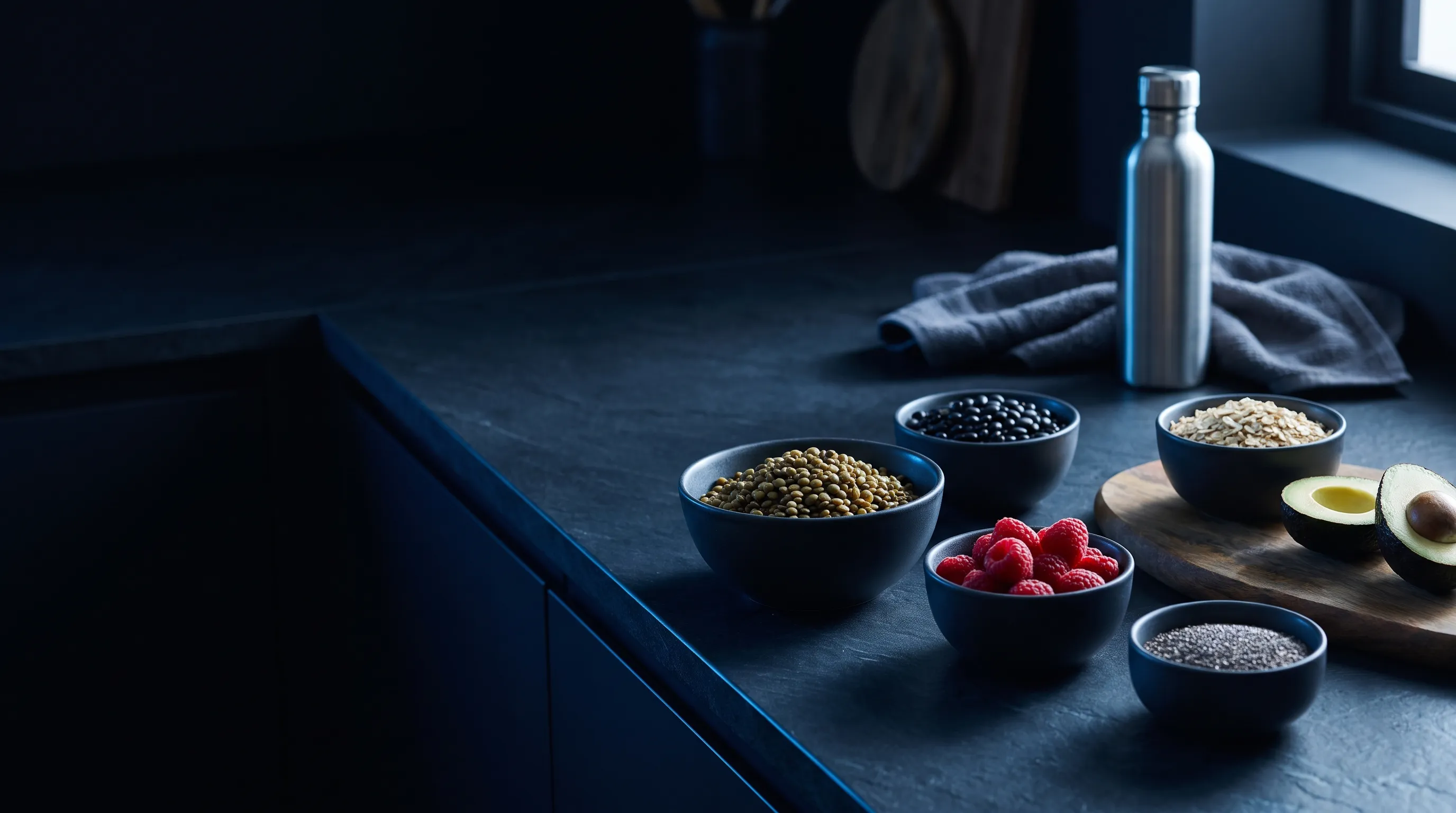
That omission has a specific cost, and it’s larger than most lifters assume. The adequate intake for dietary fiber is 14 grams per 1,000 calories — a figure the Institute of Medicine derived from prospective cohort studies showing that intake level protected against cardiovascular disease.1 For a 2,500-calorie eater, that’s 35 grams a day — about a cup of lentils, a cup of raspberries, and an ounce of chia seeds.
Only about 5% of US adults actually meet fiber recommendations, and average intakes run roughly half of what’s advised.12
Here’s the part that should interest anyone who trains: the dietary habits that make you good at building muscle are the same habits that crowd fiber out. High protein, simple carbohydrates around sessions, a narrow rotation of “safe” foods. Writing in Advances in Nutrition, Riley Hughes and Hannah Holscher of the University of Illinois Urbana-Champaign name it directly — high protein intake, simple carbohydrate intake, low fiber intake, and food avoidance are common athlete strategies that “may adversely impact the gut microbiota and, in turn, performance.”3
So this isn’t a longevity footnote you get to after the training is dialed in. It’s an input.
| Question | Short answer |
|---|---|
| How much fiber per day? | 14 g per 1,000 calories — ~25 g/day for women, ~38 g/day for men1 |
| Where’s the health sweet spot? | Risk reduction was greatest at 25-29 g/day, with more possibly better4 |
| How much does it move the needle? | 15-30% lower all-cause and cardiovascular mortality, highest vs lowest intake4 |
| Am I probably short? | Almost certainly. ~5% of US adults meet recommendations; intakes run ~half of advice12 |
| Why does it matter for training? | Low-fiber athlete diets may impair the gut microbiota and performance3 |
| Will it wreck my workout? | Only if mistimed. GI trouble concentrates in efforts ≥2 h at ~60% VO₂max5 |
| Fastest fix? | Add ~5 g/day per week from food, with fluid, rather than jumping to target |
| Do supplements work? | For specific jobs, yes — β-glucan for LDL, guar for satiety67 |
How much fiber per day do you actually need?
The headline number is 14 grams per 1,000 calories consumed. That scaling is the whole reason the recommendation looks different depending on where you read it.
Applied to typical calorie intakes, it produces the familiar targets: roughly 25 g/day for adult women and 38 g/day for adult men.1 But if you’re a 90 kg lifter eating 3,200 calories, your adequate intake is about 45 g — not 38. Fiber needs scale with how much you eat, and athletes eat a lot.
The number’s origin matters, because it explains why it isn’t arbitrary. Joanne Slavin, professor of food science and nutrition at the University of Minnesota, and co-author Renee Korczak trace the adequate intake back to prospective cohort studies in which 14 g of fiber per 1,000 kcal protected against cardiovascular disease. That single observation was then extended across the life cycle using recommended calorie intakes.1
Note what that means: the fiber recommendation is a cardiovascular recommendation. Digestion is the side effect people notice; the artery is what the number was built around.
Then there’s the second target, which is the one worth training toward.
What does the evidence say fiber does?
The most complete answer comes from a 2019 Lancet series by Andrew Reynolds and colleagues at the University of Otago — a set of systematic reviews and meta-analyses spanning 185 prospective studies and 58 clinical trials, just under 135 million person-years of data.4
Comparing the highest fiber consumers with the lowest, they found a 15-30% decrease in all-cause mortality, cardiovascular mortality, coronary heart disease incidence, stroke incidence and mortality, type 2 diabetes, and colorectal cancer. The clinical trials showed significantly lower bodyweight, systolic blood pressure, and total cholesterol at higher fiber intakes.4
And the dose question has a real answer: risk reduction across critical outcomes was greatest when daily fiber intake fell between 25 g and 29 g. Dose-response curves suggested higher intakes could confer still greater protection against cardiovascular disease, type 2 diabetes, and colorectal and breast cancer.4
The authors graded the certainty of evidence for fiber as moderate — and called the dose-response evidence “striking,” concluding the relationships could be causal.4 That’s unusually strong language for observational nutrition science, and it’s worth taking seriously precisely because the same paper graded glycemic index evidence as low to very low.
So: 25-29 g is the floor where benefits concentrate. Not 38 as a ceiling, not 15 as a shrug.
Fiber for athletes and lifters: why it matters more if you train hard
Here’s where it gets specific to athletes, and where the story is genuinely less settled — so the line between established and emerging is marked as we go.
Fiber is not digested by you. It’s fermented by the bacteria in your colon, which convert it into short-chain fatty acids — primarily butyrate, propionate, and acetate. Those metabolites are the actual mechanism behind most of fiber’s downstream effects. Feed the bacteria, and they produce compounds that feed your gut lining and modulate inflammation and immune signaling.
Think of it as a second metabolism running downstream of the first. You eat for you; you also eat for them.
Exercise itself changes that ecosystem. In a well-controlled study from the University of Illinois, Jacob Allen and colleagues put 32 previously sedentary lean and obese adults through six weeks of supervised endurance training, with three-day dietary controls before each fecal collection. Exercise increased fecal short-chain fatty acid concentrations in the lean participants — though not in the obese participants — and those shifts paralleled changes in bacterial genes and taxa capable of producing them.8
Two caveats from that study deserve equal billing with the headline. The effects depended on obesity status, and once the participants returned to a sedentary lifestyle for six weeks, the changes largely reversed.8 Training is not a deposit; it’s a subscription.
That’s the part worth emphasizing over the more exciting finding, which is where the evidence gets thinner.
Does the gut microbiome actually improve performance?
You’ve probably seen the marathon-runner study. It’s worth understanding precisely, because it is routinely overstated.
In Nature Medicine, Jonathan Scheiman and colleagues at Harvard Medical School and the Joslin Diabetes Center observed that Veillonella bacteria increased in relative abundance in marathon runners after racing. They isolated a strain, Veillonella atypica, and — critically — inoculated it into mice, which then showed significantly increased exhaustive treadmill run time.9
The mechanism is elegant. Veillonella uses lactate as its sole carbon source. The team showed serum lactate crosses the epithelial barrier into the gut lumen, that a pathway metabolizing lactate to propionate was at higher relative abundance post-exercise in elite athletes, and that instilling propionate alone reproduced the running benefit.9
So: a real mechanism, elite-athlete metagenomic support, and a performance result demonstrated in mice, not humans. Several authors also hold equity in a company commercializing the work, which is disclosed in the paper and worth knowing.9
The honest summary: gut bacteria plausibly contribute to performance, the pathway is characterized, and no one has yet shown that changing your microbiome makes you faster. Hughes and Holscher reach a similarly measured conclusion — the microbiota “could, in theory, contribute” to performance via microbial metabolites, gastrointestinal physiology, and immune modulation, and more studies manipulating diet, exercise, and microbiome together are needed.3
What they do state without hedging is the negative case: low fiber intake is among the athlete dietary patterns that may adversely affect the microbiota and performance, while adequate fiber, varied protein sources, and unsaturated fats “have shown promising results.”3 Avoiding the deficit is better supported than chasing an ergogenic effect.
This is exactly the kind of distinction that gets flattened in fitness content, and it’s the reason SensAI is built to separate what the evidence supports from what it merely suggests when it explains a recommendation to you.
Soluble vs insoluble: which fiber does which job
“Fiber” is a category, not a compound, and the subtypes have measurably different effects. This is where supplements earn their keep — for defined jobs, not as a general substitute for plants.
The split is simple. Soluble fiber dissolves in water and forms a gel, which slows digestion — that’s the mechanism behind its effects on cholesterol and blood glucose. Insoluble fiber doesn’t dissolve; it adds bulk and speeds transit, which is the regularity side of the ledger. Most plant foods carry both, which is why food-first beats supplement-first.
| Fiber type | Soluble? | Found in | Best-supported effect |
|---|---|---|---|
| β-glucan | Soluble | Oats, barley | LDL-C reduction of 0.25 mmol/L (~10 mg/dL) at ~6.5 g/day of barley β-glucan over 4 weeks6 |
| Galactomannans (guar) | Soluble | Guar gum, fenugreek | Ranked most effective of 16 fibers for lowering HbA1c and fasting glucose in type 2 diabetes10 |
| Guar gum (acute) | Soluble | Supplement form | Largest effect on post-meal energy intake of the soluble fibers tested — a large effect, d = -0.907 |
| Psyllium | Mostly soluble, gel-forming | Husk supplements | Among the most effective for fasting insulin and HOMA-IR in type 2 diabetes10 |
| Cellulose, bran | Insoluble | Wheat bran, vegetables, skins | Stool bulk and faster transit; the “regularity” side of the ledger |
A few specifics worth pinning down.
For cholesterol, a meta-analysis of 14 randomized trials (N = 615) led by Hoang Ho and Dr. John Sievenpiper at St. Michael’s Hospital and the University of Toronto found that median doses of 6.5 and 6.9 g/day of barley β-glucan over about four weeks significantly reduced LDL-C by 0.25 mmol/L and non-HDL-C by 0.31 mmol/L (~12 mg/dL) respectively.6 That’s roughly a 10 mg/dL LDL drop from a bowl of barley — a small effect that is nonetheless real and cheap.
For blood glucose, a network meta-analysis of 46 RCTs covering 2,685 patients and 16 fiber types ranked galactomannans first for reducing HbA1c and fasting blood glucose, with β-glucans and psyllium the most effective for fasting insulin and HOMA-IR (a blood-test estimate of insulin resistance).10 Most comparisons carried low-to-moderate certainty.
For appetite, the satiety evidence is real but weaker than it’s usually sold. A meta-analysis of randomized trials found guar gum had the largest effect on post-meal energy intake, ahead of β-glucan, alginate, polydextrose, and pectin — but the authors rated risk of bias as high for every included study.7 Fiber helps you feel full. It is not a weight-loss drug, and if you’re setting an intake target, our guide to how many calories you should actually eat is the more load-bearing number.
Will fiber wreck your workout?
This is the legitimate fear, and it has a real evidence base — it’s just narrower than the fear.
Ricardo Costa and colleagues at Monash University systematically reviewed what they termed exercise-induced gastrointestinal syndrome. As exercise intensity and duration increase, there’s considerable evidence for increased intestinal injury, permeability, and endotoxemia — bacterial fragments leaking into the bloodstream — along with impaired gastric emptying, slowed small intestinal transit, and malabsorption. Heat stress and running make it worse.5
The useful number: significant gastrointestinal perturbation appears at a threshold of about two hours at 60% VO₂max — and it shows up irrespective of fitness status.5 Being well trained does not exempt you.
Which gives you a clean decision rule.
- Sessions under ~90 minutes, moderate intensity: fiber timing is mostly irrelevant. Eat normally — this is the vast majority of what SensAI programs for a lifter.
- Long or hot endurance sessions, or any race: reduce fiber and residue in the 12-24 hours prior. Move your fiber to the rest of the day.
- Habitually low fiber and frequent GI symptoms: the problem is more likely the abrupt jumps and the missing adaptation than fiber itself.
The mistake is generalizing marathon-day tactics into an everyday diet. A pre-race low-residue protocol — minimal fiber and undigested material — is a tool for a two-hour-plus effort at intensity — not a reason to eat 12 g of fiber a day for a career of 50-minute lifting sessions. If you want the broader framework for what to eat before training, we cover it in the pre-workout nutrition guide.
How to add fiber without the bloat
Most people who “can’t tolerate fiber” went from 12 g to 35 g on a Monday. Bacteria adapt, but they need weeks, not hours.
Ramp it. Add roughly 5 g/day each week until you reach target — standard clinical practice rather than a trial-derived number. Six weeks gets almost anyone from average intake to 30+ g.
Bring fluid. Fiber works by holding water and adding bulk. Increase intake without increasing fluid and you get the exact symptoms you were trying to avoid — the hydration side is covered in our electrolyte and hydration strategy guide. SensAI treats the ramp as a standing target rather than a one-time instruction, which is the difference between knowing the rule and following it for six weeks.
Go food-first, and go wide. Different bacteria ferment different substrates, so variety matters as much as total grams. In a systematic review of 17 randomized controlled trials, Victoria Hindle, Nicole Veasley, and Hannah Holscher found that interventions supplying dietary fibers, phytonutrients, or unsaturated fats each enriched different bacterial genera — Akkermansia, Bacteroides, Faecalibacterium, Roseburia and others — with variable effects on microbial metabolites.11 No single substrate feeds the whole community.
Rough per-serving anchors, using USDA values:12
| Food | Serving | Approx. fiber |
|---|---|---|
| Lentils, cooked | 1 cup | ~15 g |
| Black beans, cooked | 1 cup | ~15 g |
| Chia seeds | 1 oz (28 g) | ~10 g |
| Raspberries | 1 cup | ~8 g |
| Avocado | Half | ~5 g |
| Broccoli, cooked | 1 cup | ~5 g |
| Apple, with skin | 1 medium | ~4 g |
| Oats, cooked | 1 cup | ~4 g |
| Almonds | 1 oz (28 g) | ~3.5 g |
One cup of lentils and a cup of raspberries is 23 g. The gap is closable in two food decisions, which is the actual reason the 5% statistic is frustrating rather than tragic.
Watch the diet patterns that structurally block it. Korczak and Slavin flag low-carbohydrate diets, low-gluten diets, and blanket “avoid processed foods” advice as specific barriers to reaching fiber targets.1 If you’re running a low-carb protocol, fiber needs to be engineered in deliberately — it won’t arrive by accident. The same is true of very high-protein plans; our guide on how much protein you actually need is worth reading alongside this one, because the two targets compete for plate space.
Use stool form as a cheap signal. In a study of 53 healthy women published in Gut, Doris Vandeputte and colleagues at KU Leuven found stool consistency — scored on the Bristol Stool Scale, a proxy for colon transit time — was strongly associated with gut microbiota richness, composition, enterotypes (the broad community types guts cluster into), and bacterial growth rates.13 It’s a crude readout, but it’s free and it responds within days.
Where this fits in a training system
Fiber is a slow variable. It doesn’t spike your readiness score tomorrow, which is exactly why it falls off the log — and why it’s the kind of input a coach has to keep raising.
That’s a fair description of the gap SensAI was built to close. A wearable will tell you your HRV dropped. It won’t tell you that your protein target quietly displaced your plant volume six weeks ago, or that the GI symptoms you’re blaming on stress track a diet you changed in March. Connecting nutrition patterns to recovery trends is interpretation work, and it’s the layer between a number and a decision.
The practical version inside SensAI is unglamorous: treat fiber as a tracked target alongside protein rather than an afterthought, ramp it deliberately, and pull it back only around the specific sessions where Costa’s two-hour threshold actually applies. If you’re new to tracking intake at all, our macro-counting primer is the place to start — and adding a fourth number to the three you already track is a smaller change than it sounds.
One thing SensAI will not do is promise that fiber makes you faster. The evidence doesn’t support that claim, and the ISSN’s own position stand on probiotics — led by Ralf Jäger with Chad Kerksick and colleagues — is careful to keep gut-focused interventions in the “supports health and immune function” column rather than the ergogenic one.14 Avoiding a deficit is the well-supported play.
Frequently asked questions
How much fiber per day do I need?
Fourteen grams per 1,000 calories eaten, which works out to about 25 g/day for women and 38 g/day for men at typical intakes.1 If you eat 3,200 calories, your target is closer to 45 g. Health benefits concentrate in the 25-29 g/day range.4
Is 30 grams of fiber a day enough?
Yes — 30 g sits just above the 25-29 g band where Reynolds and colleagues found risk reduction was greatest across mortality, coronary heart disease, type 2 diabetes, and colorectal cancer.4 Dose-response curves suggest going higher may add benefit, but 30 g already captures most of it.
Do most people get enough fiber?
No. Only about 5% of the population meets recommendations, and average intakes run roughly half of advised levels.12
Does fiber hurt athletic performance?
Not at normal intakes and normal timing. Gastrointestinal disturbance becomes significant at around two hours of exercise at 60% VO₂max, regardless of fitness level — so reducing fiber before long or hot sessions is sensible, while restricting it year-round is not.5 Chronically low fiber may itself impair the microbiota and performance.3
What’s the difference between soluble and insoluble fiber?
Soluble fiber dissolves in water and forms a gel that slows digestion, which is how it lowers LDL cholesterol and blunts blood glucose.610 Insoluble fiber doesn’t dissolve — it adds bulk and speeds transit, the regularity side. Most plant foods contain both, so whole foods cover both jobs without you having to choose.
Should I eat fiber before a workout or a run?
For anything under about 90 minutes at moderate intensity, eat normally — timing doesn’t matter. For a long run, a hot session, or a race, cut fiber and residue in the 12-24 hours before and shift it to the rest of the day. Gastrointestinal disturbance becomes significant at roughly two hours at 60% VO₂max, regardless of how fit you are.5
Should I take a fiber supplement?
For a specific job, it’s reasonable: β-glucan at ~6.5 g/day lowers LDL-C by about 0.25 mmol/L,6 and galactomannans rank best for HbA1c in type 2 diabetes.10 For general health, variety across plant foods is the better bet — different substrates enrich different bacteria, and no single fiber feeds the whole community.11
Does exercise change my gut bacteria on its own?
Yes, but conditionally. Six weeks of endurance training raised fecal short-chain fatty acids in lean but not obese adults under dietary control — and the changes largely reversed after six sedentary weeks.8
Will more fiber make me bloated?
Temporarily, if you increase too fast or without enough fluid. Adding about 5 g/day per week with adequate water is the standard approach.
Can gut bacteria really make me faster?
Not proven in humans. Veillonella atypica increased exhaustive treadmill run time in mice, via conversion of lactate to propionate, with supporting metagenomics in elite athletes.9 It’s a characterized mechanism, not a demonstrated human performance intervention.
The bottom line
Fiber is the most under-tracked macronutrient-adjacent number in a serious training diet, and the target isn’t vague: 14 g per 1,000 calories, with benefits concentrating at 25-29 g/day.14 Roughly 95% of people miss it, and the high-protein, narrow-variety eating that supports hypertrophy makes missing it easier.23
The strong claims are the boring ones — 15-30% lower all-cause and cardiovascular mortality at higher intakes, graded moderate certainty, with striking dose-response.4 The exciting claim, that gut bacteria can make you faster, currently rests on mice.9
Ramp by 5 g a week, drink accordingly, eat a wide range of plants, and pull fiber back only around the sessions that cross Costa’s two-hour threshold.5 That’s the whole protocol, and it’s cheaper than every supplement in this article.
References
Footnotes
-
Korczak R, Slavin JL. “Definitions, regulations, and new frontiers for dietary fiber and whole grains.” Nutrition Reviews, 2020;78(Suppl 1):6-12. https://pubmed.ncbi.nlm.nih.gov/32728750/ ↩ ↩2 ↩3 ↩4 ↩5 ↩6 ↩7 ↩8 ↩9 ↩10
-
Quagliani D, Felt-Gunderson P. “Closing America’s Fiber Intake Gap: Communication Strategies From a Food and Fiber Summit.” American Journal of Lifestyle Medicine, 2017;11(1):80-85. https://pubmed.ncbi.nlm.nih.gov/30202317/ ↩ ↩2 ↩3 ↩4
-
Hughes RL, Holscher HD. “Fueling Gut Microbes: A Review of the Interaction between Diet, Exercise, and the Gut Microbiota in Athletes.” Advances in Nutrition, 2021;12(6):2190-2215. https://pubmed.ncbi.nlm.nih.gov/34229348/ ↩ ↩2 ↩3 ↩4 ↩5 ↩6
-
Reynolds A, Mann J, Cummings J, Winter N, Mete E, Te Morenga L. “Carbohydrate quality and human health: a series of systematic reviews and meta-analyses.” The Lancet, 2019;393(10170):434-445. https://pubmed.ncbi.nlm.nih.gov/30638909/ ↩ ↩2 ↩3 ↩4 ↩5 ↩6 ↩7 ↩8 ↩9 ↩10
-
Costa RJS, Snipe RMJ, Kitic CM, Gibson PR. “Systematic review: exercise-induced gastrointestinal syndrome-implications for health and intestinal disease.” Alimentary Pharmacology & Therapeutics, 2017;46(3):246-265. https://pubmed.ncbi.nlm.nih.gov/28589631/ ↩ ↩2 ↩3 ↩4 ↩5 ↩6
-
Ho HV, Sievenpiper JL, Zurbau A, Blanco Mejia S, Jovanovski E, Au-Yeung F, Jenkins AL, Vuksan V. “A systematic review and meta-analysis of randomized controlled trials of the effect of barley β-glucan on LDL-C, non-HDL-C and apoB for cardiovascular disease risk reduction.” European Journal of Clinical Nutrition, 2016;70(11):1239-1245. https://pubmed.ncbi.nlm.nih.gov/27273067/ ↩ ↩2 ↩3 ↩4 ↩5
-
Salleh SN, Fairus AAH, Zahary MN, Bhaskar Raj N, Mhd Jalil AM. “Unravelling the Effects of Soluble Dietary Fibre Supplementation on Energy Intake and Perceived Satiety in Healthy Adults: Evidence from Systematic Review and Meta-Analysis of Randomised-Controlled Trials.” Foods, 2019;8(1):15. https://pubmed.ncbi.nlm.nih.gov/30621363/ ↩ ↩2 ↩3
-
Allen JM, Mailing LJ, Niemiro GM, Moore R, Cook MD, White BA, Holscher HD, Woods JA. “Exercise Alters Gut Microbiota Composition and Function in Lean and Obese Humans.” Medicine & Science in Sports & Exercise, 2018;50(4):747-757. https://pubmed.ncbi.nlm.nih.gov/29166320/ ↩ ↩2 ↩3
-
Scheiman J, Luber JM, Chavkin TA, MacDonald T, Tung A, Pham LD, Wibowo MC, Wurth RC, Punthambaker S, Tierney BT, Yang Z, Hattab MW, Avila-Pacheco J, Clish CB, Lessard S, Church GM, Kostic AD. “Meta-omics analysis of elite athletes identifies a performance-enhancing microbe that functions via lactate metabolism.” Nature Medicine, 2019;25(7):1104-1109. https://pubmed.ncbi.nlm.nih.gov/31235964/ ↩ ↩2 ↩3 ↩4 ↩5
-
Juhász AE, Greff D, Teutsch B, Gede N, Hegyi P, Horváth EM, Deák PÁ, Nyirády P, Ács N, Juhász R. “Galactomannans are the most effective soluble dietary fibers in type 2 diabetes: a systematic review and network meta-analysis.” The American Journal of Clinical Nutrition, 2023;117(2):266-277. https://pubmed.ncbi.nlm.nih.gov/36811560/ ↩ ↩2 ↩3 ↩4 ↩5
-
Hindle VK, Veasley NM, Holscher HD. “Microbiota-Focused Dietary Approaches to Support Health: A Systematic Review.” The Journal of Nutrition, 2025;155(2):381-401. https://pubmed.ncbi.nlm.nih.gov/39486521/ ↩ ↩2
-
U.S. Department of Agriculture, Agricultural Research Service. “FoodData Central.” Accessed August 17, 2026. https://fdc.nal.usda.gov/ ↩
-
Vandeputte D, Falony G, Vieira-Silva S, Tito RY, Joossens M, Raes J. “Stool consistency is strongly associated with gut microbiota richness and composition, enterotypes and bacterial growth rates.” Gut, 2016;65(1):57-62. https://pubmed.ncbi.nlm.nih.gov/26069274/ ↩
-
Jäger R, Mohr AE, Carpenter KC, Kerksick CM, et al. “International Society of Sports Nutrition Position Stand: Probiotics.” Journal of the International Society of Sports Nutrition, 2019;16(1):62. https://pubmed.ncbi.nlm.nih.gov/31864419/ ↩