How to Count Macros: A Step-by-Step Guide for Beginners
How to count macros from scratch — evidence-based TDEE calculation, protein-first macro splits from the 2025 research, tracking tips that stick, and the adaptive recalibration loop most guides skip.

SensAI Team
12 min read
Get a training plan that adapts to your recovery — free on iOS

Most macro guides hand you a formula, wish you luck, and disappear. This one gives you a loop: estimate your starting numbers, track them, evaluate what happened, and adjust. Then repeat. The adjustment step is the one most guides skip — and it is the step that determines whether your macros still work six weeks from now.
Here is what you are working with. Protein builds and repairs tissue. Carbohydrates fuel high-intensity work and brain function. Fat supports hormones, cell membranes, and absorption of fat-soluble vitamins. Each gram of protein and carbohydrate carries roughly 4 calories; each gram of fat carries 9. That asymmetry matters when you start doing the math.
This guide synthesizes the ISSN’s protein position stand, a 2025 network meta-analysis on macronutrient ratios, and adaptive thermogenesis research to give you a protocol that updates itself as your body changes.
Step 1: Estimate Your Starting Calories (And Why the Number Is Already Wrong)
Your total daily energy expenditure — TDEE — is the number of calories you burn in a full day, including exercise, digestion, and just existing. Every macro plan starts here. The most validated formula for estimating it is the Mifflin-St Jeor equation, which a systematic review of predictive equations identified as the most accurate, predicting resting metabolic rate within 10% of measured values for the majority of healthy individuals.1
The formula:
- Men: (10 x weight in kg) + (6.25 x height in cm) - (5 x age) + 5
- Women: (10 x weight in kg) + (6.25 x height in cm) - (5 x age) - 161
Worked example: A 30-year-old man, 80 kg (176 lb), 180 cm (5’11”):
(10 x 80) + (6.25 x 180) - (5 x 30) + 5 = 800 + 1125 - 150 + 5 = 1,780 calories (resting metabolic rate)
Then multiply by your activity level:
| Activity Level | Multiplier | Example |
|---|---|---|
| Sedentary (desk job, no exercise) | 1.2 | 2,136 cal |
| Lightly active (1-3 days/week) | 1.375 | 2,448 cal |
| Moderately active (3-5 days/week) | 1.55 | 2,759 cal |
| Very active (6-7 days/week) | 1.725 | 3,070 cal |
For our example at moderate activity: 1,780 x 1.55 = ~2,760 calories/day.
SensAI’s TDEE calculator runs this math using the activity factor you select. Treat the result as a starting estimate: the calculator itself does not read your logged workouts or adjust the multiplier automatically.
Now the uncomfortable part. This number is a starting estimate, not a prescription. A Stanford study testing seven popular wearables found that the most accurate device was still off by 27% on energy expenditure, and the least accurate was off by 93%.2 Your calculated TDEE will be wrong. The question is whether you treat it as a fixed target or a first draft. Treat it as a first draft.
Step 2: Set Your Macro Split — What the 2025 Evidence Actually Supports
Start with protein. Not because carbs and fat do not matter, but because protein has the strongest evidence linking specific intake ranges to body composition outcomes — and it is the macro most people undershoot.
Protein: set the floor first. The International Society of Sports Nutrition’s position stand recommends 1.4-2.0 g of protein per kg of body weight per day for exercising individuals.3 Dr. Jose Antonio, PhD, co-founder of the ISSN and professor at Nova Southeastern University, co-authored that position stand and has consistently argued that most active people benefit from the upper end of that range. For body composition goals specifically — whether fat loss, muscle gain, or recomposition — aim for 1.6-2.2 g/kg daily. A 2018 meta-analysis pooling 49 studies and 1,863 participants confirmed that protein supplementation significantly increased fat-free mass during resistance training, with benefits plateauing around 1.6 g/kg/day.4
A 2025 network meta-analysis in Nutrients compared dietary groups with varying macronutrient ratios and found that the specific carb-to-fat ratio mattered less than total calorie control and adequate protein.5 When protein intake was matched, different macro splits produced similar body composition outcomes — reinforcing that protein is the macro worth tracking precisely, while carbs and fat are more flexible.
Per-meal dosing matters too. Brad Schoenfeld, PhD, professor in the Department of Health Sciences at Lehman College (CUNY) and one of the most-cited hypertrophy researchers in the field, co-authored a 2018 review recommending 0.4-0.55 g/kg of body weight per meal across a minimum of four meals to maximize the anabolic response.6 For an 80 kg person, that is 32-44 g per meal. This aligns with Mamerow et al.’s finding that distributing protein evenly across meals produced 25% greater 24-hour muscle protein synthesis compared to the same total protein skewed toward dinner.7 For a deeper dive into protein distribution and workout timing, see our protein timing guide.
Fat: set the floor. Minimum 20-25% of total calories. Fat supports testosterone and estrogen production, absorbs vitamins A, D, E, and K, and maintains cell membrane integrity. Dropping below 20% chronically can disrupt hormonal function.
Carbs: fill the remainder. After protein and fat are set, carbohydrates take whatever is left. They are not unimportant — they fuel glycolytic work and replenish muscle glycogen — but they are the most flexible macro. For more on how carbohydrate timing interacts with fueling and recovery, see our CGM and fueling framework.
Worked examples for an 80 kg (176 lb) person:
| Goal | Calories | Protein | Fat | Carbs |
|---|---|---|---|---|
| Fat loss (~500 cal deficit) | 2,260 | 160 g (2.0 g/kg) | 63 g (25%) | 239 g |
| Maintenance | 2,760 | 144 g (1.8 g/kg) | 69 g (22%) | 330 g |
| Muscle gain (~300 cal surplus) | 3,060 | 144 g (1.8 g/kg) | 75 g (22%) | 380 g |
These are starting points. You will adjust them in Step 4.
Step 3: Track Without Losing Your Mind
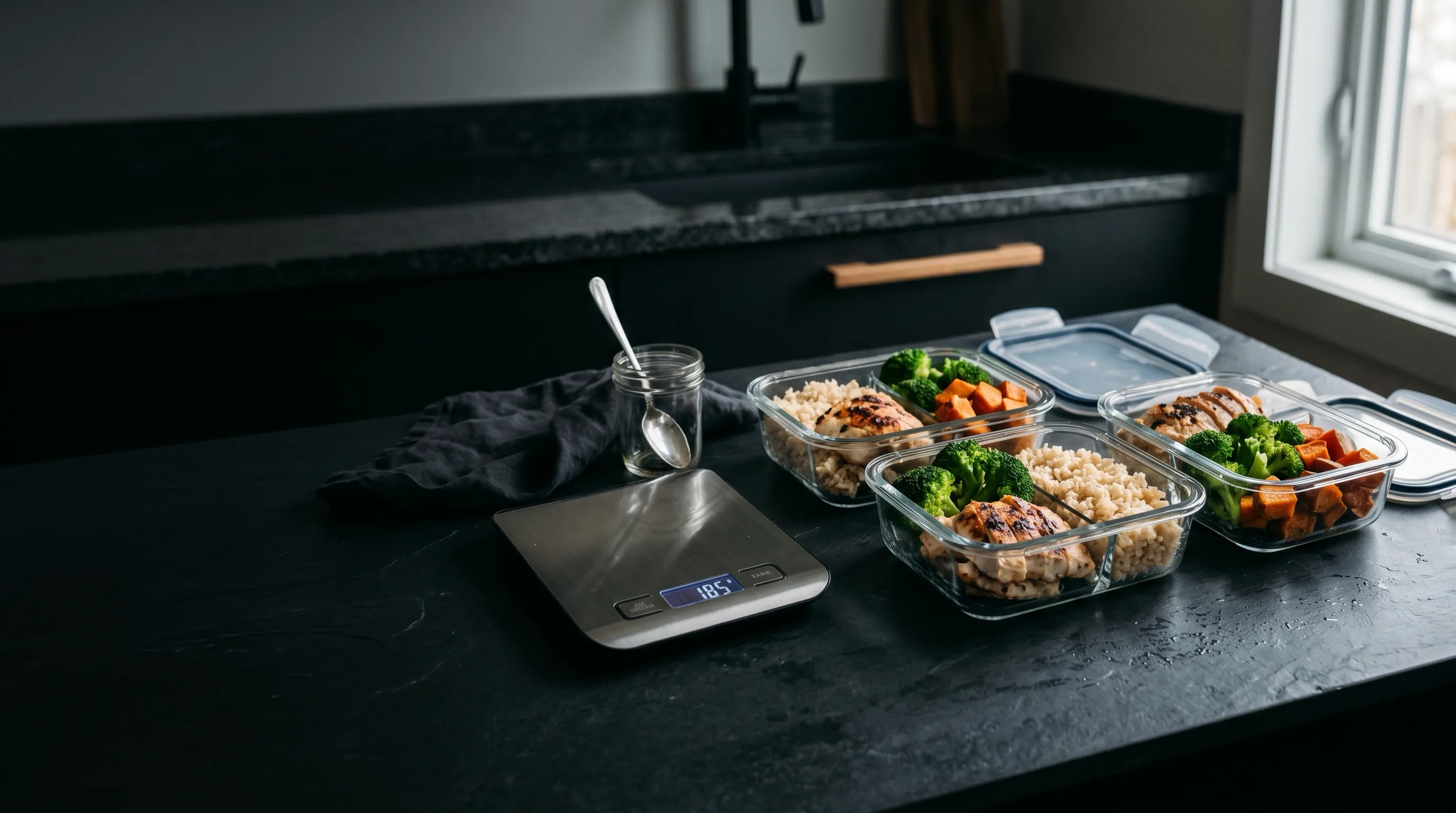
A food scale is the single most impactful tool you can buy for under $15. A landmark 1992 study in the New England Journal of Medicine found that diet-resistant obese subjects underreported their actual caloric intake by an average of 47% and overreported their physical activity by 51%.8 That is not a rounding error. That is nearly half your food intake vanishing from the record.
Eyeballing portions is not tracking. It is storytelling.
Apps that work: MyFitnessPal, Cronometer, and MacroFactor all have large food databases and barcode scanning. Pick whichever one you will actually use for more than three days.
The faster option: SensAI’s meal image analysis lets you snap a photo of your plate and get a macro estimate without manually searching a database. It is not as precise as weighing every ingredient, but it dramatically reduces the friction that causes most people to stop tracking by day five.
The 80/20 rule for sanity: Nail your protein target and total calorie number. Let carbs and fat fluctuate within reason. Chasing exact carb-to-fat ratios daily creates anxiety without meaningfully changing outcomes for most people.
Common mistakes that quietly wreck your numbers:
- Cooking oils. One tablespoon of olive oil is 120 calories. Most people add 2-3 tablespoons while cooking and never log them.
- Dry vs. cooked weight. 100 g of dry rice becomes roughly 300 g cooked. If your app says “rice, 100 g” and you weighed it cooked, you just logged one-third of what you actually ate.
- Liquid calories. A large latte with whole milk is 200+ calories. Three of those daily is a 600-calorie blind spot.
- “Just a bite.” Four bites of your partner’s dessert is a snack. Log it or accept the gap in your data.
Here is the reframe that keeps tracking sustainable: tracking is a 4-8 week skill-building phase, not a lifetime sentence. You are building caloric awareness — the ability to eyeball a plate and land within 10-15% of the real number. Once you have that skill, periodic check-ins replace daily logging.
Step 4: The Recalibration Loop — Why Static Macros Fail After 4-6 Weeks
Your body is not a calculator. It adapts. Trexler, Smith-Ryan, and Norton’s systematic review documented that metabolic adaptation — a reduction in total daily energy expenditure beyond what changes in body mass would predict — is a consistent finding across weight-loss interventions.9 Rosenbaum and Leibel’s research on the mechanisms behind this adaptation showed that both resting and non-resting energy expenditure drop below predicted levels after weight loss, driven by coordinated neuroendocrine, autonomic, and behavioral responses designed to defend stored body fat.10
Think of it like a thermostat. You turn down the heat (eat less), and your body quietly adjusts its own thermostat to compensate. The macros that created a deficit in week two may be maintenance by week six.
This is why the recalibration loop exists.
How to run it:
-
Weigh daily, use the weekly average. Daily weight fluctuates by 1-3 lbs from water, sodium, and digestion. The weekly average smooths the noise. Compare two-week averages to spot real trends.
-
Compare your trend to your expected rate. For fat loss, the evidence-based ceiling is 0.5-1% of bodyweight per week to maximize lean mass retention.11 Faster than that, and the percentage of weight lost from muscle increases significantly.
-
Check your recovery signals. Heart rate variability, resting heart rate, and sleep quality are early-warning systems. If HRV is trending down and resting heart rate is trending up while you are in a caloric deficit, your body may be telling you something your scale cannot.
-
Weight stalled + recovery fine: Reduce calories by 5-10% (typically by trimming carbs or fat, not protein) or increase activity slightly.
-
Weight stalled + recovery declining: You may be underfueling, not under-exercising. This pattern — stalled progress plus deteriorating recovery markers — can signal relative energy deficiency in sport (RED-S). See our underfueling vs. overtraining guide before cutting calories further.
SensAI turns recovery context from Apple Watch and, through HealthKit, Garmin, Oura, and WHOOP into daily recovery and readiness summaries. Declining HRV or disrupted sleep can be reasons to pause before cutting calories further, but those signals cannot tell you by themselves whether a plateau comes from metabolic adaptation, underfueling, illness, stress, or something else. Use them as context, not a diagnosis.
Common Macro Mistakes
Eating back wearable calories. Your watch says you burned 600 calories on a run. You did not. Wearable calorie estimates carry 27-93% error.2 Eating back every calorie your watch reports will erase your deficit most days.
Protein too low. The most common macro mistake is also the simplest to diagnose. If you are eating less than 1.4 g/kg/day, your protein is too low for body composition goals regardless of everything else.3
Rigid daily targets instead of weekly averages. A Thursday where you hit 180 g protein and a Friday where you hit 120 g averages to 150 g. If your target is 150, that weekly average is fine. Obsessing over daily precision creates a brittle system that breaks the first time you eat out.
Never recalibrating. The macros you calculated in January are not the macros you need in March. Your body changed. Your TDEE changed. Your macros should change too.
Ignoring context. Poor sleep increases ghrelin (hunger) and decreases leptin (satiety). Chronic stress elevates cortisol, which promotes fat storage and water retention. Menstrual cycle phases shift water weight and appetite. If you are stalled and your macros look right on paper, look at everything else before cutting food further.
When Macros Meet Real Life
Restaurant strategy: Prioritize protein. Order a protein-heavy entree (grilled chicken, fish, steak), ask for sauce on the side, and accept that the carb and fat numbers will be approximate. Log your best estimate. An 80%-accurate log is infinitely more useful than no log.
Travel: Default to “minimum viable tracking.” Track protein only. Hit your protein target, eat roughly the right amount of food overall, and do not spiral about the rest. Two weeks of protein-only tracking during a trip will preserve most of your progress.
The “bad day” protocol: If you cannot track at all — a wedding, a holiday, a day where you just do not want to — eat a palm-sized portion of protein at every meal and move on. One untracked day does not undo four weeks of consistency. SensAI’s meal image analysis works well here too — snap a quick photo of your restaurant plate and get a rough macro breakdown without searching databases on your phone at the table.
Your First 30 Days
Days 1-3: Calculate and observe. Run your TDEE calculation. Set your macro targets. But only track protein. Eat normally otherwise. You are building the habit of noticing, not optimizing yet.
Days 4-7: Add total calories. Now track protein and total calorie intake. Still do not obsess over carb/fat split. Two variables is enough.
Week 2: Track all three macros. Weigh food at home. Use a food scale for anything you prepare yourself. Get comfortable with the process before worrying about perfection.
Weeks 3-4: Review and assess. Compare your two-week weight trend to your goal. Check your recovery data — HRV, resting heart rate, sleep. Is your weight moving in the right direction? Is your recovery stable?
Day 28: First recalibration checkpoint. Run the recalibration loop from Step 4. Adjust if needed. Congratulate yourself on four weeks of data — you now know more about how your body responds to food than most people ever will.
After 8 weeks: Consider transitioning to intuitive eating with periodic check-ins. The point of tracking was never to track forever. It was to build the awareness that makes intuitive eating actually work. A week of tracking every 2-3 months keeps your calibration sharp without turning food into a spreadsheet.
SensAI can bring the macros you share, your training load, and your recovery context into the same coaching conversation. When your weight stalls at week six, the coach can help you review changes in intake, adherence, training, sleep, and stress; it does not infer a single cause from recovery data. That context is what turns macro counting from a numbers game into a more informed adjustment process.
For more on how nutrition intersects with body composition, see our guide on body recomposition. And if you are considering time-restricted eating alongside macro tracking, our intermittent fasting and performance guide covers the tradeoffs.
References
Footnotes
-
Frankenfield D, Roth-Yousey L, Compher C. “Comparison of predictive equations for resting metabolic rate in healthy nonobese and obese adults: a systematic review.” Journal of the American Dietetic Association, 2005. https://pubmed.ncbi.nlm.nih.gov/15883556/ ↩
-
Shcherbina A, Mattsson CM, Waggott D, et al. “Accuracy in Wrist-Worn, Sensor-Based Measurements of Heart Rate and Energy Expenditure in a Diverse Cohort.” Journal of Personalized Medicine, 2017. https://www.mdpi.com/2075-4426/7/2/3 ↩ ↩2
-
Jäger R, Kerksick CM, Campbell BI, et al. “International Society of Sports Nutrition Position Stand: protein and exercise.” Journal of the International Society of Sports Nutrition, 2017. https://pubmed.ncbi.nlm.nih.gov/28642676/ ↩ ↩2
-
Morton RW, Murphy KT, McKellar SR, et al. “A systematic review, meta-analysis and meta-regression of the effect of protein supplementation on resistance training-induced gains in muscle mass and strength in healthy adults.” British Journal of Sports Medicine, 2018. https://pubmed.ncbi.nlm.nih.gov/28698222/ ↩
-
Lou Y, Wang H, Wang L, Huang S, Xie Y, Song F, Lu Z, Wang F, Jiang Q, Cao S. “Comparison with Dietary Groups of Various Macronutrient Ratios on Body Weight and Cardiovascular Risk Factors in Adults: A Systematic Review and Network Meta-Analysis.” Nutrients, 2025; 17(16):2683. https://www.mdpi.com/2072-6643/17/16/2683 ↩
-
Schoenfeld BJ, Aragon AA. “How much protein can the body use in a single meal for muscle-building? Implications for daily protein distribution.” Journal of the International Society of Sports Nutrition, 2018. https://pubmed.ncbi.nlm.nih.gov/29497353/ ↩
-
Mamerow MM, Mettler JA, English KL, et al. “Dietary protein distribution positively influences 24-h muscle protein synthesis in healthy adults.” Journal of Nutrition, 2014. https://pubmed.ncbi.nlm.nih.gov/24477298/ ↩
-
Lichtman SW, Pisarska K, Berman ER, et al. “Discrepancy between self-reported and actual caloric intake and exercise in obese subjects.” New England Journal of Medicine, 1992. https://pubmed.ncbi.nlm.nih.gov/1454084/ ↩
-
Trexler ET, Smith-Ryan AE, Norton LE. “Metabolic adaptation to weight loss: implications for the athlete.” Journal of the International Society of Sports Nutrition, 2014. https://pubmed.ncbi.nlm.nih.gov/24571926/ ↩
-
Rosenbaum M, Leibel RL. “Adaptive thermogenesis in humans.” International Journal of Obesity, 2010. https://pubmed.ncbi.nlm.nih.gov/20935667/ ↩
-
Helms ER, Aragon AA, Fitschen PJ. “Evidence-based recommendations for natural bodybuilding contest preparation: nutrition and supplementation.” Journal of the International Society of Sports Nutrition, 2014. https://pubmed.ncbi.nlm.nih.gov/24864135/ ↩