How Much Protein Do You Need to Build Muscle? A Daily Target Guide Backed by Research
A practical daily protein target for building muscle — by bodyweight, goal, and life stage. The estimated point of diminishing returns, per-meal targets, plant vs. animal quality, and common myths reviewed with citations.

SensAI Team
14 min read
Get a training plan that adapts to your recovery — free on iOS

How Much Protein Do You Need to Build Muscle?
The gym has been arguing about this for decades, and the two loudest answers are a full doubling apart.
The bodybuilder in the corner says one gram per pound of bodyweight — non-negotiable. The adult recommended dietary allowance (RDA) is 0.8 grams per kilogram per day, which for a 180-pound lifter is barely a third of that. One camp is chugging shakes; the other is convinced protein is overhyped.
For most people who train regularly, a practical muscle-building target sits in between: about 1.6 grams of protein per kilogram of bodyweight per day — roughly 0.7 grams per pound — with diminishing average benefit beyond that estimated point.1
That’s the headline. But the useful target can shift if you’re cutting weight, older, or eating mostly plants. This guide gives you a practical starting point for each situation, then explains the evidence and uncertainty behind it.
The Short Answer: Your Daily Protein Target by Bodyweight
For building muscle, aim for 1.6 grams of protein per kilogram of bodyweight per day — about 0.7 grams per pound.
That figure isn’t just a gym heuristic. It comes from a 2018 systematic review and meta-regression in the British Journal of Sports Medicine that pooled 49 studies and 1,863 participants.1 When the researchers modeled muscle gains against protein intake, the estimated breakpoint — a population-level point of diminishing returns, not an individual cutoff — landed at roughly 1.6 g/kg/day.
Stuart Phillips, PhD, Professor of Kinesiology at McMaster University and the senior author of that analysis, has spent a career studying this dose-response relationship. The practical reframing is that more is not always better and about 1.6 g/kg/day is a useful target for many lifters, not a universal prescription.
That doesn’t mean 1.6 is a hard wall. It’s an estimated point of diminishing returns, and there’s individual variation around it. The International Society of Sports Nutrition puts the practical range at 1.4 to 2.0 g/kg/day for people building muscle or trying to hold onto it.2 Healthy adults can choose a target within that studied range based on preference, appetite, and goals without assuming the top end will produce more growth.
Two more recent reviews back up the same neighborhood. A 2020 meta-analysis by Tagawa and colleagues in Nutrition Reviews found muscle gains rising with protein up to a plateau in the same 1.5–1.6 g/kg region.3 A 2022 meta-analysis led by Nunes reached the same practical conclusion for healthy adults.4
Here’s what that means in real numbers. Find your weight, and you have your daily target:
| Bodyweight | Target (1.6 g/kg) | Upper end (2.0 g/kg) |
|---|---|---|
| 60 kg (132 lb) | 96 g/day | 120 g/day |
| 70 kg (154 lb) | 112 g/day | 140 g/day |
| 80 kg (176 lb) | 128 g/day | 160 g/day |
| 90 kg (198 lb) | 144 g/day | 180 g/day |
| 100 kg (220 lb) | 160 g/day | 200 g/day |
Pin down one number and everything else in this article is just fine-tuning. Total daily protein is the big rock. Per-meal splits, timing, and source quality are pebbles that only matter once the rock is in place.
Getting the rock right is also where personal context earns its keep. Instead of relying only on a generic table, you can tell an LLM-based coach like SensAI your bodyweight, training goal, and whether you’re bulking or cutting, then discuss a practical daily target. SensAI can also analyze a meal photo you choose to share, but it does not automatically log intake or verify that you hit a daily gram target.
Is 1 Gram of Protein Per Pound Enough? (Yes — And Probably More Than You Need)
One gram of protein per pound of bodyweight is a reasonable muscle-building target, but it sits above the estimated point of diminishing returns for many people.
Do the conversion and the bodybuilder’s rule of thumb comes out to about 2.2 g/kg — above the estimated 1.6 g/kg/day breakpoint in the meta-regression.1 So the classic “gram per pound” advice isn’t wrong, exactly. It simply builds in a margin that many lifters may not need.
Is that a problem? In healthy adults, higher-protein diets within the studied ranges have not shown adverse changes in kidney function, although they have not reliably produced additional hypertrophy beyond an adequate intake either.5 People with kidney disease or clinician-directed protein restrictions need individualized medical guidance.
Protein is the most satiating macronutrient, so a higher target keeps you fuller. It also has the highest thermic effect — your body burns more calories digesting it than it does fat or carbs. And “one gram per pound” is dead simple to remember and track, which is worth something.
There’s also a subtlety worth knowing: for someone carrying a lot of body fat, targets scale better to a leaner reference weight than to total scale weight. A 250-pound person with significant fat to lose doesn’t need 250 grams of protein — fat tissue isn’t metabolically demanding the way muscle is. Basing the target on goal bodyweight or lean mass keeps the number sane. This is exactly where the “gram per pound” rule can overshoot for heavier beginners.
The honest framing: 1 g/lb is a fine target if you like the simplicity, especially when you’re dieting and appetite control matters. It’s just not a requirement. For many healthy lifters, 0.7 to 1 gram per pound of a reasonable reference weight falls within a practical muscle-building range.
How Much Protein Per Meal? Spreading It Across the Day
Aim for roughly 0.4 grams of protein per kilogram of bodyweight per meal, across three to four meals — that’s how you turn a daily total into a steady muscle-building signal.
Muscle protein synthesis works in pulses, not as a running total. Each meal with enough protein flips the switch on; between meals, it idles. So the goal isn’t just to hit a daily number — it’s to trigger that switch several times a day.
Brad Schoenfeld, PhD, CSCS, Professor of exercise science at Lehman College (CUNY) and one of the most-cited researchers in resistance training, ran the numbers on this. His 2018 review with Alan Aragon recommends about 0.4 g/kg per meal, spread across at least four meals, to maximize the daily anabolic response.6 For an 80 kg lifter, that’s roughly 32 grams per meal — four times a day.
There’s a floor to how much each meal needs. Research by Oliver Witard and colleagues found that muscle protein synthesis climbs as you increase a single dose up to about 20 grams of high-quality protein — around 0.25 g/kg — after which the response largely plateaus for a young adult.7 Below that, you’re under-firing the signal.
The key inside that dose is an amino acid called leucine, the trigger that actually flips the synthesis switch. You want roughly 2.5 to 3 grams of leucine per meal to get a full response — which is what about 20–25 grams of a quality protein delivers.
Distribution matters more than most people think. A 2014 study by Mamerow and colleagues in The Journal of Nutrition fed people the same daily protein two ways — spread evenly across three meals, or skewed toward dinner. The even split produced 25% greater 24-hour muscle protein synthesis.8 Same total, better result, just from spacing it out.
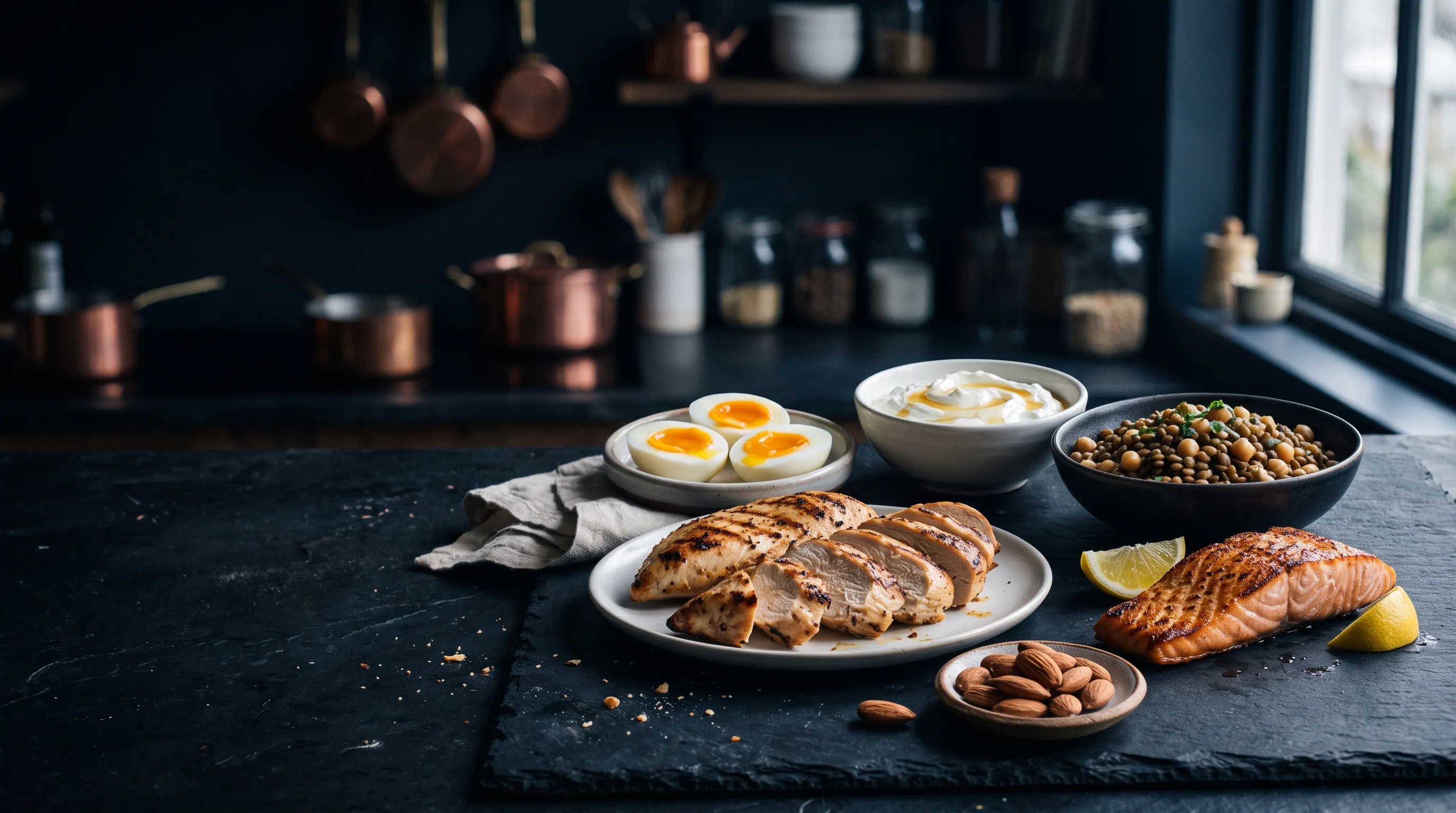
Here’s what a per-meal target looks like on a plate, with the approximate leucine each source delivers:
| Food (single serving) | Protein | Approx. leucine |
|---|---|---|
| Whey protein, 1 scoop | ~25 g | ~2.7 g |
| Chicken breast, 4 oz cooked | ~35 g | ~2.6 g |
| Greek yogurt, 1 cup nonfat | ~23 g | ~2.3 g |
| Eggs, 3 large | ~18 g | ~1.5 g |
| Lentils, 1.5 cups cooked | ~27 g | ~1.9 g |
Notice the eggs. Three of them are a real serving of protein but fall short of the leucine threshold on their own — which is why they work better alongside another source than as a standalone “protein meal.”
If eyeballing grams per meal sounds tedious, you can share a photo of your plate with SensAI’s AI coach and discuss the protein sources and portion sizes you provided. Treat that conversation as guidance, not a verified intake log or medical nutrition assessment. For the deeper logic on when — fasted training, pre-sleep, two-a-days — the evidence-based guide to protein timing around workouts breaks it down scenario by scenario.
How Much Protein When Cutting (In a Calorie Deficit)?
When you’re lean and dieting, push protein up to 2.3 to 3.1 grams per kilogram of fat-free mass — noticeably higher than your maintenance target.
A calorie deficit is when muscle is most at risk. Your body is short on energy, muscle protein synthesis dips, and breakdown creeps up. Extra protein is the counterweight — it defends the muscle you already have while you lose fat.
Eric Helms, PhD, of the Sports Performance Research Institute New Zealand (AUT), reviewed the evidence on lean, resistance-trained athletes cutting weight and arrived at that 2.3–3.1 g/kg of fat-free mass range.9 The leaner and more experienced you are, the higher in the band you should sit — you have less fat to burn and more muscle to protect.
The clearest demonstration comes from a 2016 trial by Longland and colleagues in the American Journal of Clinical Nutrition. Young men ran a steep calorie deficit alongside hard training for four weeks, split into a higher-protein group at 2.4 g/kg and a lower-protein group at 1.2 g/kg.10 The higher-protein group gained about 1.2 kg of lean mass while losing more fat. The lower-protein group barely held its muscle. Same deficit, same workouts — protein made the difference between recomposing and just shrinking.
This is the exact scenario the body recomposition playbook is built around: losing fat and building muscle at once hinges on keeping protein high while calories run low. And before you set the target, it helps to know your actual deficit — the calorie guide walks through finding your maintenance and cutting numbers.
A cut is also where recovery context can help you manage training. SensAI can summarize trends in sleep, HRV, and performance and use aggregated recovery metrics when it regenerates your weekly program. Those signals are not a diagnosis of low protein or inadequate food; nutrition intake still has to be assessed from what you actually eat and, when appropriate, with a qualified clinician or dietitian.
Do Older Adults Need More Protein to Build Muscle?
Older adults may need roughly 0.4 g/kg per meal; active older adults can use 1.6 g/kg/day as a practical muscle-building target.
The phenomenon is called anabolic resistance. As you age, the same dose of protein that lit up a 25-year-old’s muscle produces a weaker response. The switch still works — it just takes a firmer press.
Daniel Moore and colleagues quantified the shift in a 2015 study in The Journals of Gerontology. Younger men maximized muscle protein synthesis at about 0.24 g/kg per meal; older men needed roughly 0.40 g/kg to hit the same peak.11 The per-meal requirement climbs with age even when the daily target looks similar.
The mechanism was mapped by Benjamin Wall and colleagues in a 2015 paper in PLOS ONE, which showed that older muscle mounts a blunted synthetic response to protein — the anabolic signal simply registers less strongly than it did decades earlier.12 A practical response is a higher per-meal dose, adjusted for body size and any clinician-directed medical needs.
That’s why the PROT-AGE expert group, in a 2013 position paper, recommended a general baseline of 1.0–1.2 g/kg/day for healthy older adults — and more for those who train.13 Keep that general-health baseline distinct from a lifter’s practical muscle-building target: an active older adult can start around 1.6 g/kg/day, with roughly 0.4 g/kg per meal, and adjust with qualified guidance when medical needs apply.
Age is one factor to consider when choosing a target, and it’s the kind of context a generic calculator ignores. You can give an LLM-based coach like SensAI your age, goals, and preferences and discuss an appropriate starting point, but recovery data cannot diagnose anabolic resistance or determine a nutrition prescription. The same need to individualize training runs through the full guide on how to build muscle at any age.
Does Protein Quality Matter? Plant vs. Animal (DIAAS)
Protein quality can matter per gram, but resistance-training outcomes depend on the whole diet. In one trial, habitual vegans and omnivores achieved similar gains when both groups consumed 1.6 g/kg/day.
Quality is measured by a score called DIAAS (Digestible Indispensable Amino Acid Score), which is basically a grade for how well a protein’s amino acids get digested and absorbed. A score of 1.0 means the protein delivers a full complement of what your muscles need; below 1.0 means it falls a little short on one or more amino acids.
Here’s how common sources stack up:
| Protein source | Approx. DIAAS |
|---|---|
| Whey / dairy | ≥ 1.0 |
| Soy | ~0.9 |
| Pea / legumes | ~0.6–0.8 |
| Wheat | ~0.4 |
Those values come from digestibility research including a 2020 analysis by Herreman and colleagues that scored plant and animal proteins head to head.14 Stephan van Vliet and colleagues explained the why in a 2015 review: plant proteins tend to be lower in leucine and other key amino acids and are digested slightly less completely, so gram for gram they produce a somewhat smaller muscle-building signal.15
But — and this is the part that matters — a whole diet can narrow that per-gram gap. A 2021 study by Hevia-Larraín and colleagues in Sports Medicine put habitual vegans and omnivores through the same resistance-training program with protein matched at 1.6 g/kg/day; within that study population and matched intake, muscle and strength gains were similar.16
Practical options for plant eaters include aiming toward the higher end of the total-protein range, eating a variety of legumes, grains, and soy foods, and using pea or soy protein isolates when convenient. These strategies can make adequate protein and leucine easier to reach; they are options, not a guarantee that every diet or person will respond identically.
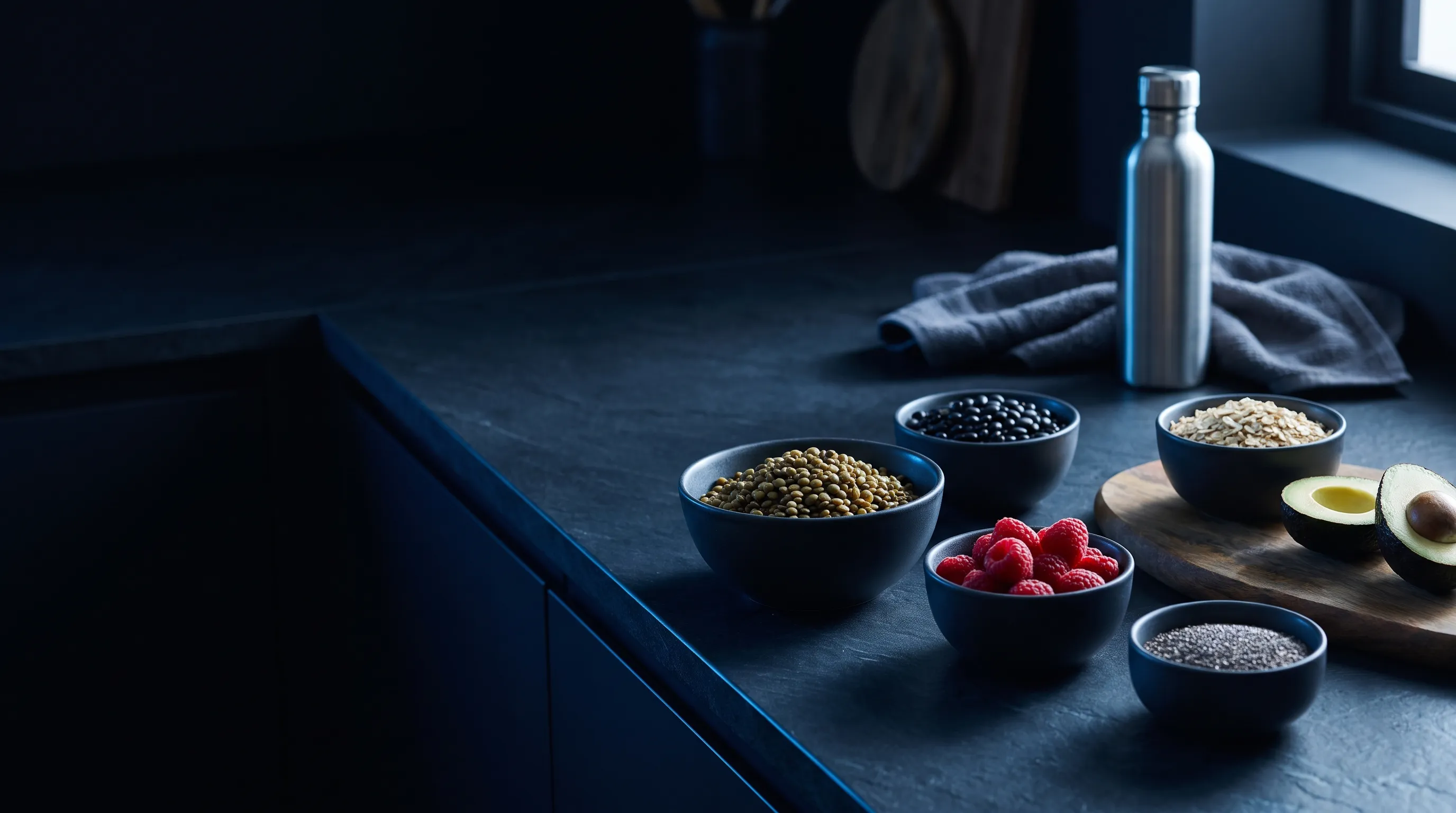
Leucine is one amino acid plant eaters may want to consider because many grains and legumes provide less per gram than dairy protein. Soy and pea isolates can be convenient higher-leucine options. The trial above supports matched high-protein diets in habitual vegans and omnivores; it does not prove that source variety alone erases every difference for every person.
The Protein Myths, Debunked
Myth 1: High protein always damages your kidneys. In healthy adults, higher-protein diets within the studied ranges have not shown adverse changes in kidney function. A 2018 systematic review and meta-analysis by Devries and colleagues in The Journal of Nutrition found no meaningful difference in glomerular filtration rate between higher- and lower- or normal-protein diets.5 People with kidney disease or clinician-directed protein restrictions need individualized medical guidance.
Myth 2: Your body can only use 30 grams of protein per meal. There’s no hard cap. Schoenfeld and Aragon addressed this directly: while the muscle-building response to a single meal plateaus around 0.4 g/kg, protein above that isn’t “wasted” — it’s still digested and used for other functions throughout the body.6 Eating 50 grams in one sitting doesn’t flush 20 grams down the drain. Spreading protein out optimizes muscle synthesis, but the “30-gram ceiling” as a rule is a myth.
Myth 3: More protein is always better. It isn’t — the average returns diminish once intake is adequate. The meta-regression estimated a breakpoint around 1.6 g/kg/day, with uncertainty and individual variation around it.1 In a crossover trial by Jose Antonio and colleagues, resistance-trained men eating a very high protein intake did not gain more muscle or fat than they did on their normal intake.17 Beyond an adequate intake, additional protein is unlikely to add measurable hypertrophy and still contributes energy and other physiological functions.
Putting It Together: Your Number, Every Day
Here’s the whole guide compressed into a single decision path.
- Start at 1.6 g/kg/day (about 0.7 g/lb). This is your muscle-building baseline and the biggest lever by far.
- Cutting weight? Raise it to 2.3–3.1 g/kg of fat-free mass — the leaner you are, the higher you go.
- Active and over 50? Use 1.6 g/kg/day as a practical target and aim for roughly 0.4 g/kg per meal.
- Distribute it: roughly 0.4 g/kg per meal across three to four meals, each hitting ~2.5–3 grams of leucine.
- Plant-based? Aim toward the top of your range and diversify your sources.
Every one of those adjustments is really the same move: taking a general research target and fitting it to your body, goal, and stage of life. A static calculator only gets you partway. You can discuss your own goal and meal photos with SensAI, while weekly training regeneration uses logged performance and aggregated recovery context; the app does not automatically track nutrition intake or change a daily protein prescription for you.
Choose a practical daily target first. Then, if you want to go deeper on turning grams into a full nutrition plan, the beginner’s guide to counting macros shows how protein fits alongside carbs and fat. Consistent protein supports the training stimulus; it does not replace progressive resistance training, adequate energy, sleep, or individual medical advice.
References
Footnotes
-
Morton RW, Murphy KT, McKellar SR, et al. “A systematic review, meta-analysis and meta-regression of the effect of protein supplementation on resistance training-induced gains in muscle mass and strength in healthy adults.” British Journal of Sports Medicine. 2018;52(6):376-384. https://pubmed.ncbi.nlm.nih.gov/28698222/ ↩ ↩2 ↩3 ↩4
-
Jäger R, Kerksick CM, Campbell BI, et al. “International Society of Sports Nutrition Position Stand: protein and exercise.” Journal of the International Society of Sports Nutrition. 2017;14:20. https://jissn.biomedcentral.com/articles/10.1186/s12970-017-0177-8 ↩
-
Tagawa R, Watanabe D, Ito K, et al. “Dose-response relationship between protein intake and muscle mass increase: a systematic review and meta-analysis of randomized controlled trials.” Nutrition Reviews. 2020;79(1):66-75. https://pubmed.ncbi.nlm.nih.gov/33300582/ ↩
-
Nunes EA, Colenso-Semple L, McKellar SR, et al. “Systematic review and meta-analysis of protein intake to support muscle mass and function in healthy adults.” Journal of Cachexia, Sarcopenia and Muscle. 2022;13(2):795-810. https://pubmed.ncbi.nlm.nih.gov/35187864/ ↩
-
Devries MC, Sithamparapillai A, Brimble KS, et al. “Changes in Kidney Function Do Not Differ between Healthy Adults Consuming Higher- Compared with Lower- or Normal-Protein Diets: A Systematic Review and Meta-Analysis.” The Journal of Nutrition. 2018;148(11):1760-1775. https://pubmed.ncbi.nlm.nih.gov/30383278/ ↩ ↩2
-
Schoenfeld BJ, Aragon AA. “How much protein can the body use in a single meal for muscle-building? Implications for daily protein distribution.” Journal of the International Society of Sports Nutrition. 2018;15:10. https://jissn.biomedcentral.com/articles/10.1186/s12970-018-0215-1 ↩ ↩2
-
Witard OC, Jackman SR, Breen L, et al. “Myofibrillar muscle protein synthesis rates subsequent to a meal in response to increasing doses of whey protein at rest and after resistance exercise.” American Journal of Clinical Nutrition. 2014;99(1):86-95. https://pubmed.ncbi.nlm.nih.gov/24257722/ ↩
-
Mamerow MM, Mettler JA, English KL, et al. “Dietary Protein Distribution Positively Influences 24-h Muscle Protein Synthesis in Healthy Adults.” The Journal of Nutrition. 2014;144(6):876-880. https://academic.oup.com/jn/article/144/6/876/4589929 ↩
-
Helms ER, Zinn C, Rowlands DS, Brown SR. “A systematic review of dietary protein during caloric restriction in resistance trained lean athletes: a case for higher intakes.” International Journal of Sport Nutrition and Exercise Metabolism. 2014;24(2):127-138. https://pubmed.ncbi.nlm.nih.gov/24092765/ ↩
-
Longland TM, Oikawa SY, Mitchell CJ, Devries MC, Phillips SM. “Higher compared with lower dietary protein during an energy deficit combined with intense exercise promotes greater lean mass gain and fat mass loss: a randomized trial.” American Journal of Clinical Nutrition. 2016;103(3):738-746. https://pubmed.ncbi.nlm.nih.gov/26817506/ ↩
-
Moore DR, Churchward-Venne TA, Witard O, et al. “Protein ingestion to stimulate myofibrillar protein synthesis requires greater relative protein intakes in healthy older versus younger men.” The Journals of Gerontology: Series A. 2015;70(1):57-62. https://pubmed.ncbi.nlm.nih.gov/25056502/ ↩
-
Wall BT, Gorissen SH, Pennings B, et al. “Aging Is Accompanied by a Blunted Muscle Protein Synthetic Response to Protein Ingestion.” PLOS ONE. 2015;10(11):e0140903. https://journals.plos.org/plosone/article?id=10.1371/journal.pone.0140903 ↩
-
Bauer J, Biolo G, Cederholm T, et al. “Evidence-based recommendations for optimal dietary protein intake in older people: a position paper from the PROT-AGE Study Group.” Journal of the American Medical Directors Association. 2013;14(8):542-559. https://pubmed.ncbi.nlm.nih.gov/23867520/ ↩
-
Herreman L, Nommensen P, Pennings B, Laus MC. “Comprehensive overview of the quality of plant- and animal-sourced proteins based on the digestible indispensable amino acid score.” Food Science & Nutrition. 2020;8(10):5379-5391. https://pubmed.ncbi.nlm.nih.gov/33133540/ ↩
-
van Vliet S, Burd NA, van Loon LJ. “The Skeletal Muscle Anabolic Response to Plant- versus Animal-Based Protein Consumption.” The Journal of Nutrition. 2015;145(9):1981-1991. https://pubmed.ncbi.nlm.nih.gov/26224750/ ↩
-
Hevia-Larraín V, Gualano B, Longobardi I, et al. “High-Protein Plant-Based Diet Versus a Protein-Matched Omnivorous Diet to Support Resistance Training Adaptations: A Comparison Between Habitual Vegans and Omnivores.” Sports Medicine. 2021;51(6):1317-1330. https://pubmed.ncbi.nlm.nih.gov/33599941/ ↩
-
Antonio J, Ellerbroek A, Silver T, et al. “The effects of a high protein diet on indices of health and body composition — a crossover trial in resistance-trained men.” Journal of the International Society of Sports Nutrition. 2016;13:3. https://pubmed.ncbi.nlm.nih.gov/26778925/ ↩