Kettlebell Training for Beginners: Swings, Goblet Squats, and Full-Body Strength
What weight to start with, how to swing safely, and a simple progression from deadlift to goblet squat to swing to press. An evidence-based beginner kettlebell guide.

SensAI Team
13 min read
Get a training plan that adapts to your recovery — free on iOS

Kettlebell Training for Beginners: Swings, Goblet Squats, and Full-Body Strength
One cast-iron ball with a handle, sitting in the corner of your apartment, can train strength and conditioning in the same set. That is the entire pitch — and it is a real one.
The reason isn’t magic. It’s geometry. And once you understand the geometry, the whole practice makes sense: which weight to buy, why the swing feels nothing like a dumbbell exercise, and why your hips should drive the movement while your lower back stays braced and controlled.
This guide walks the whole chain. What makes a kettlebell different, what weight to start with, the one movement pattern you have to own first, the four exercises to learn in order, how to program them, and how to know your swing is actually right.
What Makes a Kettlebell Different — and the Benefits of Training With a Single Bell
Is a kettlebell worth it, or should you just buy dumbbells? For most beginners chasing full-body strength and conditioning in a small space, the kettlebell wins — and the reason is where the weight sits.
A dumbbell’s mass is balanced in your hand. A kettlebell’s center of mass hangs below and outside the handle. That offset is the whole story: it lets you swing the bell ballistically, which loads your posterior chain — glutes, hamstrings, back — while spiking your heart rate at the same time.
So one set of swings is strength work and cardio at once. That’s the time-efficiency case in a single sentence.
The research backs the conditioning half of that claim. When researchers compared a 10-minute bout of two-hand kettlebell swings against graded treadmill walking, the swings drove oxygen consumption and heart rate into a genuine cardiorespiratory training zone — enough to count as aerobic exercise, not just strength work.1 A comprehensive 2024 review of kettlebell training reached the same conclusion across the literature: continuous swinging sits around 87% of maximal heart rate and 65% of maximal oxygen uptake, comfortably inside the range that builds aerobic capacity.2
The strength half is just as real. The swing is a hip-hinge movement done explosively, which means it trains the pattern most lifters quietly skip — the one that powers deadlifts, sprints, and picking your kid up off the floor without your back filing a complaint.
A dumbbell can’t replicate that. You can’t safely throw a dumbbell around by its handle the way the kettlebell’s offset load is built for. We’ll settle the buy-one decision properly later — for now, just know the difference is structural, not marketing.
What Weight Kettlebell Should a Beginner Start With?
Starting weights are estimates, not safety rules. Choose a bell you can deadlift with a neutral spine, control in the rack position, and stop without losing balance. Training history, current strength, mobility, pain, and access to coaching matter more than sex alone.
Many adults begin swings somewhere between 8 and 16 kg (18 to 35 lb), while older, deconditioned, or completely new trainees may need 4 to 8 kg (9 to 18 lb). A bell that is too heavy can pull you out of position; one that is too light may make it easier to turn the swing into an arm lift. Neither teaches technique by itself. Learn the hinge first, then choose the lightest load that lets you practice it with control.
There’s an important split between two kinds of movements. Ballistics — the swing — are powered by a violent hip snap, so they tolerate (and want) a heavier bell. Grinds — the goblet squat and the press — move slowly under control, so you start them lighter. Don’t pick one weight for everything.
Here’s where to start:
| Experience and control | Ballistic (swing) | Grind (goblet squat / press) |
|---|---|---|
| New to resistance training or deconditioned | 4–8 kg (9–18 lb) | 4–6 kg (9–13 lb) |
| Some resistance-training experience | 8–12 kg (18–26 lb) | 6–8 kg (13–18 lb) |
| Strong beginner with a controlled hinge | 12–16 kg (26–35 lb) | 8–12 kg (18–26 lb) |
The familiar 16 kg / 8 kg starting standard comes from the hardstyle coaching convention popularized by Pavel Tsatsouline.3 It is a coaching convention, not a lab finding or a universal prescription. Use the ranges above as options, then let control and symptom-free technique decide.
You only need one bell to begin. A single well-chosen kettlebell covers the entire beginner progression below.
SensAI can generate a beginner program around the bell weight you enter, your goals, training history, schedule, and constraints. It tracks planned versus completed work and uses your performance and recovery context when regenerating the next weekly program. It does not judge whether a set was technically clean or increase the bell automatically; you can log what happened and discuss progression with the coach.
The Hip Hinge: The One Pattern You Must Own First
Before you swing anything, own the hip hinge: hips travel backward, knees bend only slightly, the glutes and hamstrings drive the movement, and the lower back stays braced rather than becoming the main mover.
Here’s the distinction that trips up almost everyone. A squat is a knee-dominant movement — you sit down between your hips. A hinge is a hip-dominant movement — you push your hips back behind you, like closing a car door with your butt when your hands are full. Same upright torso, totally different mechanics.
This matters because the hinge is the engine of every ballistic kettlebell movement. Dr. Stuart McGill, Professor Emeritus of spine biomechanics at the University of Waterloo, measured strong gluteal activation alongside lumbar motion and loading during kettlebell exercises.4 That biomechanical work supports keeping the movement hip-driven and the spine controlled, but it does not establish that one visible fault predicts an injury.
Groove the pattern unloaded first, with no bell in your hands:
- Wall hinge taps. Stand a foot from a wall, feet hip-width. Push your hips straight back until your butt taps the wall, keeping a soft knee bend and a long, neutral spine. Stand tall by squeezing your glutes. Step farther out each rep until it’s a real reach.
- Dowel hinge (three points of contact). Hold a broomstick vertically against your back so it touches the back of your head, your upper back, and your tailbone. Hinge while keeping all three points pressed against the stick. If any point lifts off, your spine is bending — reset.
- The hike pass. Sit a bell a foot in front of you, hinge, grab the handle, and “hike” it back between your legs like a football snap, then stand and let it settle. This is the swing’s setup, learned without the swing.
Keep your spine neutral, your lats “packed” (think of squeezing oranges in your armpits), and brace your core as if you’re about to be poked in the stomach. Breathe out sharply at the top of each rep.
If you want a deeper primer on bracing and neutral-spine mechanics before you load anything, our exercise form and safety guide covers the foundations.
The Beginner Progression: 4 Movements in Order
Learn these four movements in this exact order, because each one teaches the skill the next one needs. The deadlift teaches the hinge under load; the goblet squat teaches bracing; the swing makes the hinge explosive; the press adds overhead control.
1. Kettlebell Deadlift — Teaches the Hinge Under Load
The deadlift is the hinge with a brake on it — slow, controlled, and the safest way to feel your glutes and hamstrings take a load.
- Setup: Bell on the floor, handle between the arches of your feet (not out in front). Feet hip-width.
- Execution: Hinge — hips back, soft knees — grip the handle, brace, then stand up by driving your hips forward and squeezing your glutes. Lower under control by hinging back.
- Common errors: Rounding the lower back to reach the bell; turning it into a squat by dropping your hips and bending your knees too much.
- Advance when: You can complete clean reps with a flat back and feel the work in your glutes and hamstrings, not your lower back.
If the squat-versus-hinge distinction is still fuzzy, our guide to the squat lays out the knee-dominant pattern side by side with the hinge.
2. Goblet Squat — Upright, Braced, Honest
The goblet squat is a knee-dominant squat that teaches you to stay tall and braced, and it doubles as a hip-mobility drill.
- Setup: Hold the bell against your chest by the “horns” (the sides of the handle), elbows tucked in.
- Execution: Sit straight down between your hips, keeping your chest up and heels planted. Let your elbows track down inside your knees at the bottom, then stand.
- Common errors: Heels lifting off the floor; chest collapsing forward; not reaching real depth.
- Advance when: You can hit a deep, controlled squat with heels down and a vertical torso for all your reps.
The front-loaded position isn’t just easier to learn — it’s mechanically distinct. EMG research comparing front-loaded squat variations found that holding the weight at the chest shifts demand and trunk activation in ways the back squat doesn’t, which is part of why goblet squats are gentler on the lower back for beginners.5
3. The Two-Hand Swing — A Hinge Made Explosive
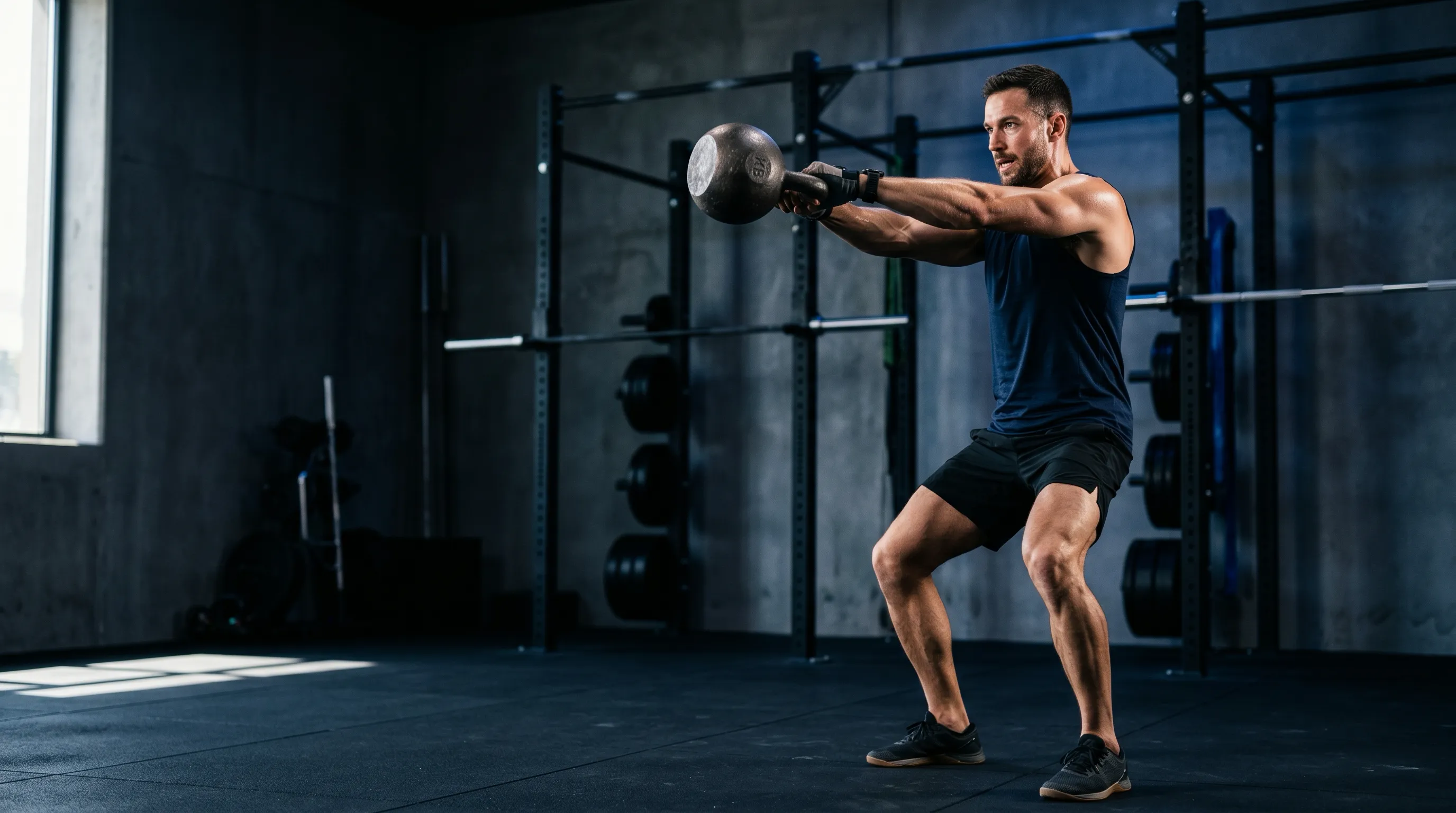
To do a kettlebell swing: hinge at the hips, hike the bell back high between your thighs, then snap your hips forward to float it out to chest height — the hips drive the bell, not the arms. The swing is a hinge fired at full speed — a vertical jump you never leave the ground for. It is emphatically not a front raise, and your arms are along for the ride.
- Setup: Bell a foot in front of you. Hinge, grab the handle, and hike it back high between your thighs (the “hike pass”).
- Execution: Snap your hips forward explosively. The hip drive — not your shoulders — floats the bell out to roughly chest height. At the top, you’re a vertical plank: glutes and abs locked, spine neutral. Let the bell free-fall back as you hinge, redirect, and snap again. Exhale sharply at the top.
- Common errors: Squatting the swing instead of hinging it; lifting the bell with your arms; leaning back and hyperextending at the top; craning your neck up to watch the bell.
- Advance when: Your hip snap is crisp, the bell floats to chest height on hip power alone, and your spine stays neutral throughout.
The swing’s posterior-chain demand is well documented. When Jason Lake and Mike Lauder measured the mechanical output of the swing, they recorded substantial net force and impulse driven by the hips, supporting its use as a power and posterior-chain exercise rather than an arm lift.6 McGill and Marshall’s lab work adds biomechanical context by measuring gluteal activation, lumbar motion, and spinal loading during kettlebell movements.4 Those measurements explain why coaches emphasize a controlled hinge; they do not guarantee that a particular technique is injury-free.
This is exactly the movement where a beginner benefits from a visual check. SensAI’s guided set-by-set tracking shows exercise illustrations with the working muscles highlighted, so you can confirm at a glance that the swing should be loading your glutes and hamstrings — not your lower back or your shoulders.
4. Overhead / Strict Press — The Grind Up Top
The strict press is a slow, controlled grind that builds overhead strength while teaching you to brace your whole body.
- Setup: Clean the bell to the “rack” position — handle resting on the back of your wrist, elbow tucked into your ribs, forearm vertical.
- Execution: Squeeze your glutes and brace your abs to lock your torso, then press straight up until your arm is fully extended overhead. Lower under control back to the rack.
- Common errors: Leaning back to “cheat” the bell up; the elbow flaring out instead of staying under the bell; the rib cage flaring as the back arches.
- Advance when: You can press with a stacked, braced torso and no backward lean, on both sides.
Kettlebell vs Dumbbell: Which Should You Buy First?
If you can only buy one implement for full-body conditioning and posterior-chain strength in minimal space, buy the kettlebell. Dumbbells win for isolation and hypertrophy variety, but for the “one tool, whole body” use case, the kettlebell is the stronger first purchase.
| Dimension | Kettlebell | Dumbbell | Best for |
|---|---|---|---|
| Ballistic / conditioning movements | Strong | Limited | KB |
| Hip-hinge / posterior-chain training | Strong | Moderate | KB |
| Offset load → grip & core demand | High | Lower | KB |
| Unilateral pressing variety | Good | Good | Tie |
| Isolation / hypertrophy variety | Limited | Strong | DB |
| Cost & space (one tool, full body) | Excellent | Good | KB |
| Learning curve | Steeper (swing) | Gentle | DB |
The evidence supports treating both as effective — the choice is about your goal, not about one being “better.” A 2024 randomized controlled trial pitting kettlebell training against bodyweight resistance training in previously inactive adults found that both groups produced large, comparable improvements in body fat and aerobic capacity over the program.7 So a kettlebell delivers real, measurable adaptations; its edge is doing so as a single, compact, conditioning-and-strength tool.
If you’re leaning dumbbell for the hypertrophy variety, our dumbbell workout plan covers that path — and if you want to train with no equipment at all while you decide, start with equipment-free home workouts.
How to Program It: Your First 4 Weeks
Train full-body two to three times a week using all four movements, and progress in strict order: master the form first, then add reps, then add load. Don’t chase intensity before the pattern is clean.
A simple, repeatable session looks like this:
| Movement | Sets × Reps | Rest |
|---|---|---|
| Kettlebell deadlift | 3 × 8 | 60–90 s |
| Goblet squat | 3 × 8–10 | 60–90 s |
| Two-hand swing | 5 × 10–15 | full recovery |
| Strict press (each side) | 3 × 5–8 | 60–90 s |
Note the swing’s prescription: sets of 10 to 15 reps with full recovery between them. As a beginner, you’re learning a high-skill power movement — fatigue wrecks technique, so rest until your hips are ready to fire crisply again. Save EMOM-style and interval swing work for later, once the pattern is grooved.
Two to three sessions a week is the right starting dose, not a compromise. The ACSM’s resistance-training guidance for novices puts beginners squarely in the two-to-three-days-per-week range, with non-consecutive days so each session lands fresh.8 More isn’t better when you’re still building the skill.
Progression is a strict ladder: first own the technique, then add reps within the prescribed range, and only then move up to the next bell size. When a session feels easy and form holds, that’s your signal to add load — not before.
SensAI generates a personalized beginner kettlebell program from scratch — not a template pulled off a shelf — built around the single bell you own, your weekly schedule, and your recovery data, then regenerates it each week as you progress. And mid-workout, when life intervenes, you can scale in plain language — “make it lighter,” “shorter session” — through quick actions or the AI coach, instead of abandoning the session entirely.
Real adaptation follows from this kind of consistent, progressive work. In one study, just four weeks of kettlebell training raised participants’ aerobic capacity by roughly 6% (about a 2.3 mL·kg⁻¹·min⁻¹ bump in VO₂max) with no extra equipment.9 If you want a broader on-ramp that blends kettlebell work with other movement, our beginner gym workout plan is a good companion.
“Am I Doing the Swing Right?” — Form Safety and Self-Checks
A correct swing is a glute-and-hamstring movement. If your lower back is doing the work, that’s a hinge fault — not a normal cost of the exercise, and not something to train through.
This is the anxiety every beginner carries, so let’s be precise about it. Run this fault-to-fix checklist:
- Squatting the swing → You’re bending your knees too much and dropping your hips. Fix: push your hips back, not down, and keep your shins nearly vertical.
- Lifting with your arms → The bell rises because your shoulders pulled it. Fix: relax your arms completely and let the hip snap float the bell up.
- Hyperextending at the top → You’re leaning back and arching your lower back to “finish.” Fix: squeeze glutes and abs to stand tall in a vertical plank — stop at upright.
- Gripping too hard → A death grip kills the float and fries your forearms. Fix: hold the handle just firmly enough to keep it from flying away.
- Looking up → Craning your neck to track the bell kinks your cervical spine. Fix: keep your head neutral and let your eyes follow the bell naturally.
When in doubt, film yourself from the side. A good swing should look like a vertical jump you don’t leave the ground for — hips fold and snap, torso stays long. If your spine is rounding or arching, that’s where the trouble is.
Muscle effort is expected; sharp, radiating, or worsening pain is not. Stop and seek qualified assessment if a swing causes persistent back pain, numbness, tingling, weakness, or pain that travels into an arm or leg. Sudden severe symptoms with new bowel or bladder changes need urgent medical care.
A pragmatic controlled trial of supervised kettlebell training in previously inactive older adults reported high adherence and a small number of minor, non-serious adverse events across the program.10 A broader clinical scoping review also found limited reporting of serious harm.11 These supervised studies support tolerability in the populations tested; they do not prove that unsupervised kettlebell training is risk-free.
This is another place the app can help without pretending to replace an assessment: you can send the SensAI coach a photo for form feedback, and it can remember constraints you have reported across sessions. A photo cannot diagnose pain or rule out an injury. For a fuller walkthrough of self-assessing technique, see our exercise form and safety guide.
The Bottom Line
Kettlebell training rewards a small, ordered set of decisions. Pick a bell you can control. Own the hip hinge before you make it ballistic. Run the four-movement progression in order: deadlift, goblet squat, swing, press. Program it two to three times a week, mastering form before adding reps or load. Keep checking the swing, because persistent lower-back effort or pain is a reason to stop and reassess.
Get those five things right and a single cast-iron ball will out-train a rack of equipment you’d never use.
References
Footnotes
-
Thomas JF, Larson KL, Hollander DB, Kraemer RR. “Comparison of two-hand kettlebell exercise and graded treadmill walking: effectiveness as a stimulus for cardiorespiratory fitness.” Journal of Strength and Conditioning Research, 2014. https://pubmed.ncbi.nlm.nih.gov/24345977/ ↩
-
Jaiswal PR, Ramteke SU, Shedge S. “Enhancing Athletic Performance: A Comprehensive Review on Kettlebell Training.” Cureus, 2024. https://pubmed.ncbi.nlm.nih.gov/38440022/ ↩
-
Tsatsouline P. “Kettlebell Simple & Sinister (Revised and Updated).” StrongFirst Press, 2019. https://www.strongfirst.com/beginners-start-here/ ↩
-
McGill SM, Marshall LW. “Kettlebell swing, snatch, and bottoms-up carry: back and hip muscle activation, motion, and low back loads.” Journal of Strength and Conditioning Research, 2012. https://pubmed.ncbi.nlm.nih.gov/21997449/ ↩ ↩2
-
Collins KS, Klawitter LA, Waldera RW, Mahoney SJ, Christensen BK. “Differences in Muscle Activity and Kinetics Between the Goblet Squat and Landmine Squat in Men and Women.” Journal of Strength and Conditioning Research, 2021. https://pubmed.ncbi.nlm.nih.gov/34341315/ ↩
-
Lake JP, Lauder MA. “Mechanical demands of kettlebell swing exercise.” Journal of Strength and Conditioning Research, 2012. https://pubmed.ncbi.nlm.nih.gov/22207261/ ↩
-
Govindasamy K, Gogoi H, Jebabli N, et al. “The effects of kettlebell training versus resistance training using the own body mass on physical fitness and physiological adaptations in obese adults: a randomized controlled trial.” BMC Sports Science, Medicine and Rehabilitation, 2024. https://pubmed.ncbi.nlm.nih.gov/38715134/ ↩
-
American College of Sports Medicine. “American College of Sports Medicine position stand. Progression models in resistance training for healthy adults.” Medicine & Science in Sports & Exercise, 2009. https://pubmed.ncbi.nlm.nih.gov/19204579/ ↩
-
Falatic JA, Plato PA, Holder C, Finch D, Han K, Cisar CJ. “Effects of Kettlebell Training on Aerobic Capacity.” Journal of Strength and Conditioning Research, 2015. https://pubmed.ncbi.nlm.nih.gov/26102260/ ↩
-
Meigh NJ, Keogh JWL, Schram B, Hing W, Rathbone EN. “Effects of supervised high-intensity hardstyle kettlebell training on grip strength and health-related physical fitness in insufficiently active older adults: the BELL pragmatic controlled trial.” BMC Geriatrics, 2022. https://pubmed.ncbi.nlm.nih.gov/35459114/ ↩
-
Meigh NJ, Keogh JWL, Schram B, Hing WA. “Kettlebell training in clinical practice: a scoping review.” BMC Sports Science, Medicine and Rehabilitation, 2019. https://pubmed.ncbi.nlm.nih.gov/31497302/ ↩