Dumbbell Workout Plan: The Evidence-Based Program for Building Muscle With Just Dumbbells
A research-backed 3-day dumbbell-only program with progressive overload strategies for when you can't just add weight. Includes no-bench alternatives, 12 exercises by movement pattern, and an 8-week progression.

SensAI Team
13 min read
Get a training plan that adapts to your recovery — free on iOS

A pair of adjustable dumbbells and a flat bench can build as much muscle as a fully equipped commercial gym. That is not motivational fluff. It is what the research actually shows.
A 2017 systematic review and meta-analysis by Schoenfeld et al. found that changes in muscle hypertrophy were similar between low-load and high-load resistance training when sets were taken to failure.1 Fonseca et al. found that varying exercises and varying loads produced comparable hypertrophy — suggesting that the specific tool matters less than the training stimulus itself.2 The equipment matters far less than most people think. What matters is progressive tension, adequate volume, and proximity to failure.
This is a complete 3-day dumbbell program with 12 exercises organized by movement pattern, an 8-week progression framework, and five strategies for overloading when you cannot just add plates to a bar.
The Dumbbell Equivalence Question
Can dumbbells produce the same muscle-building stimulus as barbells and machines? The short answer is yes, with one caveat.
Saeterbakken et al. compared EMG activity across three chest-press variations — Smith machine, barbell, and dumbbell — and found that pectoralis major and anterior deltoid activation did not differ significantly between conditions.3 The dumbbells did increase biceps brachii activation, likely because the lifter must stabilize each weight independently. Brad Schoenfeld, PhD, professor of exercise science at Lehman College (CUNY), has noted that similar activation patterns under equivalent loading generally translate to similar hypertrophic outcomes.
The rep range question matters here too. Schoenfeld’s 2017 meta-analysis comparing low-load versus high-load training found that muscle growth was equivalent across a wide spectrum of loading — from heavy sets of 6 to lighter sets of 30 — as long as sets approached failure.1 This is critical for dumbbell training, because your loads are capped by what you can get into position. If your heaviest dumbbells limit you to sets of 15 or 20, you can still build muscle. You just need to push those sets closer to failure.
The one limitation: lower-body loading eventually hits a ceiling. Holding two 100-pound dumbbells for goblet squats or lunges is technically possible but practically miserable. Once your legs outgrow your dumbbell set, you will need to compensate with tempo manipulation, paused reps, and single-leg work. More on that in the progressive overload section.
Why Dumbbells Have Advantages Most People Ignore
Dumbbells are not a compromise. They offer four genuine advantages over barbells that most lifters never think about.
Greater range of motion. Your hands are not locked to a fixed bar path. On a dumbbell bench press, you can bring the weights lower than a barbell allows, stretching the pecs through a fuller range. On rows, you can pull higher and rotate naturally. More range of motion under load means more mechanical tension through longer muscle lengths — and recent research suggests that training at longer muscle lengths may be especially effective for hypertrophy.
Higher stabilizer activation. Saeterbakken et al. demonstrated that dumbbell pressing significantly increased biceps brachii activation compared to barbell pressing, because each arm must independently control its load.3 This extra stabilization demand also engages smaller synergist muscles that barbells largely bypass.
Built-in imbalance correction. With a barbell, your dominant arm can quietly compensate for your weaker side. You will never notice it until the imbalance becomes a problem. Dumbbells force each limb to carry its own weight. If your left arm fails at rep 8 while your right arm has two more, you now have actionable information.
Safer solo training. No spotter? No problem. A failed dumbbell bench press means you drop the weights to the side. A failed barbell bench press means the bar is on your chest. For anyone training at home without a power rack, dumbbells remove the most dangerous failure scenario in the gym.
In SensAI, you can set “dumbbells only” as your available equipment, and the AI builds your entire program around that constraint — no templates, no manual exercise swapping.
The Exercise Menu: 12 Dumbbell Movements by Pattern
Every effective program is built on six fundamental movement patterns. Here are two dumbbell exercises for each — one primary option (assumes you have a bench) and one no-bench alternative.
Horizontal Push (chest, front shoulders, triceps)
1. Dumbbell Bench Press — The bread and butter. Full pec stretch at the bottom, natural hand rotation, no bar path restriction. Keep a slight arch in your upper back and drive your feet into the floor.
2. Dumbbell Floor Press (no bench) — Same pressing motion, but the floor limits your range of motion at the bottom. This actually makes it useful for overloading the lockout portion and reducing shoulder stress.
Horizontal Pull (upper back, rear shoulders, biceps)
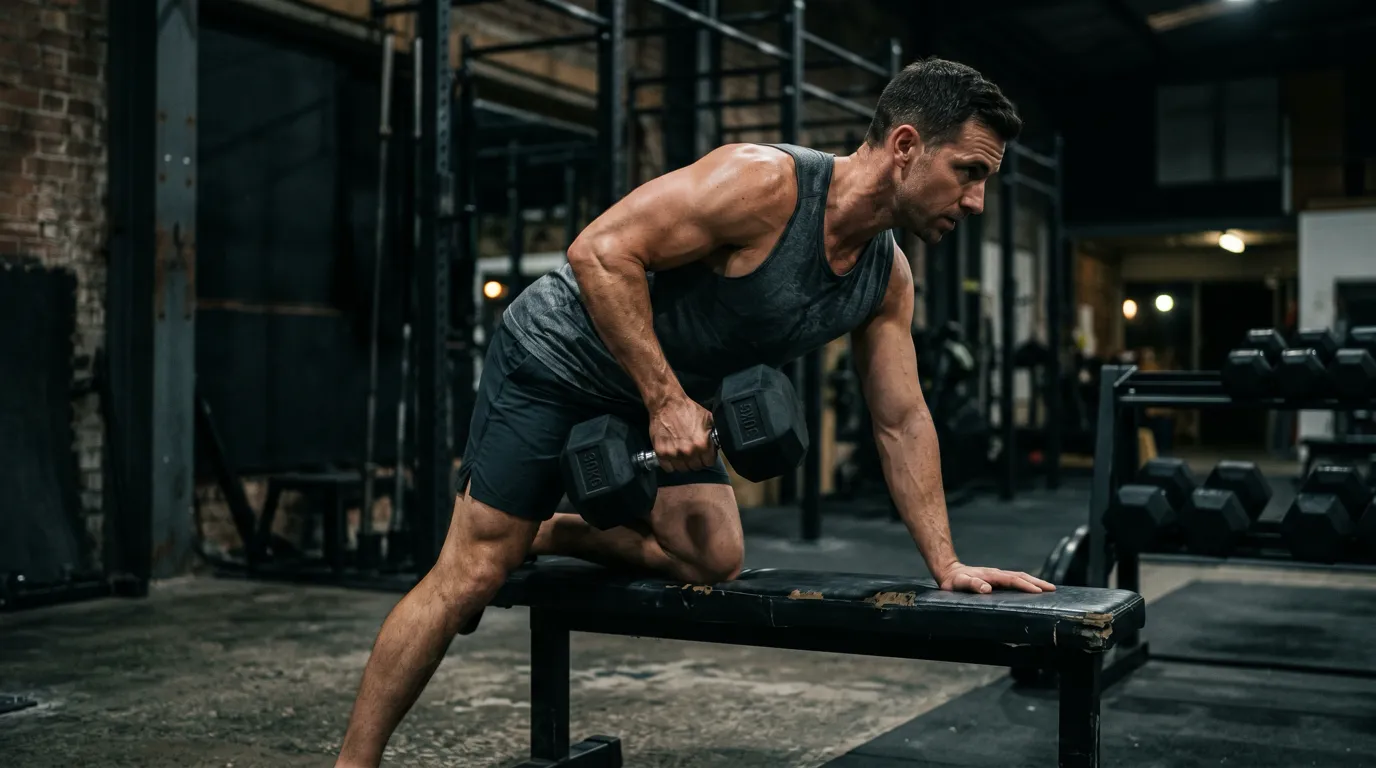
3. Single-Arm Dumbbell Row — One hand and knee on a bench, pull to your hip. The unilateral loading here trains anti-rotation through your core as a bonus.
4. Bent-Over Dumbbell Row (no bench) — Both dumbbells, hinged at the hips. Keep your back flat and pull to your lower ribs. Lighter loads than barbell rows, but each arm works honestly.
Vertical Push (shoulders, upper chest, triceps)
5. Seated Dumbbell Shoulder Press — Sit upright, press from shoulder height to lockout. Dumbbells allow a natural arc rather than the straight-line path a barbell forces.
6. Standing Dumbbell Shoulder Press (no bench) — Same movement, standing. Requires more core bracing and slightly limits load, but trains the entire kinetic chain.
Vertical Pull (lats, biceps, upper back)
7. Dumbbell Pullover — Lying on a bench, arc the weight from above your chest to behind your head. One of the few dumbbell exercises that approximates a lat pulldown.
8. Prone Dumbbell Y-Raise (no bench) — Face down on the floor, raise dumbbells in a Y pattern. Light loads only. Targets upper back and rear delts that are easy to neglect in a dumbbell-only setup.
Squat Pattern (quads, glutes, core)
9. Goblet Squat — Hold one dumbbell at your chest, squat deep. The front-loaded position forces upright posture and hammers your quads. This will be your primary lower-body builder.
10. Dumbbell Bulgarian Split Squat (no bench) — Rear foot elevated on a chair, couch, or step. Brutal in the best way. Single-leg loading means your 50-pound dumbbells feel like a 200-pound barbell squat.
Hip Hinge (hamstrings, glutes, lower back)
11. Dumbbell Romanian Deadlift (RDL) — Hinge at the hips, slight knee bend, lower the dumbbells along your shins. Feel the stretch in your hamstrings. This is your primary posterior chain builder.
12. Single-Leg Dumbbell RDL (no bench) — Same pattern, one leg. Doubles the relative load on the working leg and trains balance. Start light — this one humbles everyone.
SensAI provides guided set-by-set tracking with exercise illustrations and highlighted muscle groups for each movement, so you know exactly what you are targeting and whether your form cues are right.
The 3-Day Full-Body Program
Three full-body sessions per week is the most evidence-supported frequency for building muscle. Schoenfeld et al.’s meta-analysis in Sports Medicine found that training each muscle group at least twice per week produced significantly greater hypertrophy than once-weekly training.4 A three-day full-body split hits every muscle group three times per week — well above that minimum threshold.
Each session takes 40-50 minutes. The RPE targets ramp across the 8-week block: RPE 6-7 for weeks 1-3 (building work capacity), then RPE 7-8 for weeks 4-8 (pushing toward growth).
Day A — Push Emphasis
| Exercise | Sets | Reps | RPE | Rest |
|---|---|---|---|---|
| Goblet Squat | 3 | 8-12 | 6-8 | 90s |
| Dumbbell Bench Press | 3 | 8-12 | 6-8 | 90s |
| Single-Arm Dumbbell Row | 3 | 10-12 | 6-8 | 60s/side |
| Seated DB Shoulder Press | 3 | 8-12 | 6-8 | 90s |
| Dumbbell RDL | 3 | 10-12 | 6-8 | 90s |
Day B — Pull Emphasis
| Exercise | Sets | Reps | RPE | Rest |
|---|---|---|---|---|
| Bulgarian Split Squat | 3 | 8-12 | 6-8 | 60s/side |
| Dumbbell Pullover | 3 | 10-15 | 6-8 | 90s |
| Dumbbell Floor Press | 3 | 8-12 | 6-8 | 90s |
| Bent-Over Dumbbell Row | 3 | 10-12 | 6-8 | 90s |
| Single-Leg Dumbbell RDL | 3 | 10-12 | 6-8 | 60s/side |
Day C — Legs and Shoulders
| Exercise | Sets | Reps | RPE | Rest |
|---|---|---|---|---|
| Goblet Squat | 3 | 8-12 | 6-8 | 90s |
| Dumbbell RDL | 3 | 10-12 | 6-8 | 90s |
| Standing DB Shoulder Press | 3 | 8-12 | 6-8 | 90s |
| Single-Arm Dumbbell Row | 3 | 10-12 | 6-8 | 60s/side |
| Dumbbell Pullover | 2 | 12-15 | 6-7 | 90s |
No bench? No problem. Swap every bench exercise for its no-bench alternative from the exercise menu above. Dumbbell Floor Press replaces Bench Press. Standing Shoulder Press replaces Seated. Prone Y-Raises replace Pullovers (floor-based). The program still covers all six movement patterns.
Greg Nuckols, co-founder of Stronger by Science and one of the most trusted voices in evidence-based strength training, has written extensively about why full-body training works so well for intermediate lifters: you accumulate more total weekly volume per muscle group with better recovery between stimuli, compared to a body-part split that hammers one area into the ground once a week.
SensAI generates dumbbell-only plans from scratch based on your goals, equipment, and schedule. Tell it you have a pair of adjustable dumbbells and a bench — or just dumbbells and a floor — and it builds the full program for you.
Progressive Overload When You Cannot Just Add Weight
Here is where dumbbell training gets interesting. With a barbell, progressive overload is simple: add 2.5 pounds to each side. With dumbbells, your jumps are often 5 or 10 pounds per hand — a massive percentage increase at lighter weights. And if you own a single pair of adjustable dumbbells, adding weight means buying new plates.
You need a different playbook. The ACSM position stand on resistance training progression recommends manipulating multiple training variables — not just load — to drive continued adaptation.5 Here are five strategies that work.
1. Rep Progression (Double Progression)
This is the workhorse method. Set a rep range (say 8-12). Start at the bottom of the range with a given weight. Each session, try to add a rep to each set. When you hit the top of the range on all sets, increase the weight and drop back to the bottom.
Greg Nuckols calls this “the simplest and most effective progression method for most people.” It works because you are accumulating more total volume (sets x reps x weight) every session without needing a weight increase.
2. Set Progression
Start with 2 sets per exercise. Once you consistently hit the top of your rep range, add a third set instead of adding weight. Later, add a fourth. Research by Schoenfeld et al. established a clear dose-response relationship between weekly sets and hypertrophy — each additional set produces more growth, up to a practical ceiling of roughly 10+ sets per muscle group per week.6
3. Tempo Manipulation (Slow Eccentrics)
Control the lowering phase. A 3-4 second eccentric (lowering) on each rep dramatically increases time under tension without requiring heavier loads. Schoenfeld et al.’s systematic review found that eccentric muscle actions may produce a slightly larger hypertrophic effect than concentric actions, likely due to greater mechanical tension at longer muscle lengths.7 A 40-pound dumbbell curl with a 4-second lowering phase is a completely different stimulus than the same weight with a 1-second drop.
4. Paused Reps
Add a 2-3 second pause at the bottom of each rep — the stretched position where the muscle is under maximum tension. This eliminates the stretch-shortening cycle (the elastic bounce you normally use to reverse direction), forcing your muscles to generate force from a dead stop. Same weight, dramatically harder.
5. Unilateral Progression
Switch a bilateral exercise to its single-leg or single-arm version. Your 50-pound goblet squat becomes a 50-pound Bulgarian split squat — effectively doubling the load per leg. This is the single most powerful overload tool in the dumbbell lifter’s toolkit, and it is why single-leg work appears in this program from day one.
8-Week Goblet Squat Progression Example
Here is what double progression looks like in practice, using the Zourdos et al. RPE framework to autoregulate intensity:8
| Week | Weight | Sets x Reps | RPE | Strategy |
|---|---|---|---|---|
| 1 | 30 lb | 3 x 8 | 6 | Baseline |
| 2 | 30 lb | 3 x 10 | 6-7 | Rep progression |
| 3 | 30 lb | 3 x 12 | 7 | Top of range |
| 4 | 35 lb | 3 x 8 | 7 | Weight increase, reset reps |
| 5 | 35 lb | 3 x 10 | 7-8 | Rep progression |
| 6 | 35 lb | 3 x 12 | 7-8 | Top of range |
| 7 | 40 lb | 3 x 8 | 7-8 | Weight increase, reset reps |
| 8 | 40 lb | 3 x 10 | 8 | Building toward next jump |
That is a 33% load increase over 8 weeks — while staying in a hypertrophy-effective rep range the entire time.
SensAI tracks your planned versus performed sets across every workout and auto-adjusts your next session based on what actually happened. If you hit all your reps at RPE 7, it progresses you. If you fell short, it holds the load. No spreadsheet required.
Nutrition Basics for Dumbbell Training
Training is the signal. Protein is the raw material. Without enough of either, nothing happens.
Morton et al.’s meta-analysis of 49 studies in the British Journal of Sports Medicine identified a protein intake breakpoint at 1.6 g per kg of body weight per day — the threshold below which you are leaving measurable muscle gains on the table.9 For a 75 kg (165 lb) person, that is 120 g of protein daily. Aim for 1.6-2.2 g/kg, spread across 3-4 meals.
Beyond protein, your caloric target depends on your goal:
- Building muscle (lean bulk): Eat at a 10-20% surplus above maintenance
- Losing fat while building muscle (body recomposition): Eat at maintenance or a small deficit (10-15%)
- Cutting: Maintain high protein to preserve muscle while in a larger deficit
If you are new to tracking, start with our macros guide for beginners. Protein is the one variable you cannot afford to get wrong.
Common Mistakes That Kill Dumbbell Gains
1. Going too light and never approaching failure. The Schoenfeld meta-analysis showed hypertrophy is similar across rep ranges — but only when sets are taken close to failure.1 If you finish every set feeling like you had 6 more reps, you are not training hard enough. RPE 7-8 is the target. Two to three reps left in the tank.
2. Neglecting legs entirely. Dumbbell leg training is harder and less glamorous than upper-body pressing. That is not a reason to skip it. Bulgarian split squats, goblet squats, and single-leg RDLs with moderate dumbbells produce a legitimate hypertrophic stimulus. Your legs do not know whether you are holding dumbbells or a barbell.
3. No progression log. If you do not track your weights, reps, and RPE, you have no idea whether you are progressing. “I think I used the 30s last time” is not a training plan. Write it down — or let SensAI track it automatically with set-by-set logging and progression analysis across sessions.
4. Skipping unilateral work. Bilateral exercises are efficient, but they let your stronger side compensate. If you only do bilateral movements, imbalances accumulate silently. Include at least one single-arm or single-leg exercise per session.
5. Treating DOMS as the goal. Soreness does not mean the workout was effective. The absence of soreness does not mean it was not. If you are chasing soreness by constantly changing exercises and adding volume, you are chasing a feeling instead of building a progression. Learn how to distinguish useful soreness from counterproductive damage in our DOMS recovery guide.
Frequently Asked Questions
Can you actually build muscle with just dumbbells?
Yes. Research consistently shows that muscle hypertrophy is driven by mechanical tension, adequate volume, and progressive overload — not by any specific piece of equipment.1 Dumbbells provide all three when programmed correctly. The loading ceiling matters for advanced lower-body training, but for the vast majority of lifters, dumbbells are sufficient for years of progress.
What weight should I start with?
Start with a weight that allows you to complete 12 reps with 3-4 reps left in reserve (RPE 6-7). For most beginners, that is 10-20 lb dumbbells for upper-body pressing and 20-35 lb for lower-body exercises like goblet squats. The ACSM recommends beginners use loads corresponding to 8-12 repetitions per set.5 Err on the lighter side for the first two weeks — you are learning movement patterns, not testing strength.
Is 3 days a week enough to build muscle?
A meta-analysis of 10 studies found that training each muscle group twice per week produced significantly greater muscle growth than once per week.4 A three-day full-body program hits everything three times per week — well above the evidence-based minimum. For most people who are not competitive bodybuilders, three days is the sweet spot between stimulus and recovery.
Do I need a bench?
No. Every exercise in this program has a no-bench alternative. A floor press replaces bench press. Standing shoulder press replaces seated. You lose some range of motion on pressing movements, but you gain accessibility. A bench is a nice-to-have, not a requirement.
How long until I see results?
Expect to feel stronger within 2-3 weeks as your nervous system adapts. Visible muscle changes typically appear around weeks 6-8 for beginners — though this varies with genetics, nutrition, sleep, and starting point. If your weights are going up and your reps are increasing, you are building muscle. The mirror takes longer to catch up than the logbook. For a broader view of what realistic timelines look like, see our beginner gym workout plan.
Can I do this whole program with just one pair of dumbbells?
You can, but you will outgrow them faster on some exercises than others. Adjustable dumbbells (like PowerBlocks or Bowflex SelectTech) solve this by offering a range of loads in one unit. If you truly have one fixed pair, lean heavily on tempo manipulation, paused reps, and unilateral progressions to keep the stimulus advancing. Even a 30-minute focused session with a single pair can be effective when you use the right overload strategies.
References
Footnotes
-
Schoenfeld BJ, Grgic J, Ogborn D, Krieger JW. “Strength and Hypertrophy Adaptations Between Low- vs. High-Load Resistance Training: A Systematic Review and Meta-analysis.” Journal of Strength and Conditioning Research, 2017. https://pubmed.ncbi.nlm.nih.gov/28834797/ ↩ ↩2 ↩3 ↩4
-
Fonseca RM, Roschel H, Tricoli V, de Souza EO, Wilson JM, Laurentino GC, Aihara AY, de Souza Leão AR, Ugrinowitsch C. “Changes in exercises are more effective than in loading schemes to improve muscle strength.” Journal of Strength and Conditioning Research, 2014. https://pubmed.ncbi.nlm.nih.gov/24832974/ ↩
-
Saeterbakken AH, van den Tillaar R, Fimland MS. “A comparison of muscle activity and 1-RM strength of three chest-press exercises with different stability requirements.” Journal of Sports Sciences, 2011. https://pubmed.ncbi.nlm.nih.gov/21225489/ ↩ ↩2
-
Schoenfeld BJ, Ogborn D, Krieger JW. “Effects of Resistance Training Frequency on Measures of Muscle Hypertrophy: A Systematic Review and Meta-Analysis.” Sports Medicine, 2016. https://pubmed.ncbi.nlm.nih.gov/27102172/ ↩ ↩2
-
Ratamess NA, Alvar BA, Evetoch TK, Housh TJ, Kibler WB, Kraemer WJ, Triplett NT. “American College of Sports Medicine position stand. Progression models in resistance training for healthy adults.” Medicine & Science in Sports & Exercise, 2009. https://pubmed.ncbi.nlm.nih.gov/19204579/ ↩ ↩2
-
Schoenfeld BJ, Ogborn D, Krieger JW. “Dose-response relationship between weekly resistance training volume and increases in muscle mass: A systematic review and meta-analysis.” Journal of Sports Sciences, 2017. https://pubmed.ncbi.nlm.nih.gov/27433992/ ↩
-
Schoenfeld BJ, Ogborn DI, Vigotsky AD, Franchi MV, Krieger JW. “Hypertrophic Effects of Concentric vs. Eccentric Muscle Actions: A Systematic Review and Meta-analysis.” Journal of Strength and Conditioning Research, 2017. https://pubmed.ncbi.nlm.nih.gov/28486337/ ↩
-
Zourdos MC, Klemp A, Dolan C, Quiles JM, Schau KA, Jo E, Helms E, Esgro B, Duncan S, Garcia Merino S, Blanco R. “Novel Resistance Training-Specific Rating of Perceived Exertion Scale Measuring Repetitions in Reserve.” Journal of Strength and Conditioning Research, 2016. https://pubmed.ncbi.nlm.nih.gov/26049792/ ↩
-
Morton RW, Murphy KT, McKellar SR, Schoenfeld BJ, Henselmans M, Helms E, Aragon AA, Devries MC, Banfield L, Krieger JW, Phillips SM. “A systematic review, meta-analysis and meta-regression of the effect of protein supplementation on resistance training-induced gains in muscle mass and strength in healthy adults.” British Journal of Sports Medicine, 2018. https://pubmed.ncbi.nlm.nih.gov/28698222/ ↩