Hume Band Review 2026: Worth It vs WHOOP, Oura, Apple Watch?
Is the Hume Band legit and worth it? Hume Band 2.0 review (Oct 2026): $249, no required subscription, unvalidated scores, vs WHOOP, Oura and Apple Watch.

SensAI Team
16 min read
Get a training plan that adapts to your recovery — free on iOS

The Hume Band makes a big promise for a small, screenless strap. Hume calls it “the wearable designed to extend your lifespan and detect early illness,” and says it tracks your biological age, your pace of aging and your blood pressure, with no cuff and no required subscription.1
WHOOP now sells similar pace-of-aging and blood-pressure features in its pricier tiers. Hume offers them without a subscription.21 So this review asks three plain questions. What does the Hume Band cost in 2026? How much of what it measures has been independently checked? And how does it compare with WHOOP, Oura and Apple Watch?
We make SensAI, an AI coaching app for iPhone. We do not sell a wearable, and SensAI reads data from any band that writes to Apple Health, Hume included. We are still not neutral, so we say where each device wins. Every Hume price, feature and disclaimer below was checked on humehealth.com and its App Store listing on 19 October 2026. Every competitor price was checked on that company’s own page the same day, and every study against its PubMed record.
Hume Band review: the short answer
The Hume Band 2.0 is a screenless wrist tracker that sells for $249 against a $356 list price, with no required subscription. It covers heart rate, HRV, sleep, SpO2 and skin temperature, plus proprietary aging and blood-pressure scores. Our search found no peer-reviewed study of the band itself, so treat those scores as unvalidated.134
| Hume Band 2.0 (October 2026) | |
|---|---|
| What it is | A screenless wrist band and app from Hume Health1 |
| Price (US) | $356 list; $249 on Hume’s sale pages; $199 with some affiliate codes135 |
| Subscription | Not required; Hume Premium (“Hume Plus”) from $8.99/month or $99.99/year167 |
| Sensors | 5 LEDs and 4 photodiodes, optical PPG1 |
| Battery | “Up to 14 days” claimed; Wareable’s reviewer got 715 |
| Water | IP68, up to 1 meter for up to 2 hours1 |
| Headline scores | Metabolic Capacity, Metabolic Momentum, Biological Age, Pace of Aging, Blood Pressure Insights18 |
| Medical status | “Not a medical device”; not FDA-cleared94 |
| Independent validation | No peer-reviewed study of the band found on PubMed (19 Oct 2026) |
| Apple Health | Connects through the Hume app’s Connected Apps screen6 |
| App Store rating (US) | 4.3 from 74,469 ratings7 |
| Returns | 45 days, including opened products110 |
Here is what that means in practice. The Hume Band ties the Apple Watch SE 3 as the cheapest device here, and it is the cheapest screenless band that needs no monthly fee. What you are not buying, yet, is evidence that its longevity and blood-pressure numbers mean what the marketing says they mean.
What is the Hume Band and how does it work?
The Hume Band is a screenless optical heart-rate band from Hume Health, the company behind the Hume Pod scale (App Store seller: FitTrack Inc.). The original band went on sale in April 2025 and the Band 2.0 in May 2026. It records continuously and syncs to the Hume Health app over Bluetooth.16117
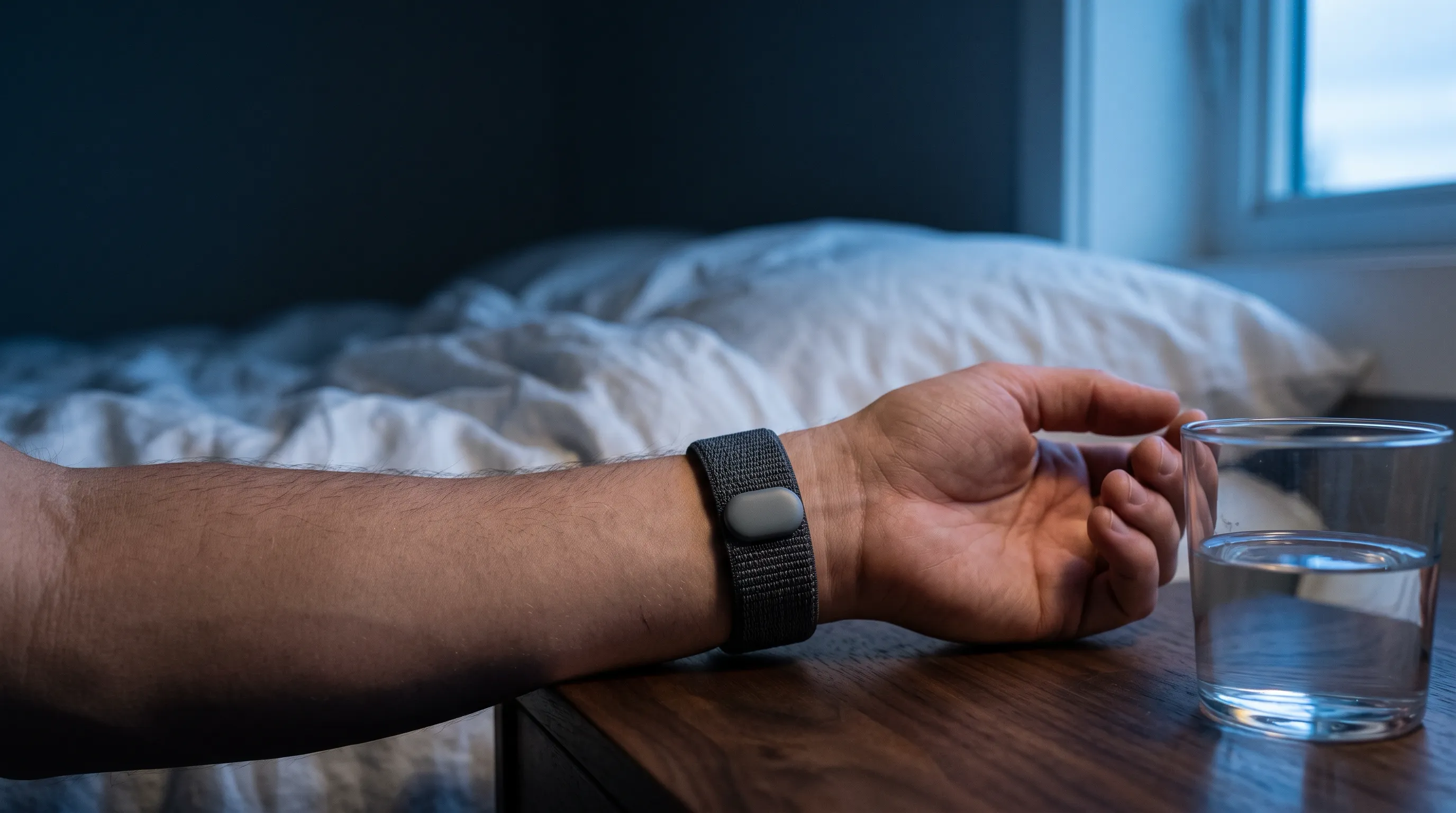
Think of it as a WHOOP-shaped strap with a different business model. There is no screen, no buttons and no watch face. Five LEDs shine into your wrist, four photodiodes read what bounces back, and the app turns that pulse signal into everything else.1
Wareable’s reviews list the same count, 5 LEDs and 4 photodiodes, for both generations.512 What changed, according to Hume, is “Blood Pressure Insights,” battery life of up to 14 days, “improved accuracy” from new signal processing, and an upgraded strap.11 Wareable’s Band 2.0 reviewer judged it not worth upgrading for owners of the first band: “if you currently have the first-generation Hume Band, I don’t think that it’s worth upgrading.”5
The app sits on top of that data in three layers.
| Layer | What Hume says it does | Source |
|---|---|---|
| Raw signals | Heart rate, HRV, SpO2, respiratory rate, skin temperature, sleep stages, steps, calories | Hume Band 2.0 page1 |
| Daily scores | Metabolic Capacity (“like a battery measuring your biological resilience”), strain and recovery | Hume FAQ6 |
| Long-term scores | Metabolic Momentum, Biological Age, Pace of Aging, Blood Pressure Insights | Hume Band 2.0 page1 |
The first layer is what every serious wearable measures. The third layer is where Hume competes with WHOOP’s top tiers, and it is also where the evidence runs thinnest.
How much does the Hume Band cost in 2026?
The Hume Band 2.0 lists at $356 but sells for $249 on Hume’s own sale pages, or 18 payments of $13.84. No subscription is required to use the band. Hume Premium, which adds AI coaching and weekly reports, starts at $8.99 a month, and the App Store lists it at $99.99 a year.1367
| Item | Price | Source |
|---|---|---|
| Hume Band 2.0, list | $356 | Hume product page3 |
| Hume Band 2.0, sale | $249 (or 18 × $13.84) | Hume Band 2.0 page1 |
| With affiliate codes | $199.25 seen in June 2026 | Wareable5 |
| Hume Premium (Hume Plus) | From $8.99/month; $99.99/year in the App Store | Hume Band 2.0 FAQ; App Store17 |
| Warranty | 1 year included; paid extensions offered | Hume Band 2.0 page1 |
Prices checked 19 October 2026. Hume’s product page showed $356 that day while its landing pages showed $249 under a “Flash Sale” banner. Treat $356 as the list price and $249 as the usual price.
What does the free tier include? Hume says the app is “free for all Hume Band 2.0 members,” with core metrics like “Metabolic Capacity, Metabolic Momentum, Health Score, and more.”8 In its own words: “No subscription is required to use the Band or access your raw data.”1
Premium adds “personalized, AI-powered coaching and feedback,” a weekly Health Report and personalized insights.86
That pricing is the Hume Band’s strongest argument. WHOOP only sells its hardware inside a membership, and Oura locks most of its daily insights behind one.213 Over two years, only the Apple Watch SE 3 matches Hume’s cost, and it is a watch with a screen, not a band.
Is the Hume Band accurate?
Nobody has published an independent accuracy study of the Hume Band. A PubMed search on 19 October 2026 found no validation study of the band, while WHOOP, Oura and Apple Watch have each been tested against ECG or sleep-lab recordings. Hume says its accuracy is “validated in lab studies and third-party testing” but has not published those studies.814151617
That gap matters more than any spec. An optical band can be accurate. The point is that, for Hume, nobody outside the company has shown it yet.
Here is what peer-reviewed studies have found for the devices Hume is usually compared with.
| Measure | What peer-reviewed studies found | Devices tested | Source |
|---|---|---|---|
| Overnight HRV vs ECG | Oura Gen 4 most accurate (CCC 0.99, MAPE 5.96%); WHOOP 4.0 “moderate” (CCC 0.94, MAPE 8.17%) | Oura Gen 3/4, WHOOP 4.0, Garmin Fenix 6, Polar Grit X Pro | Dial et al., 202515 |
| Overnight resting heart rate vs ECG | Oura Gen 3 MAPE 1.67%, Gen 4 1.94%; WHOOP 3.00% | Same | Dial et al., 202515 |
| Sleep stages vs polysomnography | Agreement 53% (Apple Watch) to 61% (Oura) and 60% (WHOOP); “all six devices require improvement” for sleep stages | Apple Watch S6, Oura Gen2, WHOOP 3.0, Garmin, Polar, Somfit | Miller et al., 202214 |
| Sleep stages vs polysomnography | Kappa 0.21 to 0.53, “fair to moderate agreement” | Apple Watch S8, WHOOP 4.0, Fitbit, Garmin, Withings | Schyvens et al., 202516 |
| Apple Watch overall | 82 studies; SpO2 bias −0.04% but wide limits of agreement (−4.00 to 3.94) | Apple Watch | Lambe et al., 202617 |
| Hume Band | No peer-reviewed study found | — | PubMed search, 19 Oct 2026 |
Most of these studies tested older models (WHOOP 3.0 and 4.0, Apple Watch Series 6 and 8, Oura Gen 2 and 3), so read them as each company’s track record. Dial 2025 also tested the Oura Ring 4 still on sale, and Lambe et al. pooled 82 studies across Apple Watch generations. Miller et al. disclosed research support from WHOOP; in the Robbins study of Oura cited below, Robbins disclosed sitting on Oura’s Medical Advisory Board.14151718
The hands-on reviews we could find point the same way. Wareable’s Karolina Ščeponaitė, who tested the Band 2.0, wrote that “some inaccuracies in heart rate, sleep, or recovery measurements can still be expected.”5 Testing the original band against an Apple Watch, Wareable found sleep totals “lined up closely” but said it “didn’t seem to accurately detect awakenings during the night as well as Apple Watch does.”12
One more caution about HRV. Hume says its HRV tiers are built on both RMSSD and SDNN, two different statistics.6 RMSSD and SDNN are not interchangeable, which is why WHOOP does not write its HRV into Apple Health at all, and even norms from different recording lengths are “not interchangeable.”1920 So never compare a Hume HRV figure with a WHOOP or Apple Watch figure directly. Compare each device only with itself over time. Our guide to wearable HRV accuracy explains why.
Can the Hume Band measure blood pressure?
Not in a way you should act on. Hume calls its feature “Blood Pressure Insights” and says it is “not a diagnosis” and does not replace a cuff. Cuffless wrist devices are not recommended for diagnosing or managing high blood pressure, and in a small test one wrist device missed nearly all of a 20 mmHg medication-driven drop.82122
Hume’s own pages disagree with each other here. One section of the Band 2.0 page promises “Continuous blood pressure monitoring without the hassle.” The FAQ further down the same page lists blood pressure as “To be released in future app update, pending FDA approval.”1 The dedicated feature page is the most careful: “Blood Pressure Insights are not a diagnosis and do not replace a blood pressure cuff, an ECG, or medical advice.”8
The research explains the caution. In 2022 the European Society of Hypertension’s working group wrote that its guidelines “do not recommend cuffless devices for the diagnosis and management of hypertension,” because these devices have accuracy problems that the standard cuff tests cannot catch.21 Its 2023 follow-up noted that “there are no generally accepted protocols for their validation.”23
The clearest illustration is a 2023 study of Aktiia, a different cuffless wrist device. Forty-one people wore it alongside a 24-hour cuff monitor. In a separate pilot of three people whose blood-pressure medication was increased, home cuff readings fell by an average of 19.7/11.5 mmHg over two weeks; the wrist device registered just 1.0/0.8 mmHg.22 The authors concluded that the results “suggested it was unable to track medication-induced BP changes.”22
“Clinicians and patients should only use validated BP cuff devices until cuffless BP measurement devices are appropriately tested and validated,” wrote cardiologist Eugene Yang of the University of Washington and co-authors in JAMA Cardiology in 2025.24 Aletta Schutte, a hypertension researcher at UNSW Sydney, put the industry’s record bluntly: “Many have tried and failed, but industry is persisting.”25
Hume is not alone. WHOOP sells “Blood Pressure Insights” in its $359-a-year Life tier.2 The FDA sent WHOOP a warning letter over that feature in July 2025, then closed the matter in June 2026 after WHOOP changed it and after new FDA guidance on wellness devices in January.26 That is a regulatory decision, not an accuracy result.
If blood pressure is the reason you are shopping, buy a validated upper-arm cuff. Our article on whether a smartwatch can measure blood pressure covers the options.
What do Hume’s biological age and pace of aging scores mean?
Hume’s Biological Age and Pace of Aging scores are its own estimates, built from wrist data such as heart rate, HRV and sleep. Hume has not published how they are calculated or how well they predict health. The best-studied “pace of aging” measures come from blood DNA tests, and even those need careful validation.162728
Hume says its Metabolic Momentum score “tracks your pace of aging and biological age in real time — showing whether your daily habits are buying you years or costing you them.”1 Its marketing also offers a “Lifespan Meter” to “see your projected lifespan.”1
The name “pace of aging” comes from serious science, which is worth knowing when you judge Hume’s version. DunedinPACE, developed by researchers at Columbia, Duke and the University of Otago, measures pace of aging from a blood sample. It was developed from “19 indicators of organ-system integrity across four time points spanning two decades,” and it predicts disease, disability and death.27
“What makes DunedinPACE unique is that, whereas other tests aim to measure how old or young a person is, DunedinPACE measures whether you are aging quickly or slowly,” said Daniel Belsky, the Columbia epidemiologist who led the work.29
Even lab tests struggle. A 2022 study in Nature Aging found that technical noise “produces deviations up to 9 years between replicates” on six widely used DNA-methylation clocks.28 If a blood test can drift by years from measurement noise alone, a wrist-based score with no published method deserves at least as much caution.
The underlying signals do matter. A meta-analysis of more than 1.2 million people found each 10-beats-per-minute rise in resting heart rate carried a 9% higher risk of death from any cause.30 So watch your resting heart rate, HRV and sleep trend. Treat a single “biological age” number as a motivational nudge, not a measurement.
Hume Band vs WHOOP vs Oura vs Apple Watch: how do they compare?
On price, the Hume Band ties the Apple Watch SE 3 at $249 and beats WHOOP’s $199-a-year membership and Oura’s $349 ring plus $69.99 a year. On evidence, it loses: WHOOP, Oura and Apple Watch have published peer-reviewed validation, and Hume has none. Apple Watch is the only one of the four with a screen.12133115
| Hume Band 2.0 | WHOOP (One) | Oura Ring 4 | Apple Watch SE 3 | |
|---|---|---|---|---|
| Form | Screenless wrist band | Screenless wrist band | Ring | Watch with screen |
| Upfront price | $249 sale; $356 list13 | Included in membership2 | From $34913 | From $24931 |
| Subscription | Optional, from $8.99/mo1 | Required: $199/yr; Peak $239, Life $3592 | $5.99/mo or $69.99/yr for full insights13 | None needed for health data |
| 2-year cost, entry option | $249 | $398 | $488.98 | $249 |
| Blood pressure | “Insights,” not FDA-cleared84 | “Insights” in Life tier only2 | No | No |
| Peer-reviewed HRV/sleep validation | None found | Yes141516 | Yes1415 | Yes141617 |
| Writes HRV to Apple Health | Not documented | No19 | No19 | Yes19 |
Prices checked 19 October 2026 on each company’s own site. Oura Ring 5 starts at $399.13 Two-year cost is hardware plus two years of the cheapest plan that unlocks the device’s main scores.
Hume Band vs WHOOP
The Hume Band is the closest thing to a WHOOP without the membership. Both are screenless straps that score strain, recovery and sleep. WHOOP costs $199 to $359 a year for as long as you use it.2 Hume costs $249 once.1
What WHOOP’s membership buys is a track record. WHOOP 4.0’s overnight HRV and resting heart rate have been tested against ECG by researchers at Ohio State and the Air Force Research Laboratory who report no competing interests, with “moderate” agreement.15 For a deeper look at WHOOP’s rivals, see our best WHOOP alternatives guide.
Hume Band vs Oura
Oura is the better choice if accuracy matters most; Hume is cheaper. Oura measured best for overnight HRV and resting heart rate in the 2025 Ohio State study, and a Harvard team found its sleep staging was “not different from PSG” on the measures they tested.1518 If accurate overnight numbers are your priority and you will wear a ring, Oura posted the best overnight HRV and resting-heart-rate results in the head-to-head tests above. It costs more: about $489 over two years for a Ring 4 with membership.13
Hume Band vs Apple Watch
Apple Watch is the only device here with a screen, workout tracking you can see during a session, and the largest research base: a living review now covers 82 studies.17 It is also the only one of the four documented to send HRV into Apple Health.19 Our Apple Watch vs Oura vs WHOOP vs Garmin comparison covers the watch side in depth.
Does the Hume Band work with Apple Health and SensAI?
Yes. The Hume Health app connects to Apple Health from its Connected Apps screen, and any device whose app writes workouts and heart rate to Apple Health can feed SensAI. Hume does not publish which data types it writes, but its September 2026 update fixed sleep syncing to Apple Health, so sleep crosses.6719
SensAI never logs into your Hume account. It reads Apple Health on your iPhone, the same way it reads Garmin, Oura or WHOOP data. Our Help Center guide explains how to connect any wearable to SensAI through Apple Health, including devices it does not list by name.19
Two limits apply to every non-Apple device. First, proprietary scores never cross into Apple Health, so Hume’s Metabolic Capacity or Biological Age will not appear in SensAI.19 Second, SensAI’s HRV tile fills only from an Apple Watch; every other device’s HRV stays in its own app.19
What does cross is what a coach most needs. Sleep is confirmed; Hume does not say whether overnight heart rate goes too. “Sleep and overnight heart rate from your device shape how hard Coach asks you to push on a given day,” the guide explains.19 In SensAI, they fill Overnight HR and Sleep Duration under Recovery & Readiness on the Progress tab.19 Our explainer on what Oura, WHOOP and Garmin send to Apple Health shows how far the same rule goes for other brands.
What do Hume Band users say?
Users rate the Hume Health app 4.3 out of 5 from 74,469 ratings on the US App Store. The Better Business Bureau, however, gives Hume Health LLC an F, citing “failure to respond to 303 complaint(s).” The app is well rated; after-sales support is the weak point.732
The App Store score is solid for a health app, and Hume ships updates often: version 9.28.1 arrived on 14 October 2026.7 Recent release notes added resting heart rate and sleep alarms, and fixed sleep data not syncing to Apple Health.7
The BBB record tells a different story about support. As of 19 October 2026, it lists Hume Health LLC, formerly FitTrack, with an F rating and 303 unanswered complaints.32 Hume’s 45-day return window, which covers opened products, is your protection: test the band in your first month, not your second.110
Professional reviews are scarce. We found no review from The Verge, CNET, Tom’s Guide, Wired or Engadget. Wareable’s verdict on the Band 2.0 was that it suits beginners and wellness users more than athletes.5
Is the Hume Band worth it in 2026?
The Hume Band is worth $249 if you want 24/7 heart rate, HRV and sleep trends without a subscription, and you will treat its aging and blood-pressure scores as unproven. It is not worth it if you want validated accuracy, a blood-pressure tool or a screen. Use the 45-day return window to decide.11021
The Hume Band is a good fit if you:
- Want a screenless sleep and recovery band and refuse to pay a monthly fee
- Care about trends in your own resting heart rate, HRV and sleep, not one-off numbers
- Will judge it inside the 45-day return window
- Already use an iPhone app that reads Apple Health, such as SensAI, to coach from the data
Look elsewhere if you:
- Need accuracy you can check against published research (Oura or Apple Watch)
- Want to monitor blood pressure (a validated upper-arm cuff)
- Want HRV inside Apple Health and SensAI (Apple Watch)
- Train hard and want live workout data on your wrist (Apple Watch or a Garmin)
Frequently asked questions
Is the Hume Band legit?
Hume Health is a real company that has sold its bands since 2025, and its app holds a 4.3 rating from 74,469 App Store ratings.7 The band works as a heart-rate and sleep tracker. Its aging and blood-pressure claims are not independently validated, and the BBB lists the company with an F rating for unanswered complaints.32
How much is the Hume Band?
The Hume Band 2.0 lists at $356 and usually sells for $249 on Hume’s site, or 18 payments of $13.84.13 Affiliate codes have taken it to about $199.5 Hume Premium is optional, from $8.99 a month or $99.99 a year.17
Does the Hume Band need a subscription?
No. Hume says “No subscription is required to use the Band or access your raw data.”1 The free app includes Metabolic Capacity, Metabolic Momentum and the Health Score; Premium adds AI coaching and a weekly Health Report.86
Is the Hume Band FDA approved?
No. Hume’s quick-start guide says “The Hume Band is not a medical device,” and its terms say its services “have not been cleared or approved by the U.S. Food and Drug Administration.”94 Its blood-pressure feature is labelled as an insight, not a diagnosis.8
Is the Hume Band better than WHOOP?
It is cheaper: $249 once versus $199 to $359 every year for WHOOP.12 WHOOP has peer-reviewed validation of its HRV and resting heart rate, and Hume has none.15 Choose Hume for cost, WHOOP for a track record.
Is the Hume Band a better longevity tracker than WHOOP, Oura or Garmin?
Not on current evidence. Hume’s longevity scores, Biological Age and Pace of Aging, have no published method or validation.16 WHOOP, Oura and Garmin devices have each been tested against ECG or a sleep lab in peer-reviewed studies.1415 Hume’s real advantage is cost: no required subscription.1
What’s new in the Hume Band 2.0?
Hume says the 2.0 adds Blood Pressure Insights, up to 14 days of battery, improved signal processing and an upgraded strap.11 Wareable judged it not worth upgrading from the original band.5
Hume Band or Oura Ring: which is better?
Oura for accuracy, Hume for cost. Peer-reviewed studies rate Oura’s overnight HRV and resting heart rate as highly accurate against ECG, and its sleep staging close to a sleep lab.1518 No equivalent study exists for the Hume Band.
How long does the Hume Band battery last?
Hume claims up to 14 days for the Band 2.0.1 Wareable’s reviewer got 7 days.5 The original band was rated at 4 to 5 days.9
Does the Hume Band sync with Apple Health?
Yes, through Connected Apps in the Hume Health app, and with Google Fit on Android.6 Sleep syncs to Apple Health.7 Hume does not list every data type it shares.
The bottom line
The Hume Band 2.0 is the cheapest way to get WHOOP-style 24/7 tracking without a subscription. Buy it for heart-rate, HRV and sleep trends. Do not buy it for blood pressure, a biological age you can trust, or validated accuracy, because no independent study supports those yet.1821
The band’s weak spot is evidence, not hardware. Until Hume publishes its studies, or someone else tests the band, its most striking scores are claims.
The data that matters most, starting with your sleep, is the data that travels. Put it into an app that coaches from it, and keep the cuff for blood pressure.
References
Footnotes
-
Hume Health. “Hume Band 2.0” landing page — “The wearable designed to extend your lifespan and detect early illness”; “FLASH SALE … $356 $249 or 18 payments of $13.84”; “No subscription is required to use the Band or access your raw data… subscribe to Hume Premium starting at $8.99/month”; “5 LEDs and 4 photodiodes”; “Up to 14 days” battery; “IP68 dustproof and water-resistant at depths up to 1 meter… for up to 2 hours”; metrics list including HRV, SpO2, respiratory rate, skin temperature, sleep stages, strain and recovery; “Metabolic Momentum tracks your pace of aging and biological age in real time — showing whether your daily habits are buying you years or costing you them”; “Lifespan Meter — See your projected lifespan”; “Continuous blood pressure monitoring without the hassle”; FAQ: “Blood Pressure (To be released in future app update, pending FDA approval)”; 1-year warranty; returns “even used and opened products.” Accessed October 19, 2026. https://humehealth.com/pages/hume-bandv2 ↩ ↩2 ↩3 ↩4 ↩5 ↩6 ↩7 ↩8 ↩9 ↩10 ↩11 ↩12 ↩13 ↩14 ↩15 ↩16 ↩17 ↩18 ↩19 ↩20 ↩21 ↩22 ↩23 ↩24 ↩25 ↩26 ↩27 ↩28 ↩29 ↩30 ↩31 ↩32 ↩33 ↩34 ↩35 ↩36 ↩37 ↩38
-
WHOOP. “Membership Pricing” — WHOOP One $199/year, Peak $239/year, Life $359/year; membership includes hardware; Peak adds Healthspan (WHOOP Age and Pace of Aging); Life adds Blood Pressure Insights and ECG. Updated May 28, 2026; accessed October 19, 2026. https://support.whoop.com/s/article/Membership-Pricing?language=en_US ↩ ↩2 ↩3 ↩4 ↩5 ↩6 ↩7 ↩8 ↩9
-
Hume Health. “Hume Band 2.0” product page — “Regular price $356 USD.” Accessed October 19, 2026. https://humehealth.com/products/hume-band-2-0 ↩ ↩2 ↩3 ↩4 ↩5 ↩6
-
Hume Health. “Terms of Service” — “THE SERVICES HAVE NOT BEEN CLEARED OR APPROVED BY THE U.S. FOOD AND DRUG ADMINISTRATION.” Accessed October 19, 2026. https://humehealth.com/pages/terms-of-service ↩ ↩2 ↩3 ↩4
-
Ščeponaitė K. “Hume Band 2.0 review: Is it worth upgrading in 2026?” Wareable, June 15, 2026 — “new sensors (5 LEDs and 4 photodiodes)”; “if you currently have the first-generation Hume Band, I don’t think that it’s worth upgrading”; “my tests revealed that some inaccuracies in heart rate, sleep, or recovery measurements can still be expected”; “it only lasted me 7 days until it was time to charge it again”; price quoted at $199.25. https://www.wareable.com/health-tech/hume-band-2-0-review ↩ ↩2 ↩3 ↩4 ↩5 ↩6 ↩7 ↩8 ↩9 ↩10
-
Hume Health. “FAQ” — Hume Premium/Hume Plus includes the weekly Health Report and personalized insights; Metabolic Capacity “like a battery measuring your biological resilience and adaptability”; RMSSD and SDNN “are the basis for the Band’s HRV tiers”; band blood-pressure readings “are estimates that track directional change within an individual’s own range”; Apple Health and Google Fit connection under Profile, Connected Apps. Accessed October 19, 2026. https://humehealth.com/pages/faq ↩ ↩2 ↩3 ↩4 ↩5 ↩6 ↩7 ↩8 ↩9 ↩10 ↩11 ↩12
-
FitTrack Inc. “Hume Health.” Apple App Store listing (US, id1477782599) — 4.3 from 74,469 ratings; version 9.28.1 released October 14, 2026; in-app purchase “Hume Plus Annual $99.99”; release notes for 9.22.0–9.23.0 (resting heart rate), 9.27.1 (“fixed an issue preventing sleep data from syncing to Apple Health,” September 29, 2026) and 9.28.0 (sleep alarms). Accessed October 19, 2026. https://apps.apple.com/us/app/hume-health/id1477782599 ↩ ↩2 ↩3 ↩4 ↩5 ↩6 ↩7 ↩8 ↩9 ↩10 ↩11 ↩12
-
Hume Health. “Hume Band 2.0 Blood Pressure Insights” — “Blood Pressure Insights are not a diagnosis and do not replace a blood pressure cuff, an ECG, or medical advice”; “best-in-class accuracy validated in lab studies and third-party testing”; “The Hume Health App is free for all Hume Band 2.0 members, giving you access to core metrics like your Metabolic Capacity, Metabolic Momentum, Health Score, and more”; Premium unlocks “personalized, AI-powered coaching and feedback.” Accessed October 19, 2026. https://humehealth.com/pages/hume-band-blood-pressure-insights ↩ ↩2 ↩3 ↩4 ↩5 ↩6 ↩7 ↩8 ↩9 ↩10
-
Hume Health. “Hume Band Quick Start” — “The Hume Band is not a medical device and should not be used as a substitute for professional medical advice, diagnosis, or treatment”; original band battery “approximately 4-5 days.” Accessed October 19, 2026. https://humehealth.com/pages/humeband-quickstart ↩ ↩2 ↩3
-
Hume Health. “Returns & Refund Policy” — “return it within 45 days of receiving your order.” Accessed October 19, 2026. https://humehealth.com/pages/returns-refund ↩ ↩2 ↩3
-
Hume Health. “Hume Band V1 vs Band 2.0” — 2.0 adds “Blood Pressure Insights,” up to 14-day battery, “improved accuracy” and signal processing, and an “Upgraded all-day comfort strap.” Store product records show the original band published April 22, 2025 and Band 2.0 May 20, 2026. Accessed October 19, 2026. https://humehealth.com/pages/hume-band-v1-vs-band-2-0 ↩ ↩2 ↩3
-
Juozaponytė L. “Hume Band review: Is it a cheaper alternative to WHOOP?” Wareable, June 15, 2026 — same 5 LEDs and 4 photodiodes; sleep totals “lined up closely” with Apple Watch, but it “didn’t seem to accurately detect awakenings during the night as well as Apple Watch does.” https://www.wareable.com/health-tech/hume-band-review ↩ ↩2
-
Oura. Store and membership pages — Oura Ring 4 from $349, Oura Ring 5 from $399; membership $5.99/month or $69.99/year. Accessed October 19, 2026. https://ouraring.com/store and https://ouraring.com/membership ↩ ↩2 ↩3 ↩4 ↩5 ↩6
-
Miller DJ, Sargent C, Roach GD. “A Validation of Six Wearable Devices for Estimating Sleep, Heart Rate and Heart Rate Variability in Healthy Adults.” Sensors (Basel), 2022;22(16):6317. PMID: 36016077. https://pubmed.ncbi.nlm.nih.gov/36016077/ ↩ ↩2 ↩3 ↩4 ↩5 ↩6 ↩7
-
Dial MB, Hollander ME, Vatne EA, et al. “Validation of nocturnal resting heart rate and heart rate variability in consumer wearables.” Physiological Reports, 2025;13(16):e70527. PMID: 40834291. https://pubmed.ncbi.nlm.nih.gov/40834291/ ↩ ↩2 ↩3 ↩4 ↩5 ↩6 ↩7 ↩8 ↩9 ↩10 ↩11 ↩12
-
Schyvens AM, Peters B, Van Oost NC, et al. “A performance validation of six commercial wrist-worn wearable sleep-tracking devices for sleep stage scoring compared to polysomnography.” Sleep Advances, 2025;6(2):zpaf021. PMID: 40303381. https://pubmed.ncbi.nlm.nih.gov/40303381/ ↩ ↩2 ↩3 ↩4
-
Lambe R, Baldwin M, O’Grady B, et al. “The accuracy of Apple Watch measurements: a living systematic review and meta-analysis.” npj Digital Medicine, 2026;9(1):63. PMID: 41513748. https://pubmed.ncbi.nlm.nih.gov/41513748/ ↩ ↩2 ↩3 ↩4 ↩5
-
Robbins R, Weaver MD, Sullivan JP, et al. “Accuracy of Three Commercial Wearable Devices for Sleep Tracking in Healthy Adults.” Sensors (Basel), 2024;24(20):6532. PMID: 39460013. https://pubmed.ncbi.nlm.nih.gov/39460013/ ↩ ↩2 ↩3
-
SensAI Help Center. “How to Connect Garmin, Oura, WHOOP, Strava, or Any Wearable to SensAI Through Apple Health.” Last updated September 25, 2026. https://www.sensai.fit/help/connect-wearable-to-sensai-apple-health ↩ ↩2 ↩3 ↩4 ↩5 ↩6 ↩7 ↩8 ↩9 ↩10 ↩11
-
Shaffer F, Ginsberg JP. “An Overview of Heart Rate Variability Metrics and Norms.” Frontiers in Public Health, 2017;5:258. PMID: 29034226. https://pubmed.ncbi.nlm.nih.gov/29034226/ ↩
-
Stergiou GS, Mukkamala R, Avolio A, et al. “Cuffless blood pressure measuring devices: review and statement by the European Society of Hypertension Working Group on Blood Pressure Monitoring and Cardiovascular Variability.” Journal of Hypertension, 2022;40(8):1449-1460. PMID: 35708294. https://pubmed.ncbi.nlm.nih.gov/35708294/ ↩ ↩2 ↩3 ↩4
-
Tan I, Gnanenthiran SR, Chan J, et al. “Evaluation of the ability of a commercially available cuffless wearable device to track blood pressure changes.” Journal of Hypertension, 2023;41(6):1003-1010. PMID: 37016925. https://pubmed.ncbi.nlm.nih.gov/37016925/ ↩ ↩2 ↩3
-
Stergiou GS, Avolio AP, Palatini P, et al. “European Society of Hypertension recommendations for the validation of cuffless blood pressure measuring devices: European Society of Hypertension Working Group on Blood Pressure Monitoring and Cardiovascular Variability.” Journal of Hypertension, 2023;41(12):2074-2087. PMID: 37303198. https://pubmed.ncbi.nlm.nih.gov/37303198/ ↩
-
Yang E, Schutte AE, Stergiou G, et al. “Cuffless Blood Pressure Measurement Devices-International Perspectives on Accuracy and Clinical Use: A Narrative Review.” JAMA Cardiology, 2025;10(6):624-631. PMID: 40266607. https://pubmed.ncbi.nlm.nih.gov/40266607/ ↩
-
Schutte AE. “Wearable cuffless blood pressure tracking: when will they be good enough?” Journal of Human Hypertension, 2024;38(9):669-672. PMID: 38997475. https://pubmed.ncbi.nlm.nih.gov/38997475/ ↩
-
Reuter E. “FDA drops Whoop warning letter over blood pressure feature.” Healthcare Dive, June 24, 2026. https://www.healthcaredive.com/news/fda-drops-whoop-warning-letter-over-blood-pressure-feature/823737/ ↩
-
Belsky DW, Caspi A, Corcoran DL, et al. “DunedinPACE, a DNA methylation biomarker of the pace of aging.” eLife, 2022;11:e73420. PMID: 35029144. https://pubmed.ncbi.nlm.nih.gov/35029144/ ↩ ↩2
-
Higgins-Chen AT, Thrush KL, Wang Y, et al. “A computational solution for bolstering reliability of epigenetic clocks: Implications for clinical trials and longitudinal tracking.” Nature Aging, 2022;2(7):644-661. PMID: 36277076. https://pubmed.ncbi.nlm.nih.gov/36277076/ ↩ ↩2
-
Columbia University Mailman School of Public Health. “Epidemiologists Develop State-of-the-Art Tool for Measuring Pace of Aging.” January 18, 2022. https://www.publichealth.columbia.edu/news/epidemiologists-develop-state-art-tool-measuring-pace-aging ↩
-
Zhang D, Shen X, Qi X. “Resting heart rate and all-cause and cardiovascular mortality in the general population: a meta-analysis.” CMAJ, 2016;188(3):E53-E63. PMID: 26598376. https://pubmed.ncbi.nlm.nih.gov/26598376/ ↩
-
Apple. “Buy Apple Watch” — Apple Watch SE 3 from $249, Series 12 from $399, Ultra 4 from $799. Accessed October 19, 2026. https://www.apple.com/shop/buy-watch ↩ ↩2
-
Better Business Bureau. “Hume Health LLC” business profile — rating F; “Failure to respond to 303 complaint(s)”; alternate names include FitTrack LLC. Accessed October 19, 2026. https://www.bbb.org/us/de/wilmington/profile/mobile-apps/hume-health-llc-0251-92029053 ↩ ↩2 ↩3