Apple Watch vs Oura Ring vs WHOOP vs Garmin: Which Fitness Tracker Should You Actually Buy in 2026?
A research-backed comparison of the four leading fitness trackers — HRV accuracy, battery life, workout tracking, HealthKit integration, and 3-year cost — with clear if/then verdicts for every type of athlete.

SensAI Team
19 min read
Get a training plan that adapts to your recovery — free on iOS

Short answer (September 2026): Buy the Oura Ring 5 ($399) if sleep and HRV accuracy matter most. Buy WHOOP ($199/yr, One tier) if you want daily recovery coaching with no screen. Buy Garmin — Forerunner 970 ($749.99) or Fenix 8 Pro ($1,199.99) — if you need GPS and multi-week battery. Buy the Apple Watch Series 12 ($399) if you want one device for everything; it closed most of its recovery gap on September 9, 2026.
All four are good. None of them are interchangeable — each was engineered around a fundamentally different user, and buying the wrong one is an expensive mistake.
This comparison was rebuilt on September 11, 2026 against the current lineup. That matters more than usual this year: Apple announced the Series 12 two days ago with an entirely new health sensing system, Oura shipped the Ring 5 in June, and Garmin’s flagship is now the Fenix 8 Pro. Every price, battery figure, and feature claim below is dated and sourced.
The 2026 Lineup: What Each Device Actually Is Right Now
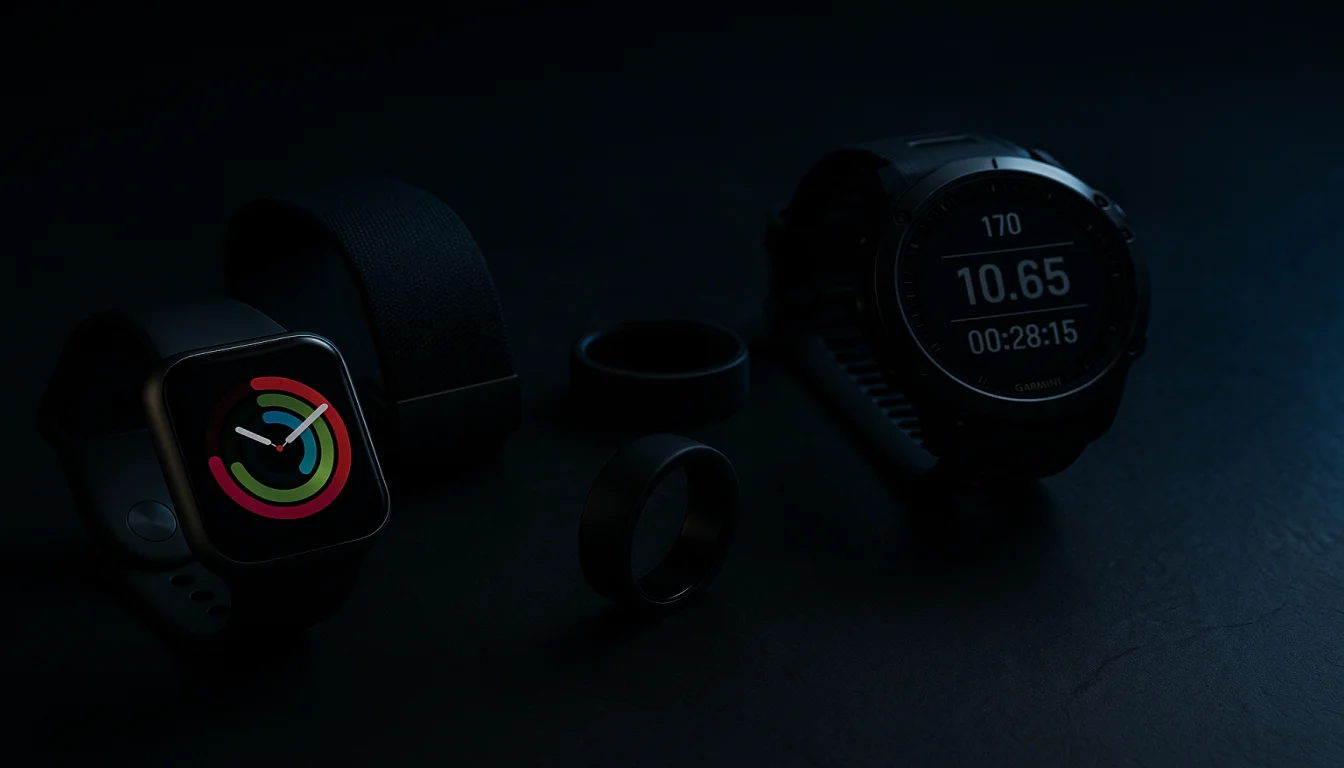
As of September 11, 2026, the current models are the Apple Watch Series 12 ($399/42mm, $449/46mm, retail September 18), the Oura Ring 5 ($399 base, $499 premium finishes, shipping since June 4), WHOOP 5.0 on a $199–$359/yr membership, and Garmin’s Fenix 8 Pro ($1,199.99+) or Forerunner 970 ($749.99). Two of the four changed generation within the last four months.
| Apple Watch Series 12 | Oura Ring 5 | WHOOP 5.0 | Garmin Forerunner 970 / Fenix 8 Pro | |
|---|---|---|---|---|
| Announced | Sept 9, 20261 | May 28, 20262 | May 8, 20253 | May 2025 / Sept 3, 202545 |
| Device price (USD) | $399 (42mm), $449 (46mm) 16 | $399 base, $499 premium finishes2 | Included with membership | $749.99 / $1,199.99 (AMOLED 47mm) 45 |
| Subscription | None | $5.99/mo or $69.99/yr2 | $199–$359/yr (3 tiers) 3 | None |
| Battery | Up to 24 hrs; 15-min charge → 12 hrs1 | 6–9 days2 | 14+ days3 | Up to 15 days / up to 27 days (51mm) 45 |
| Form factor | Wrist smartwatch | Finger ring | Screenless wrist band | Wrist smartwatch/GPS |
| GPS | Yes | No | No | Yes (multi-band GNSS) 4 |
The generational churn is the reason a comparison written even four months ago is now misleading. Two of the arguments this article made in its earlier versions — that Apple samples HRV too sparsely to track recovery, and that its charging cycle blocks overnight data — are substantially weaker against the Series 12 than they were against the Series 10. We say so below rather than quietly leaving the old verdict in place.
How Accurately Does Each Device Measure HRV?
In the most recent independent study to test these devices head-to-head against ECG, the Oura Ring Gen 4 scored a concordance correlation coefficient of 0.99, WHOOP 4.0 scored 0.94, and the Garmin Fenix 6 scored 0.87 across 536 nights7. Those are prior-generation devices. No peer-reviewed validation of the Oura Ring 5, WHOOP 5.0, or Apple Watch Series 12 exists yet.
HRV — heart rate variability — is the signal everything else is built on. Recovery scores, readiness ratings, AI coaching adjustments: they all flow from HRV. Feed a coaching platform bad HRV data and you get bad recommendations.
Understanding the accuracy stakes starts with understanding HRV as a training signal. The metric reflects how well your autonomic nervous system recovered overnight — a direct window into whether your body is primed to absorb hard training or needs another easy day. AI coaching platforms like SensAI are only as good as the data they receive, which is why HRV measurement accuracy is the first thing any serious buyer should investigate.
The gold-standard measure is Lin’s concordance correlation coefficient (CCC). Unlike a simple correlation, CCC penalizes both poor linear association and systematic offset from the reference value. A CCC of 1.0 means perfect agreement with a medical ECG. A CCC of 0.87 sounds close — but at high HRV values (the range that matters most for trained athletes), a 0.12-point gap translates into meaningful score disagreements on your hardest training days.
The landmark validation study by Michael B. Dial and colleagues at The Ohio State University ran 536 nights of simultaneous ECG-reference and consumer-wearable data on 13 healthy adults7:
| Device tested | Overnight HRV CCC vs ECG | MAPE | Current equivalent |
|---|---|---|---|
| Oura Ring Gen 4 | 0.99 | 5.96% | Oura Ring 5 (untested) |
| Oura Ring Gen 3 | 0.97 | 7.15% | — |
| WHOOP 4.0 | 0.94 | 8.17% | WHOOP 5.0 (untested) |
| Garmin Fenix 6 | 0.87 | 10.52% | Fenix 8 Pro / Forerunner 970 (untested) |
| Polar Grit X Pro | 0.82 | 16.32% | — |
| Apple Watch | Not tested | — | Series 12 (untested) |
The authors classify Oura’s agreement as the highest, WHOOP’s as moderate, and both Garmin’s and Polar’s as poor7.
The generational caveat is the honest part of this table. Every device in the study has been superseded. Manufacturers changed sensors between generations — Oura says it reengineered the Ring 5’s sensors for better skin contact and added more powerful LEDs to improve accuracy across finger sizes and skin tones2 — so the 0.99 figure is evidence about a device you can no longer buy new. Treat it as a strong prior about each manufacturer’s sensor engineering, not as a spec for the model in your cart. We cover the broader wearable HRV validation literature separately.
What changed for Apple on September 9, 2026. Apple Watch records HRV as discrete SDNN samples written automatically to HealthKit8. On pre-2026 hardware those samples arrived, in our reading of typical overnight data, far too sparsely to stand in for the continuous rMSSD trace a ring or band produces — a real limitation, and the basis for this article’s previous verdict. The Series 12 changes the measurement itself: it samples heart rate every five seconds all day and measures HRV up to 24 times more often than previous models, with overnight vitals now including a recovery HRV measurement analyzed against your personal baseline1. Apple also shipped a Readiness feature: a single 0–10 score drawn from recent activity, training load, vitals, and sleep, with one of four recommendations — Recover, Pace Yourself, Ready, or Go For It1.
That is a genuine architectural change, not a marketing refresh. It is also entirely unvalidated by anyone outside Apple. Sampling more often is necessary for a good overnight HRV signal but not sufficient — sensor placement, motion artifact rejection, and the sleep-staging model all matter, and a wrist optical sensor still faces harder physics than a finger. The defensible position in September 2026 is that Apple has closed the measurement-design gap and that nobody yet knows whether it closed the accuracy gap. Check back when someone runs a Dial-style study.
There is a second layer of skepticism worth holding, and it applies to Apple’s new Readiness score exactly as it applies to WHOOP Recovery and Oura Readiness. Cailbhe Doherty of the School of Public Health, Physiotherapy and Sports Science at University College Dublin, working with HRV researcher Marco Altini and colleagues, reviewed 14 composite health scores across 10 wearable manufacturers — Garmin’s Body Battery and Training Readiness, Oura’s Readiness and Resilience, and WHOOP’s Strain and Recovery among them. They reported major inconsistencies in how the scores integrate their inputs, limited reproducibility, and proprietary algorithms that constrain clinical trust and interpretability9. A validated HRV sensor and a trustworthy readiness score are two different claims. Every device here makes the second one; only Oura, WHOOP, and Garmin have had the first one independently tested at all.
Form Factor and Battery: The Variable Spec Sheets Never Show
Compliance beats precision. Oura Ring 5 runs 6–9 days per charge, WHOOP 5.0 runs 14+ days with on-band charging, and Garmin’s Fenix 8 Pro runs up to 27 days. The Apple Watch Series 12 gets up to 24 hours, but a 15-minute charge now buys 12 more, which largely solves its overnight gap.
A 99th-percentile accurate device you pull off at 10 PM beats nothing. A device you wear every night — even if slightly less precise — beats one that sits on the charger. Compliance is what determines whether you’re building a recovery dataset or just owning expensive hardware.
Apple Watch Series 12 is rated for up to 24 hours of everyday use, and Apple’s fast charging now delivers up to 12 additional hours from a 15-minute charge1. This is the update that most weakens the old “charging paradox” argument: a quarter-hour on the charger while you brush your teeth covers the entire sleep window. The habit is still a habit you have to build — but it is now a 15-minute habit, not a 2–3 hour one.
Oura Ring 5 lasts six to nine days on a charge, up from five to eight days on the Ring 42. It is also about 40% smaller than its predecessor — roughly two millimeters narrower and about 30% thinner. Because a ring doesn’t feel like a device you’re “wearing,” people rarely remove it. That consistency is worth more than any spec number.
WHOOP 5.0 carries 14+ days of battery in a body about seven percent smaller than the 4.03. On-band charging via the Wireless PowerPack, which WHOOP includes from the Peak tier upward10, means you charge while you wear it, eliminating the compliance problem almost entirely. Screenless by design — no notifications, no apps, no distractions. It is a pure recovery device.
Garmin Fenix 8 Pro reaches up to 27 days in smartwatch mode on the 51mm AMOLED model, or up to 10 days on the 51mm MicroLED version, whose 400,000-plus LEDs hit 4,500 nits — the brightest smartwatch display shipped to date5. The Forerunner 970 is rated up to 15 days in smartwatch mode and 26 hours in GPS-only mode, with multi-band GNSS for positioning accuracy in urban canyons and dense tree cover4. For multi-day events or expedition training where charging is genuinely difficult, nothing else in this comparison is close.
WHOOP vs Garmin (and Garmin vs WHOOP): The Direct Comparison
Choose WHOOP if recovery and sleep drive your training and you do not need GPS: $199/yr, no screen, 14+ day battery. Choose Garmin if you run, ride or race outdoors: the Forerunner 970 ($749.99) and Fenix 8 Pro ($1,199.99+) have multi-band GPS, sport-specific profiles and up to 27 days of battery, with no subscription at all.
This is the pairing people search for most often after the three-way recovery comparison, and the answer is unusually clean because the two devices barely overlap.
| WHOOP 5.0 | Garmin (Forerunner 970 / Fenix 8 Pro) | |
|---|---|---|
| Year-one cost | $199 (One) / $239 (Peak) / $359 (Life) 3 | $749.99 / $1,199.99+45 |
| Year-three cumulative | $597 / $717 / $1,077 | $749.99 / $1,199.99+ |
| GPS | None | Multi-band GNSS4 |
| Screen | None | AMOLED or MicroLED5 |
| Validated HRV (prior gen) | CCC 0.94 (WHOOP 4.0) 7 | CCC 0.87 (Fenix 6) 7 |
| Battery | 14+ days3 | Up to 15 / up to 27 days45 |
| Satellite messaging | No | Yes, on Fenix 8 Pro (inReach) 5 |
| Best for | Recovery-first athletes | Endurance and outdoor athletes |
The cost curves cross in only one place. By year three, WHOOP One ($597) and Peak ($717) are both still cheaper than a one-time Forerunner 970 ($749.99), and even WHOOP Life ($1,077) sits below a Fenix 8 Pro AMOLED ($1,199.99). Garmin comes out cheaper in exactly one of the six pairings — WHOOP Life against the Forerunner 970 — and the gap only widens in Garmin’s favour in year four, when the membership keeps charging and the watch does not.
The honest split: if you never run outdoors, Garmin’s core advantage is wasted on you and WHOOP’s recovery model is the better instrument. If you do, WHOOP cannot record your session at all, and you will end up wearing two devices anyway. For the mechanics of how each platform turns raw HRV into a daily number, see how Body Battery, WHOOP Recovery, and Oura Readiness are actually calculated and our deeper breakdown of WHOOP’s Strain score.
Which Device Fits Your Training Style?
Strength and gym athletes should buy the Apple Watch. Endurance runners, cyclists and triathletes should buy Garmin. Recovery-focused and HRV-driven athletes should buy Oura or WHOOP. Hybrid athletes frequently end up with two devices — Apple Watch plus Oura Ring, about $798 combined.
Your training style should drive your device choice more than brand loyalty.
Strength and gym athletes get the most utility from the Apple Watch. The active workout interface, set-and-rep tracking, heart rate zone data, and gym-workflow integration are unmatched in the category. Oura offers essentially nothing here — it is a passive sensor with no workout interface. WHOOP tracks strain but not exercise-type granularity for strength work. Garmin has strength profiles, but the device is primarily optimized for endurance sport.
Endurance runners, cyclists, and triathletes belong with Garmin — or an Apple Watch for shorter efforts. Garmin’s multi-band GNSS delivers positioning accuracy that matters on technical trails and in cities4. Its running power metrics, VO2 max estimation, race predictor, and sport-specific profiles go far deeper than any other device here. The Series 12’s up-to-10-hour outdoor workout battery — 25% more than the previous model1 — makes it viable for a marathon, but not for an ultra or a full-day adventure. WHOOP and Oura both lack GPS entirely.
Recovery-focused athletes and HRV training practitioners get the most from Oura and WHOOP. On the prior generation, Oura held a measurable accuracy edge (CCC 0.99 vs 0.94) 7. WHOOP’s counter-advantage is contextual: its system explicitly connects how hard you trained (Strain) to how well you recovered (Recovery), making the load-readiness relationship legible in a way the others leave you to infer. Oura’s Ring 5 adds Blood Pressure Signals during sleep and nighttime breathing tracking2, pushing it further toward general health monitoring.
Hybrid athletes — gym work plus running, or strength plus sport — often end up with two devices. Apple Watch Series 12 plus Oura Ring 5 is the common and effective pairing: the watch handles active workout tracking and smartwatch utility, the ring handles overnight HRV and sleep. SensAI supports exactly this setup through HealthKit, synthesizing active workout data from the watch with sleep and recovery data from the ring into one picture of your training state.
If you want to understand how fitness apps use your Oura and WHOOP data beyond the devices’ native interfaces, the coaching layer matters as much as the hardware.
Sleep-focused users — anyone for whom sleep quality is the primary health priority — should buy Oura. The ring form factor eliminates the compliance friction that makes other devices inconsistent. If you’re weighing it against other rings specifically, we compare Oura against the Galaxy Ring and Ultrahuman Ring separately.
How Each Device Connects to Apple Health — and Why It Matters for AI Coaching
Only the Apple Watch writes HRV into Apple Health. Oura exports sleep stages, heart rate, respiratory rate, steps, active energy and workouts — but not HRV, Readiness or temperature11. WHOOP exports sleep, resting heart rate, respiratory rate, SpO2 and workouts, and explicitly does not export HRV12. Garmin shares steps, sleep, workouts and heart rate, keeping VO2 max and Training Readiness in Garmin Connect13.
This is the most misreported section in every comparison of these devices, including earlier versions of this one. “Syncs with Apple Health” is not one thing — each manufacturer picks which HealthKit data types it writes, and all three third-party brands withhold their headline recovery metric.
HealthKit is the nervous system connecting your wearable data to every coaching platform and third-party app that wants to act on your health metrics. What each device actually writes determines how much of your data becomes usable outside its own app.
| Data type | Apple Watch | Oura Ring 511 | WHOOP12 | Garmin13 |
|---|---|---|---|---|
| HRV | Yes (SDNN) 8 | No | No | Not a listed category |
| Sleep stages | Yes | Yes | No — asleep/awake only14 | Sleep Analysis13 |
| Heart rate | Yes, continuous | Yes, 1-min intervals | Sparse — no workout HR series14 | Yes |
| Respiratory rate | Yes | Yes (nightly average) | Yes | No |
| Workouts | Yes | Yes (+ routes) | Yes | Yes |
| Active energy | Yes | Yes | Yes | Yes |
| Proprietary score | Readiness — Apple’s own surface1 | Readiness: no | Recovery/Strain: no | Body Battery, VO2 max: no |
Apple Watch Series 12 integrates natively and in real time: heart rate, HRV, sleep, workouts and respiratory rate all land in HealthKit as standard data types, with no sync delay and no third-party app in the path. Because the Series 12 samples heart rate every five seconds and HRV up to 24 times more often than before1, there is far more underlying signal for it to write. One caveat applies to Apple too — its new Readiness score is an Apple-app surface, not a HealthKit type other apps can read.
Oura Ring 5 exports Active Energy, Heart Rate in one-minute intervals, Height, Mindful Minutes, nightly average Respiratory Rate, Sleep (duration, start/end time and stages), Steps, Weight, Workouts and Workout Routes11. HRV, the Readiness Score and skin temperature are not on that list — they stay inside the Oura app. Oura’s own documentation notes that Apple Health updates appear after an activity or workout completes11, so this is a batched export rather than a live feed.
WHOOP writes sleep, resting heart rate, respiratory rate, blood oxygen, workouts and workout calories12. It is the thinnest export of the four, and two gaps matter. It does not send HRV — the reason is technical rather than commercial: WHOOP computes RMSSD while Apple Health stores SDNN, and the two are not interchangeable. What it does write is also coarse: sleep arrives as asleep/awake blocks rather than WHOOP’s five-stage breakdown, and heart rate does not come through as a workout series14. For WHOOP data at full resolution in another app, you need WHOOP’s own API, not HealthKit.
Garmin Connect pushes steps, sleep, workouts with duration and heart rate, active energy, distance and weight into Apple Health, one-way13. Its proprietary analytics — VO2 max, Training Readiness, Body Battery and HRV Status — are not among the shared categories and remain in Garmin Connect.
The practical consequence: if you want a coaching platform to read your recovery data, an Apple Watch hands over the most, Oura and WHOOP hand over the sleep and heart-rate substrate but keep the score, and Garmin keeps its analytics entirely. That is why platforms that depend on HealthKit alone see a different picture depending on which device you wear.
Whether you use Apple Watch natively, Garmin for GPS training, or Oura Ring for sleep accuracy, SensAI pulls your health data through HealthKit and uses LLM intelligence to translate it into a weekly training program that adapts to how your body actually recovered. The AI reads the HRV and sleep-quality trends your device exposes along with your training load; synthesizes them against your goals and constraints; and generates a program from scratch — not a template — that reflects what your body can handle this week.
For athletes running a multi-device setup — Oura for sleep, Garmin for runs — SensAI can synthesize those streams into a single coherent readiness picture. That is where the platform earns its keep: not by giving you another score, but by turning a messy multi-device dataset into a training decision.
Privacy note: SensAI uses aggregated recovery metrics for coaching. Raw HealthKit data stays on-device.
To see how AI and wearable integration is changing fitness coaching more broadly, the 2026 overview of AI and wearables in fitness covers the platform landscape in detail.
The Cost of Ownership: Which Device Is Cheapest Over 3 Years?
Over three years: Apple Watch Series 12 $399, WHOOP One $597, Oura Ring 5 about $609, WHOOP Peak $717, Garmin Forerunner 970 $749.99, WHOOP Life $1,077, Garmin Fenix 8 Pro AMOLED $1,199.99. Subscriptions, not sticker prices, drive the ranking.
The sticker price isn’t the real number. For two of these four brands, the real cost plays out over years. Here is the honest math, priced September 11, 2026.
| Device cost | Annual subscription | 3-year total | |
|---|---|---|---|
| Apple Watch Series 12 (42mm) | $3991 | $0 | $399 |
| Apple Watch Series 12 (46mm) | $4496 | $0 | $449 |
| WHOOP One | Included | $1993 | $597 |
| Oura Ring 5 (base finish) | $3992 | $69.992 | ~$609 |
| WHOOP Peak | Included | $2393 | $717 |
| Garmin Forerunner 970 | $749.994 | $0 | ~$750 |
| WHOOP Life (WHOOP MG) | Included | $3593 | $1,077 |
| Garmin Fenix 8 Pro (AMOLED, 47mm) | $1,199.995 | $0 | ~$1,200 |
Two results are worth pulling out.
The Apple Watch is now the cheapest device in the comparison and no longer the weakest on recovery. That combination did not exist before September 9, 2026. Its 3-year cost is $198 below WHOOP One and $210 below an Oura Ring 5 — and it is the only device here that does active workout tracking, GPS, and overnight HRV in one $399 package.
WHOOP’s subscription inverts against Garmin over time. By month 36 the Life tier has cost $1,077 — more than a Forerunner 970 and closing on a Fenix 8 Pro, neither of which charges anything ongoing. Whether that is worth it depends on what you value: if WHOOP’s daily recovery coaching changes even one bad training decision a month — prevents one overtraining injury, catches one cumulative fatigue week — the membership probably earns its keep. That is the values question subscription models always pose.
One historical note, since it is widely misreported: Oura introduced the $5.99/month membership in October 2021 alongside the $299 Gen 3 ring, not later, and Gen 2 owners who upgraded to a Gen 3 at launch received a lifetime membership rather than being moved onto the new charge15. The subscription applied to new Gen 3 buyers. It is still a real ongoing cost today, at $5.99/month or $69.99/year16, but it was not a retroactive charge.
Quick Answers: The Head-to-Head Questions People Actually Search
Most buyers do not compare all four at once — they pit two or three against each other. Each question below is answered on its own, in the order people search them: the three-way recovery comparison first, then WHOOP against Garmin, then the subscription and battery questions that decide close calls.
WHOOP vs Oura vs Apple Watch: Which Is Best for Recovery and HRV?
In the most recent head-to-head ECG validation, the Oura Ring Gen 4 led at CCC 0.99 with WHOOP 4.0 at 0.947; the Apple Watch was not tested and, on pre-2026 hardware, recorded HRV as sparse discrete SDNN samples rather than a continuous overnight signal8. The Series 12 changed that in September 2026 by sampling HRV up to 24 times more often and adding a 0–10 Readiness score1, but no independent validation of it exists yet. Pick Oura for the cleanest sleep and HRV data, WHOOP if you want that data wrapped in strain-to-recovery coaching, and Apple Watch if you want one device and are willing to wait on the accuracy evidence.
WHOOP vs Garmin (Garmin vs WHOOP): Which Should I Buy?
WHOOP if recovery and sleep drive your training and you do not need GPS; Garmin if you train outdoors. WHOOP costs $199–$359/yr with no hardware charge and has no GPS or screen3; a Forerunner 970 is $749.99 once, with multi-band GNSS and up to 15 days of battery4. By year three Garmin is cheaper only if you are on WHOOP’s top Life tier; after that the subscription keeps running and the watch does not.
WHOOP vs Garmin vs Apple Watch: Which One?
Three different jobs, so pick by the one you actually need: WHOOP ($199/yr) for screenless recovery coaching, Garmin ($749.99+) for outdoor GPS and multi-week battery, and the Apple Watch Series 12 ($399) for one device that does workouts, notifications and — since September 2026 — overnight HRV, at the lowest three-year cost of the three.
Oura Ring vs WHOOP vs Apple Watch: Which Should You Buy?
Oura Ring 5 ($399 + $69.99/yr) for the most accurate sleep and HRV signal, WHOOP ($199/yr) for the clearest strain-to-recovery coaching, Apple Watch Series 12 ($399) if you also want workouts, GPS and notifications from the same device. Oura and WHOOP have independent ECG validation on their prior generations7; the Apple Watch has none.
Is the Apple Watch Accurate Enough to Drive Recovery Decisions?
As of the Series 12, on paper yes — it samples heart rate every five seconds, measures HRV up to 24 times more often than previous models, and computes recovery HRV against your personal baseline1. The caveat is that no independent study has tested it. On pre-Series-12 hardware the answer was no for overnight recovery, though it was always excellent for active workouts and has carried an ECG app with FDA De Novo classification for atrial fibrillation since the Series 4 in 201817.
Oura vs WHOOP: Which Measures HRV More Accurately?
In the Dial et al. validation against ECG, the Oura Ring Gen 4 scored CCC 0.99 and WHOOP 4.0 scored 0.94 — both excellent, with Oura holding a measurable edge at the high HRV values that matter most on hard-training days7. Both devices have since been replaced by untested successors. WHOOP’s counter-advantage is contextual: it explicitly links Strain to Recovery, a relationship Oura leaves you to infer.
Oura Ring vs WHOOP vs Garmin: Which for a Non-Runner?
Oura or WHOOP. Garmin’s advantages are GPS, sport profiles, and battery for outdoor endurance work; if you train indoors, you are paying $749.99 or more for capability you will not use, and both Oura ($399 + $69.99/yr) and WHOOP ($199/yr) deliver a better recovery signal for less.
Do These Trackers Need a Subscription?
Apple Watch and Garmin have no subscription. Oura charges $5.99/month or $69.99/year, and WHOOP is subscription-only across three tiers: One at $199/yr, Peak at $239/yr, and Life at $359/yr32. Over three years that makes the Apple Watch cheapest ($399) and WHOOP Life and the Fenix 8 Pro the priciest.
Which Tracker Has the Longest Battery Life?
The Garmin Fenix 8 Pro AMOLED (51mm), at up to 27 days in smartwatch mode5. The Forerunner 970 follows at up to 15 days4, WHOOP 5.0 at 14+ days3, the Oura Ring 5 at six to nine days2, and the Apple Watch Series 12 at up to 24 hours — though its 15-minute fast charge returns up to 12 hours1.
Whichever pair you are weighing, the device that wins is the one whose data your coaching actually uses — which is why SensAI reads all four through HealthKit and turns whatever your device records into a training plan that adapts to how you recovered.
Our Verdict: Match the Device to Your Situation
Sleep and HRV accuracy first: Oura Ring 5, $399. Recovery coaching without a screen: WHOOP One, $199/yr. Outdoor training: Garmin Forerunner 970, $749.99, or Fenix 8 Pro, $1,199.99. One device for everything at the lowest three-year cost: Apple Watch Series 12, $399. Both active tracking and overnight recovery: Series 12 plus Oura Ring 5, about $798 plus $69.99/yr.
The best way to decide isn’t to find the highest-rated device. It’s to find the device built for the athlete you actually are.
| If you are… | Buy | 3-year cost |
|---|---|---|
| An iPhone owner who wants one device for everything | Apple Watch Series 12 (42mm) | $399 |
| Budget-constrained | Apple Watch Series 12 (42mm) | $399 |
| Sleep- and HRV-accuracy driven | Oura Ring 5 | ~$609 |
| A recovery-focused athlete who wants no screen | WHOOP One | $597 |
| A runner or triathlete | Garmin Forerunner 970 | ~$750 |
| A multisport or expedition athlete | Garmin Fenix 8 Pro (AMOLED) | ~$1,200 |
| A hybrid athlete wanting active + overnight data | Apple Watch Series 12 + Oura Ring 5 | ~$1,008 |
If you want a smartwatch that handles calls, messages, and fitness in one device, and you use an iPhone → Apple Watch Series 12. Nothing competes with it as a full-stack wearable for iOS users, and its recovery story is dramatically stronger than it was a week ago.
If sleep accuracy and HRV validation are your top priorities → Oura Ring 5. The prior generation posted the highest CCC of the five devices Dial et al. tested against ECG7, the Ring 5’s sensors were reengineered rather than carried over2, and the ring form factor means you will actually wear it every night.
If you are a serious athlete wanting daily recovery coaching without smartwatch distraction → WHOOP. The screenless design, 14+ day battery, and integrated strain-to-recovery system is a coherent philosophy executed well. Start at the One tier ($199/yr) unless you specifically want the Wireless PowerPack (Peak, $239/yr) or medical-grade ECG and blood pressure insights (Life with WHOOP MG, $359/yr) 310.
If you are an endurance athlete who needs GPS precision, sport profiles, and weeks of battery → Garmin. The Forerunner 970 for runners at $749.99; the Fenix 8 Pro for multisport and expedition use, where inReach satellite messaging and up to 27 days of battery have no equivalent in this comparison45.
If you want both active workout tracking and passive overnight recovery → Apple Watch Series 12 + Oura Ring 5, about $798 combined plus $69.99/yr. Best active tracking interface and the most accurate passive recovery sensor, simultaneously.
If budget is the primary constraint → Apple Watch Series 12 (42mm). Lowest 3-year cost in the category at $399, no subscription, broadest utility of any single device here.
If you want the strongest published accuracy evidence → Oura. It is the only device in the Dial et al. comparison to reach a 0.99 CCC against ECG7 — with the honest asterisk that the tested ring is last year’s.
What is not in this comparison, and why. The Samsung Galaxy Watch is excluded because its health features are gated to Samsung phones, which rules it out for most buyers weighing these four. The Samsung Galaxy Ring, Ultrahuman Ring Air and the Amazfit range are excluded because we found no independent ECG-referenced HRV validation of them. Coros does ship its own recovery layer through EvoLab and is a credible Garmin alternative for endurance athletes, but that layer is likewise unvalidated against ECG. Fitbit is excluded because Google account requirements and a shifting Premium feature set make a three-year cost estimate unreliable. Polar’s Grit X Pro was tested in the Dial et al. study7 — it posted the lowest HRV CCC of the five devices — but it is not a mainstream option in this category.
Any of these devices, used consistently, makes you a smarter athlete. The data they surface — even imperfect data — is more actionable than training by feel alone. When your wearable scores conflict with how you feel, that tension is itself useful information.
Whichever device you land on, SensAI works with all four through HealthKit. It reads what your device actually writes there — sleep, heart rate, workouts, and HRV where the manufacturer exposes it — and uses LLM intelligence to translate it into a training program built for your body, your schedule, and your real recovery state. Device-agnostic by design, and honest about the fact that an Apple Watch hands it more to work with than a WHOOP does.
References
Footnotes
-
Apple. “Introducing Apple Watch Series 12, with the all-new Health Sensing System.” Apple Newsroom, September 9, 2026. https://www.apple.com/newsroom/2026/09/introducing-apple-watch-series-12-with-the-all-new-health-sensing-system/ ↩ ↩2 ↩3 ↩4 ↩5 ↩6 ↩7 ↩8 ↩9 ↩10 ↩11 ↩12 ↩13
-
Wiggers, K. “Oura unveils its Ring 5 with a thinner, lighter design starting at $399.” TechCrunch, May 28, 2026. https://techcrunch.com/2026/05/28/oura-unveils-its-ring-5-with-a-thinner-lighter-design-starting-at-399/ ↩ ↩2 ↩3 ↩4 ↩5 ↩6 ↩7 ↩8 ↩9 ↩10 ↩11 ↩12
-
WHOOP. “WHOOP Unveils WHOOP 5.0 and WHOOP MG — Powerful New Devices with Breakthrough Health and Longevity Features.” WHOOP Press Release, May 8, 2025. https://www.whoop.com/us/en/press-center/whoop-unveils-5.0-MG/ ↩ ↩2 ↩3 ↩4 ↩5 ↩6 ↩7 ↩8 ↩9 ↩10 ↩11 ↩12 ↩13
-
Maker, R. “Garmin Forerunner 970 In-Depth Review.” DC Rainmaker, June 2025. https://www.dcrainmaker.com/2025/06/garmin-forerunner-970-in-depth-review-brillance.html ↩ ↩2 ↩3 ↩4 ↩5 ↩6 ↩7 ↩8 ↩9 ↩10 ↩11 ↩12 ↩13
-
Garmin. “Introducing fēnix 8 Pro: The First-Ever Smartwatches from Garmin with inReach Technology for Satellite and Cellular Connectivity.” Garmin Newsroom, September 3, 2025. https://www.garmin.com/en-US/newsroom/press-release/wearables-health/introducing-fenix-8-pro-the-first-ever-smartwatches-from-garmin-with-inreach-technology-for-satellite-and-cellular-connectivity/ ↩ ↩2 ↩3 ↩4 ↩5 ↩6 ↩7 ↩8 ↩9 ↩10 ↩11
-
Clover, J. “Apple Watch Series 12 Received a Price Increase You Might Have Missed.” MacRumors, September 10, 2026. https://www.macrumors.com/2026/09/10/apple-watch-series-12-46mm-price-increase/ ↩ ↩2
-
Dial, M. B., Hollander, M. E., Vatne, E. A., Emerson, A. M., Edwards, N. A., & Hagen, J. A. “Validation of nocturnal resting heart rate and heart rate variability in consumer wearables.” Physiological Reports, 13(16), e70527, 2025. PMID: 40834291. https://doi.org/10.14814/phy2.70527 ↩ ↩2 ↩3 ↩4 ↩5 ↩6 ↩7 ↩8 ↩9 ↩10 ↩11 ↩12
-
Apple. “Heart Rate Variability (SDNN).” Apple Developer Documentation, 2025. https://developer.apple.com/documentation/healthkit/hkquantitytypeidentifier/heartratevariabilitysdnn ↩ ↩2 ↩3
-
Doherty, C., Baldwin, M., Lambe, R., Burke, D., & Altini, M. “Readiness, recovery, and strain: an evaluation of composite health scores in consumer wearables.” Translational Exercise Biomedicine, 2(2), 128–144, 2025. https://doi.org/10.1515/teb-2025-0001 ↩
-
WHOOP. “WHOOP Membership Options — Compare Plans & Features.” WHOOP, 2026. https://www.whoop.com/us/en/membership/ ↩ ↩2
-
Oura. “Apple Health Integration.” Oura Member Care, 2026. https://support.ouraring.com/hc/en-us/articles/360025438734-Apple-Health-Integration ↩ ↩2 ↩3 ↩4
-
WHOOP. “Apple Health Integration.” WHOOP Support, 2026. https://support.whoop.com/s/article/Apple-Health-Integration ↩ ↩2 ↩3
-
Garmin. “Sharing Your Garmin Connect Data With Apple Health.” Garmin Customer Support, 2026. https://support.garmin.com/en-US/?faq=lK5FPB9iPF5PXFkIpFlFPA ↩ ↩2 ↩3 ↩4
-
Maker, R. “Whoop Exporting to Apple Health: Here’s how it actually works.” DC Rainmaker, April 2022. https://www.dcrainmaker.com/2022/04/exporting-health-actually.html ↩ ↩2 ↩3
-
Oura Health. “ŌURA Health Launches Oura Ring Generation 3.” Business Wire, October 26, 2021. https://www.businesswire.com/news/home/20211026005340/en/URA-Health-Launches-Oura-Ring-Generation-3 ↩
-
Oura. “Oura Membership.” Oura Ring, 2023. https://ouraring.com/membership ↩
-
Apple. “ECG app and irregular heart rhythm notification available today on Apple Watch.” Apple Newsroom, December 6, 2018. https://www.apple.com/newsroom/2018/12/ecg-app-and-irregular-heart-rhythm-notification-available-today-on-apple-watch/ ↩