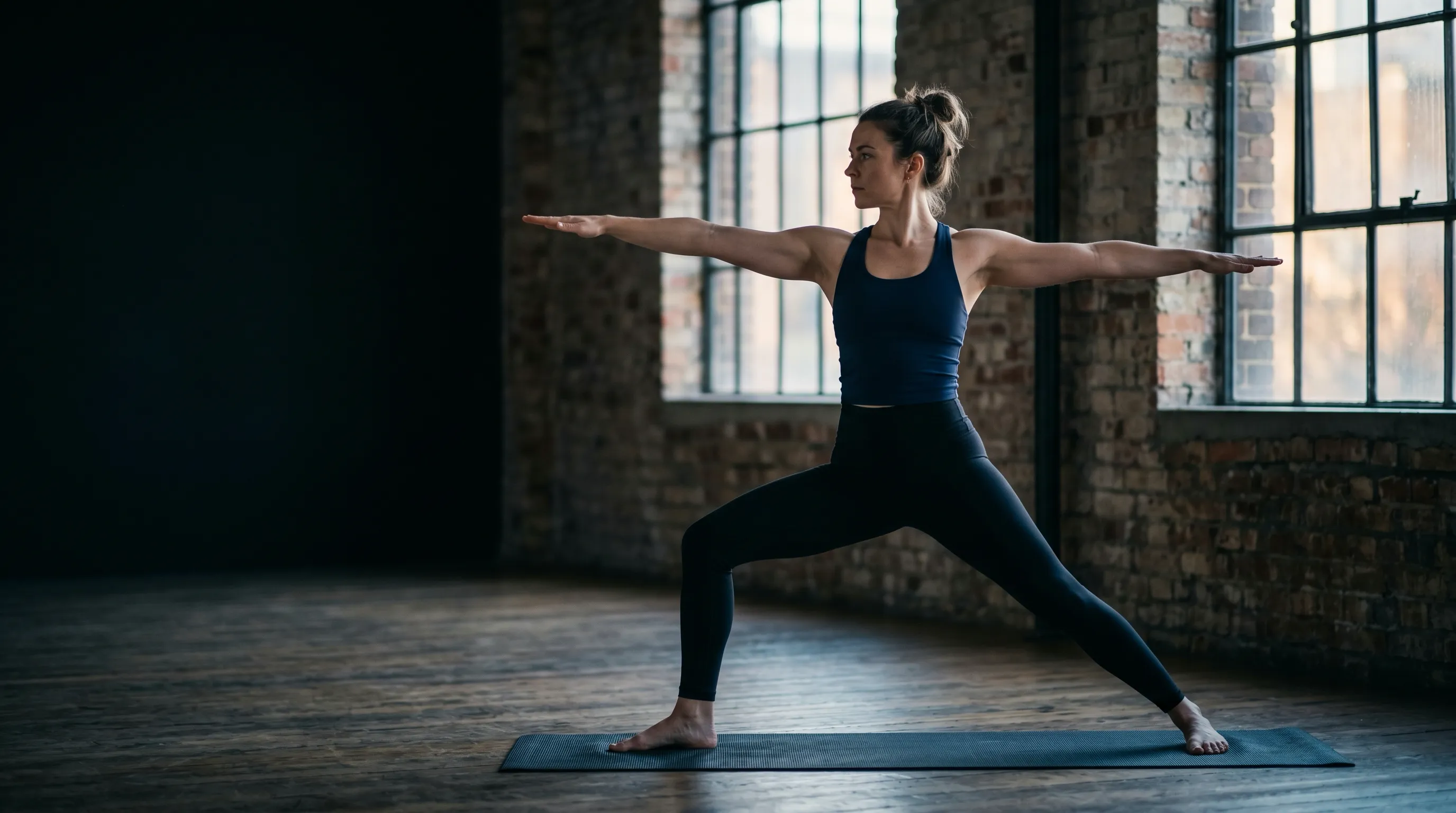
Yoga for Beginners: How to Start, What the Research Says, and a Simple First Routine
An evidence-aware beginner yoga guide covering styles, realistic benefits, safety, and a gradual four-week starter routine.

SensAI Team
12 min read
Get a training plan that adapts to your recovery — free on iOS

Most yoga advice either assumes you already know the poses or stays so abstract that a beginner still does not know what to do. A useful starting guide should answer four questions: which class fits your goal, how much practice is realistic, what benefits the research supports, and when you should modify or stop.
This article offers a gradual four-week routine, but it is not a medical prescription. Yoga can complement appropriate care; it should not replace treatment for depression, high blood pressure, persistent pain, or another health condition.
Which Style of Yoga Matches Which Goal?
Yoga styles overlap, and labels vary between teachers and studios. Choose a class by its actual pace, poses, and level rather than assuming the name guarantees a specific intensity or outcome.
Hatha classes commonly move slowly and spend more time setting up and holding poses. That can make a beginner-level hatha class an approachable first step, but research on depression and other outcomes includes several styles and does not establish hatha as universally best.1
Vinyasa links poses in a continuous flow. Yoga averaged about 3.3 METs across the studies in one systematic review, while some faster sequences, including certain sun-salutation protocols, reached higher intensities.2 A class can therefore range from light to vigorous; the label alone does not make it cardiovascular training.
Yin generally uses long, supported, passive holds. Some people enjoy it as mobility practice, but claims that it uniquely changes fascia or avoids all muscular fatigue are not established.
Restorative uses props and supported positions to reduce physical effort. A meta-analysis found changes in several stress-related measures across heterogeneous yoga and mindfulness interventions, but it did not show that restorative yoga has a uniquely strong cortisol-lowering mechanism.3
Power and Ashtanga classes are usually faster and more demanding. Beginners who choose them should look for an introductory class, use modifications, and avoid inversions or ranges they cannot control.
| Style | Typical Pace | What to Expect | Beginner Starting Point |
|---|---|---|---|
| Hatha | Slow to moderate | Pose setup, holds, breathing | Introductory class |
| Vinyasa | Moderate to vigorous | Continuous transitions | Beginner or slow-flow class |
| Yin | Slow | Long, often supported holds | Short, comfortable holds |
| Restorative | Very slow | Props and low-effort positions | Useful when a gentler session is preferred |
| Power/Ashtanga | Vigorous | Faster sequences and demanding poses | Learn foundations first or use an introductory class |
SensAI includes Yoga as a workout type. Its large-language-model coach can generate a plan from your goals, available time, equipment, and stated constraints. Recovery context can inform later weekly programming, but a wearable score does not diagnose which yoga style your body needs.
What the Research Says Yoga Can—and Cannot—Do
Yoga research varies widely in style, session length, comparator, and participant population. Treat average study results as context, not a guaranteed personal response.
Depression. A 2024 review covering 1,395 participants found a moderate reduction in symptoms versus passive controls, but the effect was not significant versus active controls in some analyses, and certainty ranged from moderate to very low.1 A broader exercise network meta-analysis also found yoga helpful, but indirect effect-size comparisons do not establish that yoga works the same as antidepressant medication.4 Yoga can be an adjunct to professional care, not a replacement. If you may harm yourself or cannot stay safe, contact local emergency or crisis services now.
Blood pressure. A 2025 review found average reductions of about 8 mmHg systolic and 5 mmHg diastolic versus waitlist controls among people with prehypertension or hypertension.5 Heterogeneity was high and certainty was very low, so this does not justify changing medication or monitoring without a clinician.
Workplace well-being. A review of desk-based workers reported possible improvements in pain, function, and mental health, but the studies were heterogeneous and the certainty was low or very low.6 It does not establish one optimal schedule or prove online and in-person delivery are equivalent for everyone.
Flexibility. Static stretching can improve range of motion, and many yoga practices include it.7 Improvements depend on the poses, total exposure, and the person rather than the yoga label alone.
Strength, bone health, and weight. Some demanding poses can improve balance and muscular endurance, but evidence for bone-density effects is inconclusive and yoga is not a complete substitute for progressive resistance training. Yoga also does not bypass energy balance for weight loss. Use it as one part of a broader activity plan.
How Often and How Long?
The studies do not converge on one universal minimum effective dose. Interventions often use two or three sessions per week for several weeks, but session length and style vary substantially.1456
| Goal | Practical Beginner Start | Evidence Caveat |
|---|---|---|
| Learn the movements | 10–20 min, 1–2x/week | Technique and comfort matter more than reaching a fixed dose |
| Flexibility | 15–30 min, 2x/week | Adaptation depends on the specific positions and total stretch exposure |
| Stress management | Short, regular sessions | Response is individual; yoga is not treatment for a mental-health crisis |
| Blood-pressure support | Discuss with a clinician when relevant | Trials mainly involved people with elevated blood pressure |
| General activity | Add gradually to other movement | Some activity is better than none; yoga need not be the only modality |
Start below your current tolerance and add time only when the practice leaves you feeling recovered rather than progressively more painful or exhausted. SensAI can generate a yoga workout within the schedule and constraints you provide; it does not infer a medically correct dose from HRV.
Injury Risk and Beginner Safety
One systematic review estimated 1.18 injuries per 1,000 practice hours across five heterogeneous epidemiological studies.8 That estimate cannot be cleanly compared with injury rates from running studies that used different populations and definitions. Reported yoga injuries are often musculoskeletal, but serious adverse events can occur; “low average rate” does not mean risk-free.
Use these safeguards:
- Choose a beginner class or qualified instructor when you are learning unfamiliar positions.
- Move within a pain-free range and use blocks, a chair, wall support, or a folded blanket when helpful.
- Do not force a joint, hold your breath, or copy an advanced inversion because someone else can do it.
- Stop for sharp or increasing pain, chest pain or pressure, faintness, severe shortness of breath, new weakness or numbness, or a severe headache. Seek appropriate medical care.
- Ask a qualified clinician about modifications if you are pregnant or have an acute injury, significant joint or spine condition, glaucoma or retinal disease, uncontrolled blood pressure, or another condition affected by position or exertion.
Hot rooms, fatigue, and unsupervised advanced poses can make it harder to judge a safe range. A guided illustration can help you recognize a pose, but it cannot assess your alignment or replace an instructor or clinician.
A Gradual Four-Week Starter Routine
This example assumes you can get down to and up from the floor comfortably. If not, use standing or chair-supported alternatives. Keep every movement comfortable and skip any pose that conflicts with medical guidance you have received.
Weeks 1–2: Learn the pattern (2 sessions per week, 10–20 minutes)
- Comfortable breathing (1–2 minutes). Breathe without straining. A slightly longer exhale may feel calming, but one breathing ratio is not proven to switch the nervous system into a specific state.
- Movement (8–15 minutes). Try Cat-Cow, Mountain Pose, a supported forward fold, a short Warrior I stance, and Child’s Pose or a chair-supported rest. Use 3–5 comfortable breaths per position.
- Quiet finish (1–3 minutes). Rest in a position that feels comfortable. Side-lying or supported reclining is a valid alternative to lying flat.
Weeks 3–4: Add only tolerated volume (2–3 sessions per week, 15–30 minutes)
- Repeat the Week 1–2 movements.
- If transitions feel controlled, add a slow modified sun salutation, Bridge Pose or a supported alternative, and a gentle seated or chair-supported rotation.
- Add a few minutes, not a deeper range, when the previous session caused no concerning symptoms or lingering pain.
Four weeks is enough to learn whether the routine fits your life, not enough to guarantee a specific clinical result. Track comfort, confidence, and consistency before chasing pose depth.
SensAI can generate Yoga sessions from scratch based on the goals, equipment, time, and constraints you share. The workout tracker can provide exercise illustrations and muscle-group context, while you remain in control of requested changes during a session.
What to Track
The most useful beginner measures are simple: whether you practiced, whether movements became more comfortable, and whether symptoms improved or worsened.
HRV and resting heart rate are contextual trends, not diagnostic tests. A review of yoga and HRV found promising results but emphasized small samples, varied methods, and the inability to draw firm conclusions.9 HRV can rise or fall for many reasons. A flat trend does not prove the yoga dose is wrong, and a higher value does not prove recovery.
Sleep and mood are worth noting without promising a mechanism. Record how you feel over several weeks, while remembering that medication, illness, stress, alcohol, menstrual-cycle changes, and many other factors can affect the same measures.
Raw Apple HealthKit data stays on your device. SensAI can use aggregated recovery trends, sleep quality, and workout summaries server-side to give its LLM useful context, and SensAI does not sell that data to third parties.
Getting Started Today
Your first practice can be ten comfortable minutes. You do not need to be flexible before you begin.
If strength performance is the priority, avoid a long bout of static stretching for the same muscles immediately before heavy work. The review behind the often-cited 4.6% reduction found that the clearest acute effect occurred with at least 60 seconds of static stretching per muscle; shorter stretching had a much smaller average effect, and a complete dynamic warm-up can reduce the concern.10 Yoga after lifting or on another day is an option, not a universal requirement.
If you are also starting resistance training, see our beginner gym workout plan and active recovery guide. With SensAI, you can select Yoga as a workout type and ask the LLM coach to create a session that respects your experience, schedule, available equipment, and stated limitations.
References
Footnotes
-
Moosburner, A., Cramer, H., Bilc, M., Triana, J., & Anheyer, D. “Yoga for Depressive Disorder: A Systematic Review and Meta-Analysis.” Depression and Anxiety, 2024. https://pubmed.ncbi.nlm.nih.gov/40226719/ ↩ ↩2 ↩3
-
Larson-Meyer, D. E. “A Systematic Review of the Energy Cost and Metabolic Intensity of Yoga.” Medicine & Science in Sports & Exercise, 48(8), 1558-1569, 2016. https://pubmed.ncbi.nlm.nih.gov/27433961/ ↩
-
Pascoe, M. C., Thompson, D. R., & Ski, C. F. “Yoga, mindfulness-based stress reduction and stress-related physiological measures: A meta-analysis.” Psychoneuroendocrinology, 86, 152-168, 2017. https://pubmed.ncbi.nlm.nih.gov/28963884/ ↩
-
Noetel, M., Sanders, T., Gallardo-Gómez, D., et al. “Effect of exercise for depression: systematic review and network meta-analysis of randomised controlled trials.” BMJ, 384, e075847, 2024. https://pubmed.ncbi.nlm.nih.gov/38355154/ ↩ ↩2
-
Geiger, C., Cramer, H., Anheyer, D., Dobos, G., & Kohl-Heckl, W. K. “A systematic review and meta-analysis of yoga for arterial hypertension.” PLOS ONE, 20(5), e0323268, 2025. https://pubmed.ncbi.nlm.nih.gov/40367243/ ↩ ↩2
-
Wadhen, V., Pavey, L., & Vyas, N. S. “Exploring the effectiveness of yoga interventions in improving the well-being and productivity of desk-based workers — A systematic review and meta-analysis.” Applied Psychology, 74, e70040, 2025. https://iaap-journals.onlinelibrary.wiley.com/doi/10.1111/apps.70040 ↩ ↩2
-
Warneke, K., et al. “Practical recommendations on stretching exercise: A Delphi consensus statement of international research experts.” Journal of Sport and Health Science, 2025. https://pubmed.ncbi.nlm.nih.gov/40513717/ ↩
-
Bekhradi, A., Wong, D., Gerrie, B. J., McCulloch, P. C., Varner, K. E., Ellis, T. J., & Harris, J. D. “Although the injury rate of yoga is low, nearly two-thirds of musculoskeletal injuries in yoga affect the lower extremity: a systematic review.” Journal of ISAKOS, 2018. https://www.sciencedirect.com/science/article/pii/S2059775421002972 ↩
-
Tyagi, A., & Cohen, M. “Yoga and heart rate variability: A comprehensive review of the literature.” International Journal of Yoga, 9(2), 97-113, 2016. https://pubmed.ncbi.nlm.nih.gov/27512317/ ↩
-
Behm, D. G., Blazevich, A. J., Kay, A. D., & McHugh, M. “Acute effects of muscle stretching on physical performance, range of motion, and injury incidence in healthy active individuals: a systematic review.” Applied Physiology, Nutrition, and Metabolism, 41(1), 1-11, 2016. https://pubmed.ncbi.nlm.nih.gov/26642915/ ↩