Grip Strength and Longevity: How to Test, Benchmark, and Train the Biomarker That Predicts How Long You'll Live
A 4-step protocol to test, benchmark, and train your grip strength — the single metric that predicts mortality better than blood pressure. Includes age-specific norms, an 8-week training plan, and retest benchmarks.

SensAI Team
13 min read
Get a training plan that adapts to your recovery — free on iOS

Grip Strength and Longevity: How to Test, Benchmark, and Train the Biomarker That Predicts How Long You’ll Live
Your doctor checks your blood pressure every visit. Nobody checks your grip strength. That’s a problem.
Because grip strength predicts your risk of dying from any cause more accurately than blood pressure does. It predicts heart attack. Stroke. Cancer. Disability. Cognitive decline. And unlike most biomarkers, you can train it deliberately, measure it cheaply, and improve it in weeks.
This article gives you a four-step protocol: Test your current grip strength. Benchmark it against age- and sex-specific norms from 2.4 million adults worldwide. Train it with an 8-week program targeting all four grip patterns. Retest every 8 weeks to track progress against the expected age-related decline. By the end, you’ll know exactly where you stand — and exactly what to do about it.
The Number That Predicts How Long You’ll Live
Grip strength is a stronger predictor of all-cause mortality than systolic blood pressure. That’s not speculation — it’s the conclusion of the largest study ever conducted on the topic.
The Prospective Urban Rural Epidemiology (PURE) study, led by Dr. Darryl Leong at McMaster University, tracked 139,691 adults across 17 countries over a median follow-up of four years1. The findings were striking: every 5 kg decrease in grip strength was associated with a 16% increase in all-cause mortality, a 17% increase in cardiovascular mortality, and a 7% increase in the risk of myocardial infarction1.
Think of grip strength as a dashboard light for your entire body. When it drops, it’s not because your hands got weaker — it’s because something systemic is changing. Muscle mass, neuromuscular efficiency, hormonal status, nutritional health, inflammatory load — grip captures all of it in a single squeeze.
A separate UK Biobank analysis of 502,293 participants, led by Celis-Morales and colleagues, confirmed the pattern across an even broader set of outcomes: each 5 kg reduction in grip strength was associated with a 16–20% higher risk of all-cause mortality and significant increases in cardiovascular, respiratory, and cancer-related death2. The associations held after adjusting for age, sex, body mass, and physical activity.
This isn’t a niche finding buried in an obscure journal. It’s replicated across hundreds of thousands of people, dozens of countries, and multiple disease categories. Your grip strength is talking. The question is whether you’re listening.
The protocol that follows is a four-step loop: test, benchmark, train, retest. Do it once and you’ll know where you stand. Repeat it every eight weeks and you’ll build one of the most powerful longevity habits available — one that costs almost nothing and takes less than 20 minutes, three times a week.
Why Grip Predicts Everything
Grip strength is a whole-body neuromuscular proxy — not just a measure of your forearms.
When you squeeze a dynamometer, you’re recruiting motor units across your hand, wrist, forearm, upper arm, and shoulder. The force you produce depends on intact nerve signaling, adequate muscle fiber recruitment, sufficient muscle cross-sectional area, and a hormonal and metabolic environment that supports all of it. When any of those systems degrade, grip drops.
That’s why Dr. Ryan McGrath, a researcher at North Dakota State University, has called grip strength “a panoptic measurement of muscle strength that is representative of overall health status” — an umbrella assessment that captures something no single lab test can3. His 2020 review documented the association patterns between handgrip strength and adverse health conditions spanning metabolic, cardiovascular, respiratory, and neurological domains.
The biological evidence runs even deeper than clinical associations. A 2023 study published in the Journal of Cachexia, Sarcopenia and Muscle found that lower grip strength is associated with accelerated DNA methylation aging — a measure of how fast your cells are biologically aging regardless of your chronological age4. The weaker your grip, the older your cells look at the molecular level.
Richard Bohannon’s 2019 review in Clinical Interventions in Aging catalogued the evidence systematically: grip strength is consistently linked to concurrent overall strength, bone mineral density, fracture risk, falls, cognitive impairment, depression, diabetes, multimorbidity, and quality of life5. It also predicts future mortality, hospitalization outcomes, and functional decline.
And this applies at scale. The UK Biobank data show that low grip strength is associated with elevated risk across 14+ chronic condition categories — from musculoskeletal disease to respiratory illness to cancer2. When a single measurement correlates with that many outcomes, it’s not measuring one thing. It’s measuring the integrity of the entire system.
If you’re using SensAI to track your training, grip strength is one of those metrics that contextualizes everything else. Your HRV trends, your VO2max trajectory, your recovery scores — they all paint a richer picture when you know where your baseline strength sits.
Step 1 — Test Your Grip Strength
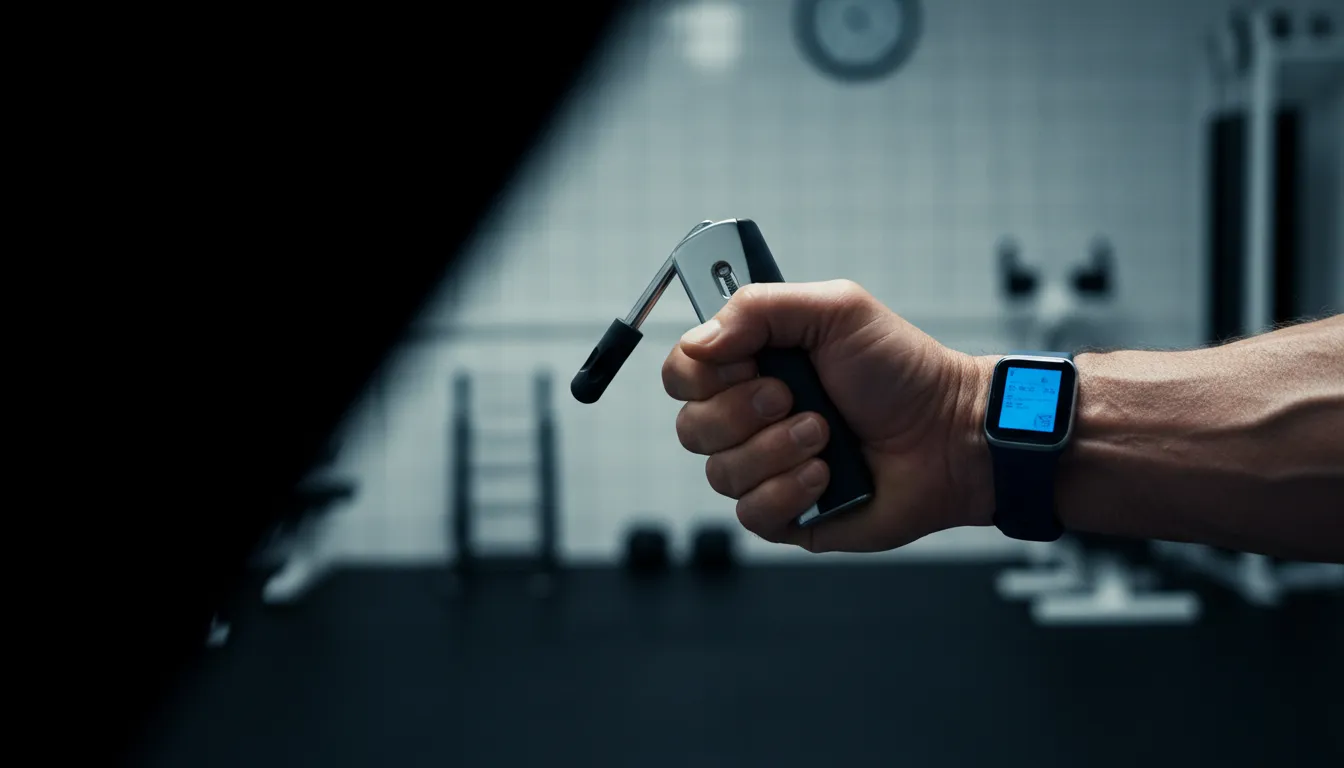
The gold-standard grip test uses a hydraulic hand dynamometer in a standardized seated position. It takes less than five minutes.
What you need: A Jamar-style hydraulic dynamometer (available for $25–40 online) or access to one at a physical therapy clinic, gym, or doctor’s office. The Jamar dynamometer is the most widely validated instrument in the literature, with well-established test-retest, inter-rater, and intra-rater reliability6.
The protocol:
- Sit upright in a chair with your feet flat on the floor. Hips and knees at approximately 90 degrees.
- Position your arm: Shoulder relaxed at your side (not pressed against your body). Elbow bent to 90 degrees. Forearm in a neutral position (thumb facing up). Wrist in slight extension (0–30 degrees).
- Set the dynamometer handle to the second position. Hold it vertically, in line with your forearm.
- Squeeze as hard as you can for 3–5 seconds. No jerking. Breathe out as you squeeze.
- Record the reading in kilograms.
- Rest 30 seconds. Repeat for a total of 3 trials per hand, alternating hands between trials.
- Your score is the highest single reading from either hand.
This follows the standardized protocol recommended by the American Society of Hand Therapists (ASHT) and codified in Roberts et al.’s 2011 review in Age and Ageing6. The key is consistency: same position, same rest intervals, same effort each time.
No dynamometer? Use the dead hang test.
Grab a pull-up bar with both hands, palms facing away, and hang with arms fully extended. Time how long you hold on. This isn’t a perfect substitute — it measures grip endurance rather than maximal force — but it provides a useful proxy that you can track over time. General benchmarks: most healthy adults sustain 30–60 seconds. Peter Attia, MD, suggests that a 40-year-old man should target at least 120 seconds; a 40-year-old woman, 90 seconds7.
Step 2 — Benchmark Against Your Age and Sex
Once you have your number, the question is: where do I stand?
The largest normative dataset ever assembled for grip strength was published in 2025 by the iGRIPS (International handGRIP Strength) Group, led by Tomkinson, Lang, and McGrath. Their systematic review pooled data from 2.4 million adults aged 20 to 100+ across 69 countries8. The table below shows approximate 50th-percentile (median) values by age and sex for the dominant hand:
| Age Group | Men (kg) | Women (kg) |
|---|---|---|
| 20–29 | 49 | 29 |
| 30–39 | 50 | 30 |
| 40–49 | 48 | 29 |
| 50–59 | 44 | 26 |
| 60–69 | 39 | 23 |
| 70–79 | 33 | 20 |
| 80+ | 27 | 16 |
How to read your result:
- At or above the 50th percentile for your age: You’re in solid shape. The goal is to maintain or improve.
- Below the 50th percentile but above sarcopenia cutoffs: Room for improvement. The 8-week protocol below should move you meaningfully.
- Below sarcopenia cutoffs (<27 kg men, <16 kg women): This warrants attention. The European Working Group on Sarcopenia in Older People (EWGSOP2) established these thresholds as indicators of clinically significant muscle weakness associated with adverse health outcomes9. If you’re under these values and under 65, talk to your doctor.
These aren’t vanity numbers. Low grip strength relative to your age predicts future disability, hospitalization, and death — independent of how fit you look or how much you exercise. The benchmark gives you a target. The next step gives you the plan to hit it.
Step 3 — Train: The 8-Week Grip Strength Protocol
Grip strength responds to targeted training. A 2019 meta-analysis by Labott et al. in Gerontology, pooling data from 24 trials and 3,018 older adults, found that exercise training produced significant improvements in handgrip strength — with the greatest gains coming from task-specific and multimodal training approaches10.
The key insight: general resistance training improves grip strength modestly, but direct grip work improves it substantially. To maximize transfer, you need to train all four grip patterns.
Dr. Andy Galpin, exercise physiologist and one of the leading voices on strength training for functional longevity, categorizes grip into four trainable patterns: crush (closing the hand around an object), support (holding a load with a closed hand), pinch (squeezing between thumb and fingers), and wrist/forearm (stabilizing under rotational and flexion loads). A complete grip protocol hits all four.
Schedule: 3 sessions per week. 15–20 minutes per session. Can be done at the end of any strength training workout or as a standalone session.
Weeks 1–4: Foundation
| Exercise | Grip Pattern | Sets x Reps | Rest |
|---|---|---|---|
| Farmer’s carry (heavy dumbbells or kettlebells) | Support | 3 x 30–40 sec | 60 sec |
| Towel dead hang (drape a towel over a pull-up bar, grip towel ends) | Crush / Support | 3 x 15–25 sec | 60 sec |
| Plate pinch (pinch two smooth weight plates together, flat sides out) | Pinch | 3 x 20–30 sec | 45 sec |
| Wrist curls (barbell or dumbbell, palms up then palms down) | Wrist | 2 x 12–15 | 45 sec |
Weeks 5–8: Progression
| Exercise | Grip Pattern | Sets x Reps | Rest |
|---|---|---|---|
| Heavy farmer’s carry (increase load 10–20%) | Support | 4 x 30–40 sec | 60 sec |
| Dead hang (bar, no towel — add weight via belt if >60 sec) | Support | 3 x max hold | 90 sec |
| Fat grip dumbbell rows (wrap a towel around the handle or use Fat Gripz) | Crush | 3 x 8–10 | 60 sec |
| Plate pinch (progress to heavier plates or single-hand pinch) | Pinch | 3 x 20–30 sec | 45 sec |
| Wrist roller (or wrist curls with increased load) | Wrist | 3 x 2 rolls (up and down = 1) | 60 sec |
Programming notes:
- Progressive overload applies to grip just like any other muscle group. Add weight, time, or difficulty every 1–2 weeks. If you can hold a farmer’s carry for 40 seconds comfortably, the load is too light.
- Don’t use straps for your regular training during this 8-week block. Deadlifts, rows, pull-ups — let your grip be the limiting factor. This converts your existing training into additional grip stimulus.
- SensAI users: Log your grip work like any other training session. Tracking load progression over the 8 weeks gives you a concrete trendline to pair with your retest numbers. The app’s adaptive programming adjusts your training based on performance and recovery data, which means your grip sessions stay calibrated to your actual capacity — not a static template.
Step 4 — Retest Every 8 Weeks
Same protocol. Same dynamometer position. Same three trials per hand. Same rest intervals. The only thing that changes is your number.
Why every 8 weeks? Neuromuscular adaptations to grip training appear within 4–6 weeks, with meaningful strength gains consolidating by week 8. This aligns with the Labott et al. meta-analysis finding that training periods of 8–12 weeks produced the most reliable improvements10.
What to expect:
- First 8 weeks: Expect a 2–4 kg improvement in maximal grip strength if training consistently. First-time trainees with low baselines may see larger gains.
- Ongoing: After the initial adaptation, progress slows to 1–2 kg per testing cycle. This is normal and valuable.
- The real win is fighting decline. Untrained adults lose approximately 0.5 kg of grip strength per year starting in midlife, with the rate accelerating after age 608. Syddall et al. demonstrated that grip strength was associated with more markers of frailty than chronological age itself in a study of adults aged 64–7411. Holding your grip strength stable — or improving it — while your untrained peers decline is one of the highest-leverage longevity investments available.
Track absolute grip strength over time, not just your percentile. Percentile comparisons shift because the normative population is also aging. What matters is your real-world force output: can you open jars, carry groceries, catch yourself during a fall, get off the floor unassisted? Those capacities map directly to independence and quality of life in later decades.
If you’re using SensAI to manage your training, pair your grip retest data with your broader performance metrics — recovery trends, cardiovascular fitness, and training readiness scores. Grip strength in isolation is informative. Grip strength in the context of your full health picture is powerful.
Beyond the Squeeze: Grip as One Pillar of the Longevity Stack
Grip strength matters. But it’s one metric inside a larger system.
Peter Attia, MD, frames this through what he calls the Centenarian Decathlon — the concept of identifying the ten physical tasks you want to perform in the last decade of your life, then back-casting the fitness you need today to make them possible7. Carrying a 30-pound grandchild. Lifting a suitcase into an overhead bin. Getting off the floor without help. Climbing a flight of stairs without stopping. These tasks don’t require elite athleticism. They require maintained muscle mass, cardiovascular capacity, balance, and — yes — grip strength.
The four pillars of Attia’s longevity-training framework are aerobic efficiency (Zone 2), peak aerobic capacity (VO2max), strength, and stability. Grip strength sits at the intersection of the last two. It’s a direct measure of upper-body force production and a proxy for the neuromuscular integrity that supports balance and fall prevention.
Your VO2max is declining by about 10% per decade if you don’t train it. Your lean muscle mass is declining by 3–8% per decade after 30 if you ignore it. Your grip strength is declining by roughly 5–6 kg per decade in men and 3–4 kg per decade in women8. The math is simple: if you don’t deliberately push back, you will cross the disability threshold decades earlier than you need to.
The protocol mindset applies to all of it. Test. Benchmark. Train. Retest. Don’t guess. Don’t assume your current routine is enough. Measure what matters, track it over time, and adjust when the data tells you to. SensAI exists to make that loop seamless — connecting your wearable data, your training log, and your recovery metrics into a coherent picture that adapts to how your body is actually responding.
You probably won’t die from a weak grip. But the systems that a weak grip reveals — declining muscle mass, eroding neuromuscular function, accelerating biological aging — those are what take people out of the game. Squeeze the dynamometer. Write down the number. Do the work. Retest in 8 weeks. That’s the protocol. That’s the investment. And unlike most things in health, the ROI on this one is immediate, measurable, and entirely in your hands.
References
Footnotes
-
Leong DP, Teo KK, Rangarajan S, et al. “Prognostic value of grip strength: findings from the Prospective Urban Rural Epidemiology (PURE) study.” Lancet, 2015. https://pubmed.ncbi.nlm.nih.gov/25982160/ ↩ ↩2
-
Celis-Morales CA, Welsh P, Lyall DM, et al. “Associations of grip strength with cardiovascular, respiratory, and cancer outcomes and all cause mortality: prospective cohort study of half a million UK Biobank participants.” BMJ, 2018. https://pubmed.ncbi.nlm.nih.gov/29739772/ ↩ ↩2
-
McGrath R, Johnson N, Klawitter L, et al. “What are the association patterns between handgrip strength and adverse health conditions? A topical review.” SAGE Open Medicine, 2020. https://journals.sagepub.com/doi/10.1177/2050312120910358 ↩
-
Peterson MD, Collins S, Meier HCS, Brahmsteadt A, Faul JD. “Grip strength is inversely associated with DNA methylation age acceleration.” Journal of Cachexia, Sarcopenia and Muscle, 2023. https://pubmed.ncbi.nlm.nih.gov/36353822/ ↩
-
Bohannon RW. “Grip Strength: An Indispensable Biomarker For Older Adults.” Clinical Interventions in Aging, 2019. https://pubmed.ncbi.nlm.nih.gov/31631989/ ↩
-
Roberts HC, Denison HJ, Martin HJ, et al. “A review of the measurement of grip strength in clinical and epidemiological studies: towards a standardised approach.” Age and Ageing, 2011. https://pubmed.ncbi.nlm.nih.gov/21624928/ ↩ ↩2
-
Attia P. Outlive: The Science and Art of Longevity. Harmony Books, 2023. ↩ ↩2
-
Tomkinson GR, Lang JJ, Rubin L, McGrath R, et al. “International norms for adult handgrip strength: A systematic review of data on 2.4 million adults aged 20 to 100+ years from 69 countries and regions.” Journal of Sport and Health Science, 2025. https://pubmed.ncbi.nlm.nih.gov/39647778/ ↩ ↩2 ↩3
-
Cruz-Jentoft AJ, Bahat G, Bauer J, et al. “Sarcopenia: revised European consensus on definition and diagnosis (EWGSOP2).” Age and Ageing, 2019. https://pubmed.ncbi.nlm.nih.gov/30312372/ ↩
-
Labott BK, Bucht H, Morat M, Morat T, Donath L. “Effects of Exercise Training on Handgrip Strength in Older Adults: A Meta-Analytical Review.” Gerontology, 2019. https://pubmed.ncbi.nlm.nih.gov/31499496/ ↩ ↩2
-
Syddall H, Cooper C, Martin F, Briggs R, Aihie Sayer A. “Is grip strength a useful single marker of frailty?” Age and Ageing, 2003. https://pubmed.ncbi.nlm.nih.gov/14600007/ ↩