Zone 2 Cardio: Benefits, Heart-Rate Estimates, and the Evidence Behind the Hype
Learn what people mean by Zone 2, how to estimate an easy-to-moderate aerobic effort, where wearables help, and where the evidence remains uncertain.

SensAI Team
9 min read
Get a training plan that adapts to your recovery — free on iOS

Zone 2 cardio has become shorthand for sustainable aerobic training: an effort that raises your breathing but still lets you talk. That simplicity is useful, but online discussions often treat several different definitions as though they were identical.
SensAI can use workout summaries and aggregated recovery context from Apple HealthKit when its large-language-model coach creates or regenerates a weekly plan. That context can support a conversation about training; it does not turn a watch into a laboratory test or make one heart-rate zone medically precise.
What Is Zone 2 Cardio?
Definitions of Zone 2 vary. On a common five-zone display, Zone 2 is often 60–70% of maximum heart rate. In a three-zone physiological model, coaches often mean work below the first lactate or ventilatory threshold (LT1/VT1). Other discussions use FatMax, the intensity at which measured fat oxidation peaks. These boundaries overlap on average in some groups but can differ substantially within an individual.12
The practical talk-test description is simpler: your breathing is elevated, but you can still speak in comfortable full sentences. This is an approximation of a physiological boundary, not proof that lactate or fat oxidation is at a particular value.
At every aerobic intensity, your body uses a mixture of fat and carbohydrate. The relative contribution changes with intensity, duration, fitness, nutrition, and modality. Moving into a higher zone increases carbohydrate use; it does not create an abrupt switch from fat to carbohydrates or protein.
Here is one common display convention, not a universal physiology chart:
| Display Zone | Approximate % of Max HR | General Feel |
|---|---|---|
| 1 | 50–60% | Very easy |
| 2 | 60–70% | Easy to moderate; full-sentence conversation usually possible |
| 3 | 70–80% | Moderate to hard; speech becomes less comfortable |
| 4 | 80–90% | Hard; short phrases |
| 5 | 90–100% | Very hard to maximal |
Device makers, laboratories, and coaches may use different boundaries. State the model before comparing “Zone 2” recommendations.
How to Estimate Your Aerobic Range
The familiar 220 - age equation is a rough population estimate, not an individual maximum. Tanaka and colleagues proposed 208 - 0.7 × age from a large pooled analysis, but any age equation still has substantial individual error.3
Using 60–70% of an estimated maximum can provide a provisional display range. Heart-rate reserve, which incorporates resting heart rate, produces a different range. Neither automatically identifies LT1, and medication, temperature, hydration, illness, altitude, and fatigue can alter heart-rate response.
Use three checks together:
- A conservative provisional range. Treat a formula or device default as a starting estimate.
- Talk and perceived effort. Full-sentence speech should remain comfortable for an easy-to-moderate session.
- Session context. Slow down when heat, hills, fatigue, or symptoms make the same heart rate harder to sustain.
A laboratory test can measure ventilatory and blood-lactate responses, but threshold methods also differ. A field talk test can be useful without pretending it is equivalent to a blood sample.
What Benefits Are Reasonable to Expect?
Easy-to-moderate aerobic exercise can contribute to cardiorespiratory fitness, blood-pressure control, metabolic health, and endurance. Those are benefits of aerobic training across a range of intensities; current evidence does not show that a narrowly defined Zone 2 is uniquely optimal for mitochondrial capacity or fat oxidation in the general population.1
Fat Oxidation and Weight Management
The highest proportion of energy from fat often occurs at lower intensities, while the highest absolute fat-oxidation rate varies widely between people.4 Burning a higher proportion of fat during one workout does not guarantee greater body-fat loss. Total energy balance, diet, adherence, and total activity matter more over time.
Cardiovascular and Metabolic Health
Regular aerobic activity can improve fitness and several cardiovascular risk factors. Do not interpret a heart-rate-zone display as evidence that a session is treating hypertension, diabetes, or another condition. People using glucose-lowering medication or managing cardiovascular disease should follow individualized clinical guidance.
Lower-Impact Training Volume
Walking, cycling, swimming, and elliptical work can let some people accumulate aerobic time with less impact than fast running. Injury risk still depends on modality, technique, progression, prior injury, surface, and total load; Zone 2 is not inherently injury-proof.
HRV and Resting Heart Rate
Aerobic training can lower resting heart rate on average, but the magnitude and timing vary. HRV is a noisy contextual trend influenced by sleep, illness, alcohol, stress, measurement conditions, and training. It cannot diagnose readiness or prove that a particular zone caused an adaptation.
Zone 2 Exercise Options
Any rhythmic activity can be easy-to-moderate if the effort suits the person:
- Walking: Choose a pace and terrain that allow comfortable speech.
- Running or run-walking: Slow down or add walking intervals rather than chasing a pace.
- Cycling: Adjust resistance and cadence in small steps.
- Swimming: Use a sustainable stroke and stop if breathing control or technique deteriorates.
- Rowing or elliptical: Keep technique steady; machine settings are not universal intensity prescriptions.
Start with a duration you can tolerate without concerning symptoms or escalating joint pain. Stop and seek appropriate care for chest pain or pressure, fainting, severe or unusual shortness of breath, or a new symptomatic irregular heartbeat.
How Much Should You Do Per Week?
The American Heart Association recommends at least 150 minutes of moderate-intensity aerobic activity, 75 minutes of vigorous activity, or an equivalent combination per week, along with muscle-strengthening activity on at least two days.5 These are general targets, not a Zone 2 minimum, and some activity is better than none.
If you are inactive, begin with short sessions and progress gradually. A practical starting range might be 10–20 minutes once or twice per week, followed by small increases as tolerance develops. No single schedule fits every beginner, athlete, older adult, or person with a health condition.
The often-cited 80/20 distribution comes largely from observations and studies of high-volume endurance athletes using a three-zone model.6 It should not be converted automatically into “80% of every recreational program in five-zone Zone 2.” Your goal and total training volume determine the useful mix of easy, moderate, and hard work.
Zone 2, Fitness, and Longevity
Higher cardiorespiratory fitness is strongly associated with lower mortality. For example, a large 2018 treadmill-test cohort found progressively lower mortality with greater measured fitness.7 It was an observational study of patients referred for testing, not a randomized Zone 2 trial, so it cannot show that Zone 2 caused the difference or that fitness was “more important than smoking.”
Improving fitness can involve moderate continuous work, vigorous intervals, or both. The best program is one that matches your health, goals, current capacity, and ability to recover.
Is Zone 2 Overhyped?
The balanced answer is yes and no. Sustainable aerobic work is valuable, especially when it lets you accumulate activity without turning every session into a hard workout. But a 2025 review concluded that current evidence does not support Zone 2 as uniquely superior for mitochondrial or cardiorespiratory adaptations, particularly when time is limited.1
For lower-volume recreational training, including some higher-intensity work may improve fitness efficiently when it is appropriate and tolerated. For high-volume endurance athletes, a large amount of low-intensity work helps manage fatigue. Those are different use cases.
What Wearables Can—and Cannot—Do
Wearables make heart-rate trends visible, but wrist optical accuracy varies with device, fit, motion, skin perfusion, and activity. A compatible chest strap can improve heart-rate measurement in some settings; neither sensor directly measures LT1 or FatMax.
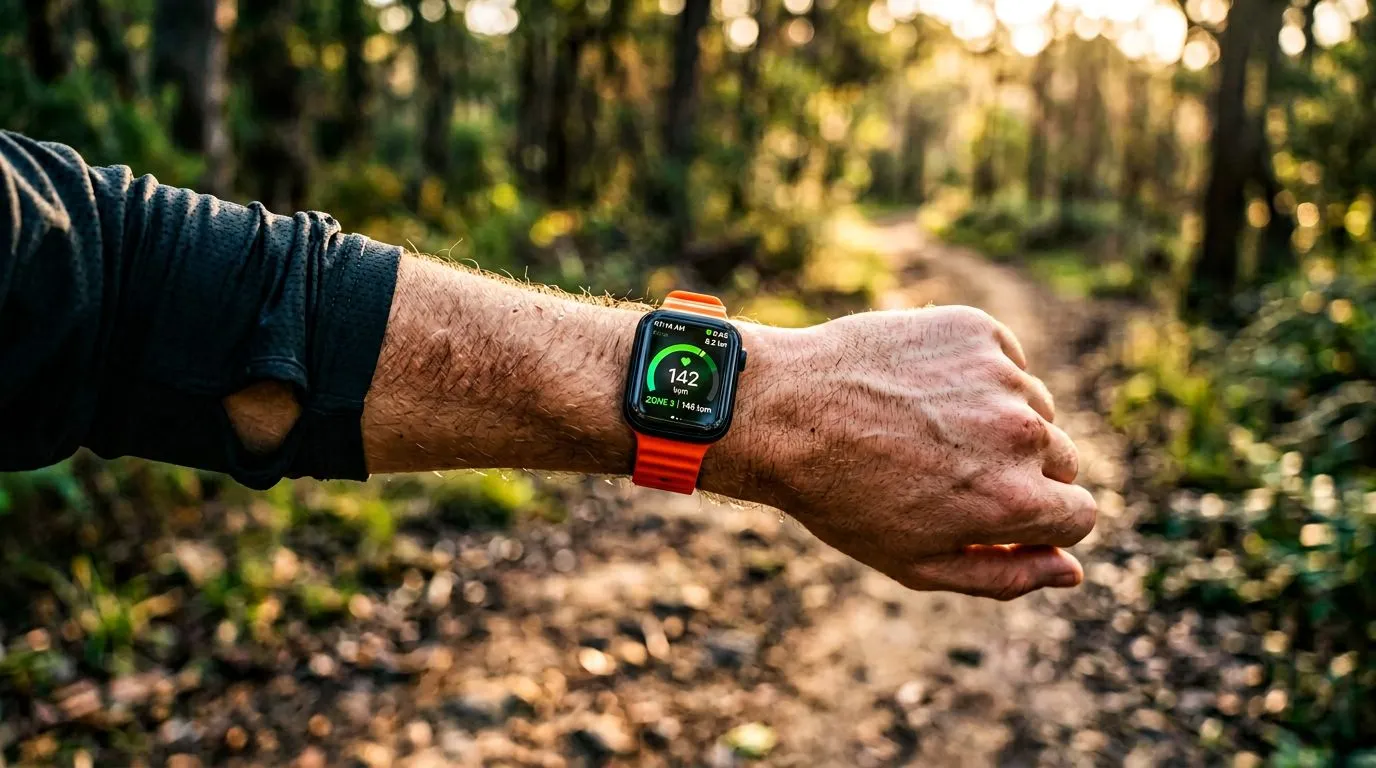
Apple Watch automatically calculates displayed heart-rate zones from health data and percentages of maximum heart rate, and users can edit zone boundaries manually.8 Compatible Garmin devices can display zones based on %Max HR, %HRR, or %LTHR; available features vary, and lactate-threshold heart rate should not be confused with LT1.9
SensAI does not claim to derive a verified personal LT1 or continuously verify your physiological zone during a session. Apple Watch data connects directly through HealthKit, while Garmin, Oura, and WHOOP data can flow through HealthKit. SensAI can use aggregated HRV trends, sleep quality, and workout summaries as context for its LLM and weekly program regeneration. Raw HealthKit data remains on-device, aggregated metrics may be sent server-side, and SensAI does not sell that data to third parties.
Frequently Asked Questions
What qualifies as Zone 2 cardio?
It depends on the zone model. For practical easy-to-moderate training, use a conservative heart-rate estimate alongside comfortable full-sentence speech and perceived effort.
Is 60–70% of maximum heart rate always Zone 2?
No. It is a common five-zone display convention. Individual LT1, VT1, and FatMax can occur above or below that range.
Is a wearable more reliable than the talk test?
They answer different questions. A wearable estimates heart rate; the talk test describes ventilatory strain. Cross-check both, and remember that neither is a laboratory threshold measurement.
Can Zone 2 help with weight loss?
It can contribute activity and energy expenditure, but it is not a fat-loss shortcut. Long-term energy balance and adherence matter more than the fuel proportion in one session.
Does Zone 2 impair muscle growth?
Concurrent aerobic and resistance training generally does not compromise hypertrophy or maximal strength when programmed sensibly, although same-session work can affect explosive-strength quality.10 If strength is the priority and both must occur together, lift first; otherwise choose spacing based on the goal and recovery.
References
Footnotes
-
Storoschuk, K., et al. “Much Ado About Zone 2: A Narrative Review Assessing the Efficacy of Zone 2 Training for Improving Mitochondrial Capacity and Cardiorespiratory Fitness in the General Population.” Sports Medicine, 2025. https://doi.org/10.1007/s40279-025-02261-y ↩ ↩2 ↩3
-
Meixner, B., et al. “Zone 2 Intensity: A Critical Comparison of Individual Variability in Different Submaximal Exercise Intensity Boundaries.” Translational Sports Medicine, 2025. https://pmc.ncbi.nlm.nih.gov/articles/PMC11986187/ ↩
-
Tanaka, H., Monahan, K. D., & Seals, D. R. “Age-Predicted Maximal Heart Rate Revisited.” Journal of the American College of Cardiology, 2001. https://doi.org/10.1016/S0735-1097(00)01054-8 ↩
-
Purdom, T., Kravitz, L., Dokladny, K., & Mermier, C. “Understanding the factors that effect maximal fat oxidation.” Journal of the International Society of Sports Nutrition, 2018. https://doi.org/10.1186/s12970-018-0207-1 ↩
-
American Heart Association. “American Heart Association Recommendations for Physical Activity in Adults and Kids.” https://www.heart.org/en/healthy-living/fitness/fitness-basics/aha-recs-for-physical-activity-in-adults ↩
-
Seiler, S. “What Is Best Practice for Training Intensity and Duration Distribution in Endurance Athletes?” International Journal of Sports Physiology and Performance, 2010. https://doi.org/10.1123/ijspp.5.3.276 ↩
-
Mandsager, K., et al. “Association of Cardiorespiratory Fitness With Long-term Mortality Among Adults Undergoing Exercise Treadmill Testing.” JAMA Network Open, 2018. https://doi.org/10.1001/jamanetworkopen.2018.3605 ↩
-
Apple Support. “View Heart Rate Zones on Apple Watch.” https://support.apple.com/guide/watch/view-heart-rate-zones-apd897dccddf/watchos ↩
-
Garmin. “Setting Your Heart Rate Zones.” Garmin fēnix Manual. https://www8.garmin.com/manuals/webhelp/GUID-C001C335-A8EC-4A41-AB0E-BAC434259F92/EN-US/GUID-30C91919-943C-44E9-8048-901AC0881AEA.html ↩
-
Schumann, M., et al. “Compatibility of Concurrent Aerobic and Strength Training for Skeletal Muscle Size and Function: An Updated Systematic Review and Meta-Analysis.” Sports Medicine, 2022. https://doi.org/10.1007/s40279-021-01587-7 ↩