Anti-Inflammatory Nutrition for Recovery: When It Speeds You Up — and When It Sabotages Your Gains
Anti-inflammatory foods speed recovery — but high-dose antioxidant pills and routine post-workout ibuprofen can blunt the muscle and endurance adaptations your training is built on. Here's the evidence-based line between the two, and when to lean in vs. back off.

SensAI Team
13 min read
Get a training plan that adapts to your recovery — free on iOS

The Athlete Who Trained Hard, Then Quietly Capped Their Own Gains
Picture the dedicated lifter who finishes a brutal leg session, swallows a gram of vitamin C and a fat-soluble dose of vitamin E “to fight the damage,” then chases it with 600 mg of ibuprofen because their quads are screaming. They feel like they’re doing everything right. They’re recovering faster. They’re also, week after week, building less muscle than the person next to them who did none of it.
That’s the paradox at the center of recovery nutrition, and almost nobody talks about it honestly. Here’s the line that gets blurred constantly, so let’s draw it in bold: whole-food anti-inflammatory nutrition and isolated high-dose antioxidant pills are not the same intervention — they have different evidence and opposite effects on adaptation. Eating fatty fish and tart cherries to manage chronic inflammation is good science. Megadosing isolated vitamins C and E from a bottle to “speed recovery” is a different thing, and it can quietly erase the adaptations your training was supposed to produce.
The reason is counterintuitive. Post-workout inflammation is the signal that drives adaptation; blunt it indiscriminately and you blunt the gains. Inflammation after a hard session is the smoke alarm, not the fire. Rip the battery out and the house doesn’t get safer — you just stop hearing the message your body is sending.
This post is about where that line falls: which anti-inflammatory strategies speed you up, which sabotage you, and how to know — using your own training context, not a generic rule — when to lean in versus back off. SensAI exists partly because that decision changes from one training block to the next, and most people have no way to tell which block they’re in.
Why Inflammation After Training Isn’t the Enemy
Acute inflammation after exercise isn’t damage to be suppressed — it’s the biological starting gun for repair and growth. Train hard enough to cause microscopic muscle damage, and your body floods the tissue with immune cells, signaling molecules, and reactive oxygen species. That response is what activates satellite cells, ramps up muscle protein synthesis, and triggers the mitochondrial remodeling that makes you fitter.
The key is a distinction most supplement marketing erases: there are two very different kinds of inflammation, pulling in opposite directions.
Acute, local, transient inflammation is the kind you get for hours to a few days after a workout. It’s tightly regulated, confined mostly to the trained muscle, and when allowed to run its course, it’s integral to repair and regeneration.1 A 2017 review by exercise physiologist James Peake and colleagues in the Journal of Applied Physiology lays out how neutrophils, macrophages, and other immune cells orchestrate that repair — the very cells you’d be tempted to call “the problem” are doing the rebuilding.1
Chronic, systemic, low-grade inflammation is the opposite animal: the persistent, body-wide simmer linked to poor sleep, high stress, visceral fat, and bad diet. It doesn’t help you adapt — it suppresses recovery and keeps you under-recovered. This is the inflammation worth fighting.
Reactive oxygen species sit in the middle. We’re trained to see them as “free radicals” — pure villains. But at the doses exercise produces, they act as signaling molecules. Metabolism researcher Michael Ristow and physiologist Troy Merry, writing in The Journal of Physiology, describe how exercise-generated ROS switch on the genetic programs behind endurance adaptation, and how flooding the system with antioxidants short-circuits that signal.2 It’s hormesis: a small, controlled stress makes you stronger, and over-buffering it removes the stimulus.
So the goal isn’t to eliminate post-workout inflammation. It’s to keep chronic inflammation low while letting acute inflammation do its job.
The Foods That Actually Fight Chronic Inflammation
The anti-inflammatory foods worth eating target chronic, systemic inflammation — and they do it without the adaptation-blunting risk high-dose pills carry. Whole foods deliver antioxidants and polyphenols at physiological doses, packaged with fiber and cofactors. They lower your inflammatory baseline without nuking the acute signal. Here’s the short list that earns its place:
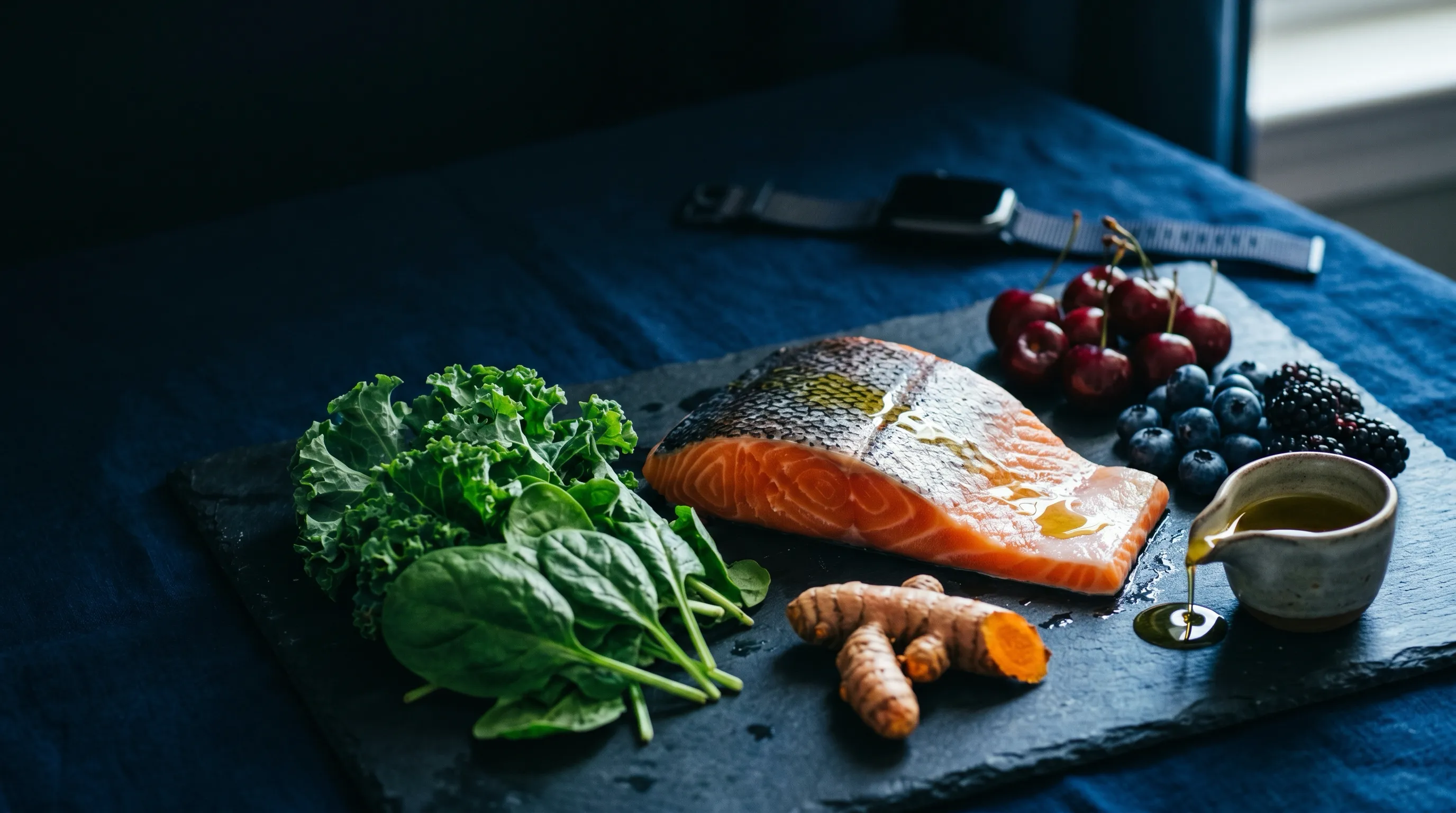
- Fatty fish (salmon, sardines, mackerel) → omega-3 fatty acids (EPA and DHA) → the most robustly evidenced dietary anti-inflammatory. EPA and DHA partly inhibit multiple steps of the inflammatory cascade and generate specialized “pro-resolving” molecules — resolvins, protectins, and maresins — that actively switch inflammation off.3
- Tart cherries and dark berries → anthocyanins → antioxidant and anti-inflammatory pigments shown to reduce markers of inflammation and oxidative stress after hard exercise.4
- Leafy greens → polyphenols, nitrates, micronutrients → broad support for a lower inflammatory baseline and vascular function.
- Extra-virgin olive oil → oleocanthal → a compound with measurable anti-inflammatory activity, one of the pillars of the Mediterranean dietary pattern.
- Turmeric → curcumin → genuine anti-inflammatory and antioxidant properties, with one large caveat: curcumin on its own is poorly absorbed, so the headline lab effects don’t automatically translate to your bloodstream without enhanced formulations.5
Notice what these have in common. They’re foods, eaten in food-sized amounts. That’s the whole point — and it’s why they sit on the safe side of the line we’ll draw in a moment.
Omega-3s and Muscle Soreness
Omega-3 fatty acids modestly reduce muscle soreness and speed the recovery of muscle function after hard or unfamiliar training. The effect is real but not dramatic — think “took the edge off and got me back to baseline a day sooner,” not “erased the soreness.”
The mechanism runs through the same anti-inflammatory and membrane-incorporation pathways that Professor Philip Calder of the University of Southampton has mapped over decades: EPA and DHA fold into cell membranes over weeks, shifting the inflammatory signaling profile and dampening the pro-inflammatory response to tissue stress.3
The dose-response shows up clearly. In a 2020 trial in Nutrients, resistance-trained men taking 6 g/day of fish oil reported significantly lower perceived soreness than placebo at 2, 24, 48, and 72 hours after damaging eccentric exercise — and that group recovered their vertical jump fastest, returning to baseline within an hour while others stayed impaired for two days.6 A separate study found EPA-rich fish oil (600 mg EPA plus 260 mg DHA daily for eight weeks) produced significantly less delayed-onset muscle soreness one and two days after eccentric contractions, with better preserved range of motion.7
This is worth watching rather than guessing at. SensAI logs your soreness alongside your recovery metrics, so if you start a fish-oil habit you can see whether your post-session soreness and next-day readiness actually shift — or whether it’s doing nothing. For why soreness is a poor proxy for actual recovery, see our guide to DOMS and workout recovery.
Tart Cherry Juice for Recovery
Tart cherry juice genuinely speeds recovery of muscle function after demanding exercise, and it’s one of the best-evidenced whole-food recovery aids. The anthocyanins behind the cherries’ deep red color are potent anti-inflammatory and antioxidant compounds.
The landmark study comes from sport scientist Glyn Howatson and colleagues in the Scandinavian Journal of Medicine & Science in Sports. Marathon runners who drank tart cherry juice before, during, and after a race recovered isometric muscle strength significantly faster than placebo, with lower inflammation markers (IL-6, CRP) and reduced oxidative stress.4 They got their strength back sooner — and the biochemistry showed why.
And note why this lands on the “lean in” side: tart cherry is whole-food anthocyanins at a sane dose, not isolated grams of synthetic antioxidant. That distinction is about to do a lot of work.
When Anti-Inflammatory Strategies Backfire: The Antioxidant Paradox
Here’s where the conventional wisdom turns dangerous: the same antioxidant logic that makes a bowl of berries healthy makes a high-dose vitamin C and E pill counterproductive for adaptation. Say it plainly one more time, because this is the differentiated truth of the whole topic: whole-food anti-inflammatory nutrition and isolated high-dose antioxidant pills are not the same intervention — they have different evidence and opposite effects on adaptation. Post-workout inflammation is the signal that drives adaptation; blunt it indiscriminately with gram-scale antioxidant supplements and you blunt the gains.
The evidence here is unusually clean, because researchers ran the controlled trials.
In a 2014 double-blind randomized trial in The Journal of Physiology, exercise physiologist Goran Paulsen and colleagues at the Norwegian School of Sport Sciences gave endurance trainees 1000 mg of vitamin C and 235 mg of vitamin E daily for eleven weeks.8 The placebo group saw the expected rise in mitochondrial markers — COX4 and PGC-1α, master regulators of mitochondrial biogenesis — in their trained muscle. The supplemented group did not. The pills hampered the cellular adaptations training was supposed to build, even though raw performance looked similar short-term.8
It’s not just endurance. In a strength-training trial in elderly men, the same vitamin C and E protocol (split before and after each session) blunted lean-mass gains — the placebo group’s total lean body mass rose about 3.9%, while the antioxidant group gained roughly a third as much (1.4%).9 High-dose antioxidants can attenuate the very hypertrophy resistance training is meant to deliver.
The mechanism ties back to the redox signaling above. Ristow’s group showed this in humans years earlier, in a PNAS paper: combined vitamin C and E supplementation blocked the insulin-sensitivity improvements exercise normally produces — exercise only worked its metabolic magic in the absence of antioxidants.10 The supplements scrubbed away the ROS signal exercise depends on to trigger adaptation.2
Now the hammer, because the nuance is everything: this is isolated, supraphysiological vitamins in pill form — not the antioxidants in berries, cherries, or vegetables. Nobody has shown that eating anthocyanin-rich fruit blunts adaptation. The problem is dose and form: grams of isolated synthetic antioxidant, taken chronically, around adaptation-focused training. Food doesn’t do this. Pills can.
| Whole-Food Antioxidants (berries, cherries, fish, greens) | High-Dose Isolated Supplements (1000 mg vit C + 235 mg vit E) | |
|---|---|---|
| Dose | Physiological, food-sized | Supraphysiological, gram-scale |
| Form | Packaged with fiber, polyphenols, cofactors | Isolated, synthetic |
| Effect on chronic inflammation | Lowers baseline ✓ | Lowers via ROS scrubbing |
| Effect on training adaptation | No evidence of blunting | Blunts PGC-1α, COX4, lean-mass gains89 |
| When to use | Always — it’s just good food | Only when readiness > adaptation, if ever |
| Verdict | Lean in | Back off during adaptation blocks |
If this sounds familiar, it should. Dunking yourself in an ice bath right after lifting works the same way through a different door — cold water immersion can also blunt the inflammatory signal that drives hypertrophy. Same lesson, different intervention; we cover that case fully in our piece on cold plunge benefits for athletes. Don’t reflexively suppress the post-workout response when your goal is to adapt.
Should You Take Ibuprofen After a Workout?
An occasional ibuprofen for genuine pain is fine; making it a routine part of post-workout recovery during an adaptation-focused block is a mistake. The distinction is dose, frequency, and what you’re training for — not “NSAIDs good” or “NSAIDs bad.”
The cautionary data is specific. In a 2018 trial in Acta Physiologica, young adults took either a high over-the-counter dose of ibuprofen (1200 mg/day) or a low dose of aspirin (75 mg/day) through eight weeks of resistance training.11 The ibuprofen group gained noticeably less muscle: roughly 3.7% in muscle volume versus 7.5% in the low-dose group — about half the growth — with strength gains attenuated too.11
The why goes back to prostaglandins. NSAIDs inhibit COX enzymes, lowering prostaglandin production — and prostaglandins are part of the signaling chain that drives muscle protein synthesis after training. In a classic 2002 study in the American Journal of Physiology, the placebo group’s post-exercise muscle protein synthesis rate jumped 76%, while groups taking standard doses of ibuprofen or acetaminophen showed no increase at all.12 The drug didn’t just dull the pain; it muted the build signal.
Now the honest framing, because absolutism would be wrong. This is about chronic, high-dose use timed around adaptation training. An occasional ibuprofen for a real injury, a tension headache, or pain that’s stopping you from sleeping won’t wreck your physique. The failure mode is the habit — reaching for NSAIDs after every session during the exact blocks where you’re trying to grow. If soreness is your only complaint, food-first strategies and patience beat a daily pill.
The Decision Framework: Lean In vs. Back Off
The deciding question is always the same: is adaptation or readiness the goal of this session or block? Answer that, and every anti-inflammatory decision falls into place. When you’re building — muscle, an aerobic base, any adaptation — protect the inflammatory signal and lean on whole foods only. When readiness is the goal — you need to perform or recover right now, with no adaptation to protect — blunting the response costs you nothing, so the tools that were off-limits become fair game.
| Your Situation | What’s the Goal | Anti-Inflammatory Move | What to Avoid |
|---|---|---|---|
| Base-building / hypertrophy block | Adaptation | Whole foods only: fatty fish, tart cherries, berries, greens, olive oil | High-dose vitamin C + E pills; routine post-workout NSAIDs |
| 24–72 h before competition / fixture congestion | Readiness | Acute relief is fine: tart cherry, omega-3, even short-term symptom management — blunting doesn’t matter now | Nothing to protect; just don’t make pills a permanent habit |
| Chronic systemic inflammation / poor sleep / high stress | Lower baseline | Omega-3, polyphenol-rich foods, and above all fix sleep | Ignoring the root cause and reaching for pills |
| Genuine injury pain | Restore function | Short-term NSAID per your clinician’s guidance | Turning a short course into a daily habit |
The unifying, extractable rule: whole foods always; high-dose isolated antioxidants and routine NSAIDs only when you’re deliberately prioritizing readiness over adaptation.
The catch is that most people don’t know which phase they’re in. An adaptation block where you should protect the signal, or a peaking window where acute relief is harmless? SensAI knows, because it knows your program — it generates a daily recovery and readiness summary from your HRV, resting heart rate, sleep, and logged soreness, so the question stops being a guess.
If your wearable and your program both say you’re mid-adaptation with good recovery trends, that’s your cue to skip the antioxidant megadose and trust the process. If you’re staring down three matches in five days, the math flips. SensAI pairs naturally with a smart supplement-and-recovery approach, and it leans heavily on sleep quality as a readiness signal — because sleep, not a pill, is the highest-leverage anti-inflammatory you have.
Putting It Together: A Practical Anti-Inflammatory Recovery Approach
The whole framework collapses into a few rules you can actually live by:
- Eat anti-inflammatory by default, supplement antioxidants by exception. Fatty fish, tart cherries, berries, leafy greens, and olive oil are always a yes. Gram-scale vitamin C and E pills are almost never the move during adaptation blocks.
- Reserve pharmacology for readiness windows and real pain. Acute relief — NSAIDs, even higher-dose antioxidants — has its place 24–72 hours before you need to perform, or for genuine injury under a clinician’s guidance. It has no place as a daily post-lift habit.
- Don’t let soreness make your decisions — let recovery data do it. Soreness is a notoriously bad proxy for actual recovery and adaptation. Back off load when your HRV, resting heart rate, and sleep trends say so, not because your muscles ache.
- Fix the cheap stuff first. Sleep, stress, and a generally good diet do more against chronic inflammation than any supplement on the shelf.
- Protein and the proven basics still come first. Recovery nutrition starts with hitting your protein target and, for many, the most evidence-backed performance aids — see our guides on protein timing around workouts and creatine for the everyday athlete — before you ever worry about anti-inflammatory fine-tuning.
The smartest recovery plan is mostly a grocery list, with pharmacology held in reserve for the moments it actually earns its place.
Frequently Asked Questions
Does inflammation help muscle growth? Acute, post-workout inflammation helps; chronic, systemic inflammation hurts. The transient inflammatory response to a hard session activates satellite cells and muscle protein synthesis and is integral to repair and adaptation.1 The persistent low-grade inflammation tied to poor sleep, stress, and bad diet does the opposite — it suppresses recovery. The goal is to keep the chronic kind low while letting the acute kind do its job.
Do antioxidant supplements blunt your gains? Isolated high-dose antioxidant pills can; the antioxidants in food don’t. Controlled trials show that 1000 mg of vitamin C plus 235 mg of vitamin E daily blunts mitochondrial adaptation markers in endurance training and attenuates lean-mass gains in strength training.89 This is a dose-and-form problem — grams of isolated synthetic antioxidant scrub the ROS signal exercise depends on. Eating berries and cherries does not carry the same risk.
Is it bad to take ibuprofen after every workout? Routine high-dose use during adaptation training is a mistake; occasional use for real pain is fine. High-dose ibuprofen (1200 mg/day) cut muscle and strength gains roughly in half over eight weeks of resistance training compared to a low-dose control.11 The mechanism is suppressed muscle protein synthesis via reduced prostaglandins.12 An occasional dose for genuine pain won’t derail you — making it a daily habit during a growth block will.
Does tart cherry juice actually work? Yes — for recovering muscle function and reducing inflammation after demanding exercise. Marathon runners drinking tart cherry juice recovered isometric strength significantly faster and showed lower inflammation and oxidative-stress markers than placebo.4 It’s whole-food anthocyanins at a reasonable dose, which is exactly why it speeds recovery without the adaptation-blunting concern of isolated antioxidant pills.
Should I take omega-3 for soreness? Omega-3s offer a modest but real reduction in soreness and faster recovery of muscle function. Higher doses around 6 g/day of fish oil lowered perceived soreness across 72 hours post-exercise and sped performance recovery in one trial,6 and EPA-rich fish oil reduced DOMS after eccentric contractions in another.7 Get it from fatty fish where you can, or supplement around 2–3 g/day of combined EPA and DHA.
References
Footnotes
-
Peake JM, Neubauer O, Della Gatta PA, Nosaka K. “Muscle damage and inflammation during recovery from exercise.” Journal of Applied Physiology. 2017;122(3):559-570. https://pubmed.ncbi.nlm.nih.gov/28035017/ ↩ ↩2 ↩3
-
Merry TL, Ristow M. “Do antioxidant supplements interfere with skeletal muscle adaptation to exercise training?” The Journal of Physiology. 2016;594(18):5135-5147. https://pubmed.ncbi.nlm.nih.gov/26638792/ ↩ ↩2
-
Calder PC. “Omega-3 fatty acids and inflammatory processes: from molecules to man.” Biochemical Society Transactions. 2017;45(5):1105-1115. https://pubmed.ncbi.nlm.nih.gov/28900017/ ↩ ↩2
-
Howatson G, McHugh MP, Hill JA, Brouner J, Jewell AP, van Someren KA, Shave RE, Howatson SA. “Influence of tart cherry juice on indices of recovery following marathon running.” Scandinavian Journal of Medicine & Science in Sports. 2010;20(6):843-852. https://pubmed.ncbi.nlm.nih.gov/19883392/ ↩ ↩2 ↩3
-
Hewlings SJ, Kalman DS. “Curcumin: A Review of Its Effects on Human Health.” Foods. 2017;6(10):92. https://pubmed.ncbi.nlm.nih.gov/29065496/ ↩
-
VanDusseldorp TA, Escobar KA, Johnson KE, Stratton MT, Moriarty T, Kerksick CM, Mangine GT, Holmes AJ, Lee M, Endito MR, Mermier CM. “Impact of Varying Dosages of Fish Oil on Recovery and Soreness Following Eccentric Exercise.” Nutrients. 2020;12(8):2246. https://pubmed.ncbi.nlm.nih.gov/32727162/ ↩ ↩2
-
Ochi E, Tsuchiya Y, Yanagimoto K. “Effect of eicosapentaenoic acids-rich fish oil supplementation on motor nerve function after eccentric contractions.” Journal of the International Society of Sports Nutrition. 2017;14:23. https://pubmed.ncbi.nlm.nih.gov/28717347/ ↩ ↩2
-
Paulsen G, Cumming KT, Holden G, Hallén J, Rønnestad BR, Sveen O, Skaug A, Paur I, Bastani NE, Østgaard HN, Buer C, Midttun M, Freuchen F, Wiig H, Ulseth ET, Garthe I, Blomhoff R, Benestad HB, Raastad T. “Vitamin C and E supplementation hampers cellular adaptation to endurance training in humans: a double-blind, randomised, controlled trial.” The Journal of Physiology. 2014;592(8):1887-1901. https://pubmed.ncbi.nlm.nih.gov/24492839/ ↩ ↩2 ↩3 ↩4
-
Bjørnsen T, Salvesen S, Berntsen S, Hetlelid KJ, Stea TH, Lohne-Seiler H, Rohde G, Haraldstad K, Raastad T, Køpp U, Haugeberg G, Mansoor MA, Bastani NE, Blomhoff R, Stølevik SB, Seynnes OR, Paulsen G. “Vitamin C and E supplementation blunts increases in total lean body mass in elderly men after strength training.” Scandinavian Journal of Medicine & Science in Sports. 2016;26(7):755-763. https://pubmed.ncbi.nlm.nih.gov/26129928/ ↩ ↩2 ↩3
-
Ristow M, Zarse K, Oberbach A, Klöting N, Birringer M, Kiehntopf M, Stumvoll M, Kahn CR, Blüher M. “Antioxidants prevent health-promoting effects of physical exercise in humans.” Proceedings of the National Academy of Sciences. 2009;106(21):8665-8670. https://pubmed.ncbi.nlm.nih.gov/19433800/ ↩
-
Lilja M, Mandić M, Apró W, Melin M, Olsson K, Rosenborg S, Gustafsson T, Lundberg TR. “High doses of anti-inflammatory drugs compromise muscle strength and hypertrophic adaptations to resistance training in young adults.” Acta Physiologica. 2018;222(2):e12948. https://pubmed.ncbi.nlm.nih.gov/28834248/ ↩ ↩2 ↩3
-
Trappe TA, White F, Lambert CP, Cesar D, Hellerstein M, Evans WJ. “Effect of ibuprofen and acetaminophen on postexercise muscle protein synthesis.” American Journal of Physiology - Endocrinology and Metabolism. 2002;282(3):E551-556. https://pubmed.ncbi.nlm.nih.gov/11832356/ ↩ ↩2