Heat-Adjusted Training: A 14-Day Wearable Protocol to Distinguish Heat Acclimation from Dehydration and Functional Overreaching
A data-driven 14-day heat acclimation protocol using HR drift, HRV, resting HR, temperature, body-mass loss, and sweat rate to decide when to push, modify, or recover.

SensAI Team
12 min read
Get a training plan that adapts to your recovery — free on iOS

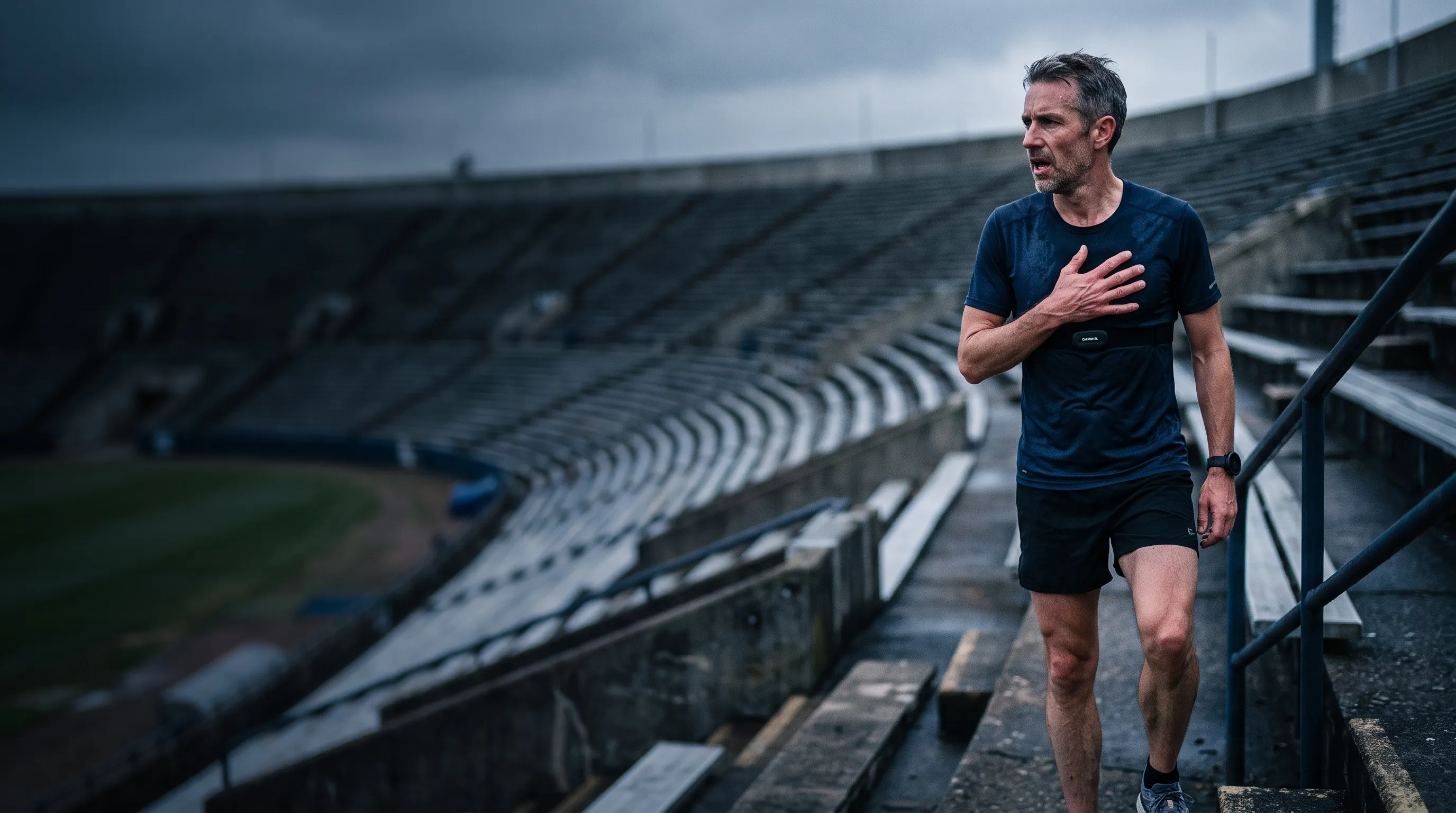
When your heart rate rises in hot weather, your fitness did not suddenly disappear. In most cases, you are seeing a mix of cardiovascular drift, thermoregulation strain, and hydration status—not a true loss of aerobic capacity.123
The practical problem is decision quality. Athletes often treat “high HR in heat” as one signal and either push too hard or back off too much. This protocol uses wearable data to separate three states: normal acclimation stress, actionable dehydration, and functional overreaching risk. Then you can decide whether to progress, modify, or recover with confidence.
Chris Tyler and colleagues’ meta-analysis (96 studies) is a good anchor: “short heat-acclimation blocks under 14 days still produce meaningful physiological and perceptual benefits, with larger gains from longer exposures.”4 In other words, discomfort during week one can be productive—if you can tell productive strain from the wrong kind of strain.
Why hot-weather HR rises (cardiovascular drift vs true fitness loss)
In heat, blood flow is increasingly directed to the skin for cooling, plasma volume shifts, and stroke volume often falls over time. To maintain cardiac output at the same external workload, heart rate rises.15
Wingo et al. showed this clearly at 35°C: from minute 15 to 45, heart rate rose ~12% while stroke volume dropped ~16%, alongside a ~19% reduction in VO2max under heat stress.1 That pattern is a heat load effect, not proof your base fitness regressed.
Hydration amplifies the same pattern. Heaps et al. found that at 0.9% vs 2.8% body-mass loss, heart rate increased about +10 vs +18 bpm during steady cycling.2 Deshayes et al. later confirmed pre-exercise hypohydration impairs aerobic outcomes, including ~2.4% reductions in both performance and VO2peak on average.3
So the right question is not “Is my HR high?” It is: “Is this expected acclimation strain, hydration-related strain, or broader recovery failure?” This guide uses a two-lane matrix to help you answer that question.
Two-Lane Heat Readiness Matrix (overnight + in-session signals)
The Heat Readiness Matrix combines what happened overnight (recovery readiness) and what happens during training (strain expression). Use both lanes to reduce false positives from any single metric or wearable.
Overnight lane—HRV trend, resting-HR delta, skin-temperature delta, sleep debt
Overnight signals help you estimate whether your autonomic and thermal systems are adapting or accumulating fatigue.
- HRV trend (3-7 day vs baseline): Useful, but never standalone. Bellenger et al. showed HRV markers can improve with positive adaptation, yet some overreaching datasets also show vagal increases.6
- Resting HR delta: A persistent upward shift vs your baseline usually indicates unresolved strain.
- Skin-temperature delta: Elevated nocturnal skin temperature can reflect thermal strain or illness context.
- Sleep debt trend: Heat blocks are less forgiving when sleep shrinks. In this protocol, accumulated debt moves the overnight lane toward Modify or Recover.
Important nuance: increased HRV is not always “green.” Manresa-Rocamora et al. reported weekly-averaged HRV and HRR can both rise in functional overreaching (SMD 0.81 and 0.65, respectively).7 That is why this protocol requires multi-signal agreement before calling a Push day.
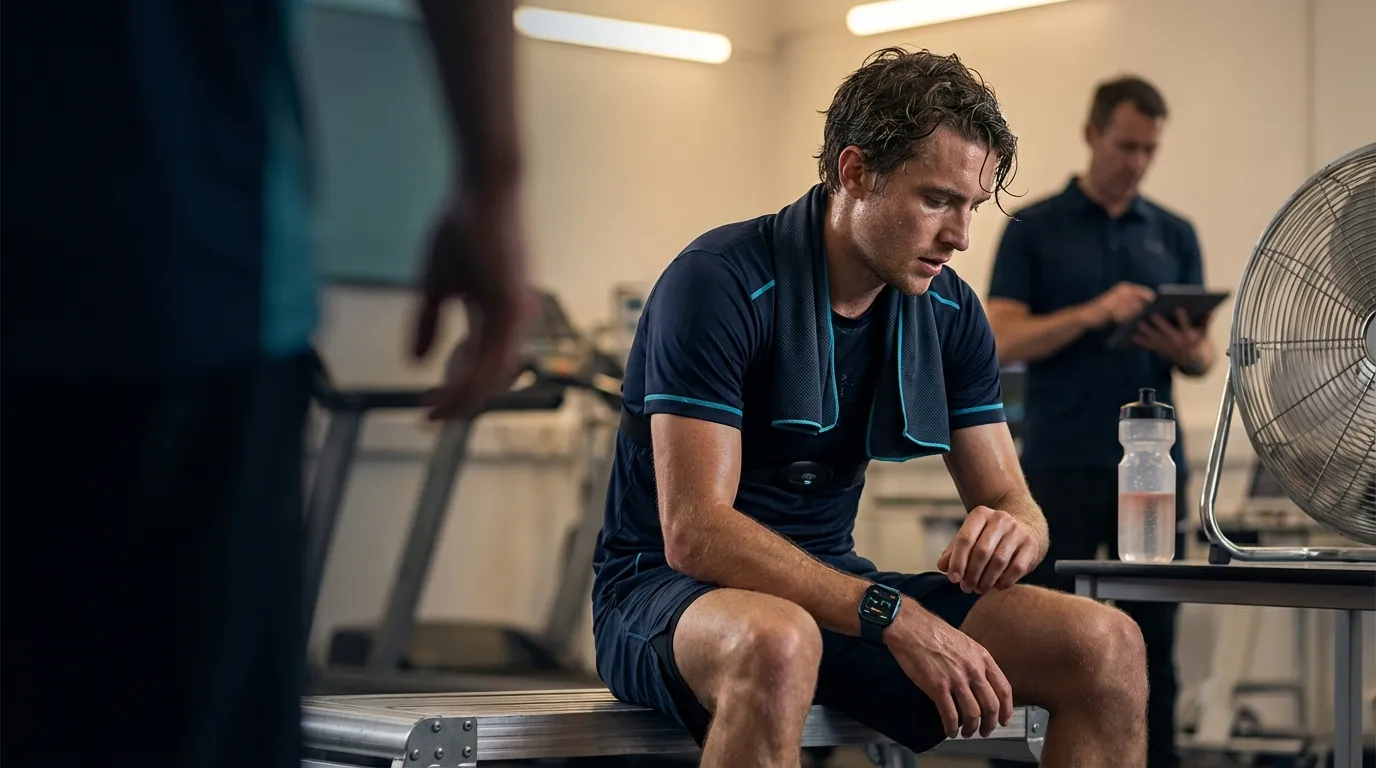
Session lane—HR drift/decoupling, pace-or-power drop, body-mass-loss %, RPE mismatch
In-session signals tell you whether your current prescription matches your current physiology.
Track these anchors:
- HR drift / decoupling at steady effort (pace or power held constant)
- Pace-or-power drop at fixed RPE/HR cap
- Body-mass-loss % from pre/post body mass; account for fluid intake and urine when calculating sweat rate
- RPE mismatch (effort feels unusually hard at routine output)
As a practical hydration guardrail, this protocol treats risk as rising above ~2% body-mass loss, consistent with Scott Montain’s summary that dehydration “in excess of 2% of body weight consistently impairs aerobic exercise performance.”8
Decision rules to separate acclimation gains from dehydration and functional overreaching
You should make next-day decisions by combining both lanes. Use the traffic-light logic below with explicit thresholds.
Push day criteria (progress heat load)
Use a Push day when all of these are true:
- Overnight lane mostly stable (HRV and resting HR near baseline trend)
- Sleep debt not escalating
- HR drift acceptable for session type and environment
- Body-mass-loss estimate controlled (generally <2% body mass)
- RPE is proportionate to output
Push-day progression options:
- Add 5-10 minutes heat exposure at easy-to-moderate intensity
- Add one controlled quality interval set
- Keep workload progression modest (no major jumps)
This is where acclimation benefits accumulate. Tyler et al. suggest most protocols cluster around 7-14 days, with meaningful gains even in shorter blocks.4
Modify day criteria (cap intensity, preserve volume)
Use a Modify day when one lane is yellow or two sub-signals are mildly adverse:
- HRV suppressed or resting HR elevated for 1-2 days
- Heat-session drift above your expected range
- Pace/power down while RPE is up
- Body-mass loss trending toward 2% body mass
Modify-day actions:
- Cap intensity by one zone
- Preserve total session time with lower thermal load (earlier/later training, shade, airflow)
- Increase planned fluid + sodium intake and intra-session cooling
- Recheck next morning before restoring full intensity
This protects adaptation momentum without converting manageable strain into overreaching.
Recover day and red-flag criteria (stop/medical escalation)
Use a Recover day when multiple markers stack:
- Overnight lane clearly adverse (e.g., persistent resting-HR elevation + poor sleep trend)
- Session lane failure (large drift, output collapse, disproportionate RPE)
- Body-mass loss >2% with symptoms, or repeated inability to rehydrate between sessions
Red flags requiring session stop and medical escalation include confusion, collapse/syncope, severe CNS symptoms, persistent vomiting, or signs consistent with exertional heat illness guidance from ACSM.9
A recover day is not a missed day. It is how you keep the next 10 training days on track.
Device-agnostic metric crosswalk (Garmin, WHOOP, Oura, Apple Watch, chest strap)
Different devices label similar physiology differently. Compare them by trend quality, not branding.
| Signal domain | Garmin | WHOOP | Oura | Apple Watch (+ apps) | Chest strap role | How to interpret |
|---|---|---|---|---|---|---|
| Overnight autonomic | HRV Status, Resting HR | HRV, Recovery, RHR | HRV, Readiness, RHR, temp trend | HRV + resting HR via Health | Not overnight-first | 3-7 day baseline delta |
| In-session HR behavior | Real-time HR, heat acclimation widget | Live HR via paired app stack | Limited live training metrics | Live HR + workout apps | Gold standard HR capture | Drift/decoupling at fixed workload |
| Thermal context | Heat acclimation estimate10 | Strain context (indirect) | Temp trend overnight | External weather + skin temp proxies | N/A | Heat-load-adjusted intensity caps |
| Hydration proxy | Manual weight logging | Manual/3rd-party | Manual | Manual | N/A | % body-mass-loss guardrails |
| Recovery decision output | Training readiness widgets | Recovery color + strain planning | Readiness score | Mixed ecosystem | N/A | Push/Modify/Recover protocol action |
Measurement quality note: ring/wrist PPG is generally good overnight, but error increases in some dynamic exercise contexts. Kinnunen et al. reported strong nocturnal ring-vs-ECG agreement (r²=0.996 HR; r²=0.980 HRV), while Zhang et al. found higher wrist-PPG error in certain exercise modes.1112 INTERLIVE and wearable-method papers recommend checking reliability and validity before high-stakes decisions.1314
How to adjust training zones in heat (HR-cap and pace/power correction workflow)
Use this workflow instead of forcing sea-level, cool-weather zones into hot sessions.
- Set a heat HR cap for the day (based on overnight lane + weather severity).
- Anchor by internal load first (HR/RPE), then accept slower pace or lower power in heat.
- Track decoupling: if HR rises while output falls at same RPE, reduce intensity density.
- Apply correction, not ego: preserve session purpose (aerobic durability, threshold time, technique), even if external metrics are down.
- Re-test in cooler conditions before changing long-term baseline zones.
A practical rule for endurance sessions: once decoupling or RPE mismatch crosses your usual bounds, step down one zone and preserve quality. Apply that correction yourself; if you want the workout changed, ask SensAI in chat. What you complete and how you recover will inform the next weekly program regeneration.
The 14-day protocol (Days 1-4 load, 5-7 consolidate, 8-11 progress, 12-14 taper and verify)
Tyler et al. show 7-14 days is the most common acclimation window; this protocol uses the full 14 for better decision confidence.4
Days 1-4: Load (controlled exposure)
- Objective: establish heat stimulus while preventing early dehydration debt
- Keep intensity mostly easy-to-moderate
- Start daily body-mass-loss and sweat-rate tracking alongside overnight baseline capture
- Use Modify logic aggressively at first sign of mismatch
Days 5-7: Consolidate (stabilize adaptation)
- Objective: lock in early adaptations and remove noise
- Maintain exposure frequency, avoid large load spikes
- Recalculate individual heat HR caps from observed drift patterns
- Expect smoother HR behavior if hydration and sleep are managed
Tebeck et al. found short-term heat acclimation can expand plasma volume by ~4.6% (dry) to ~5.3% (humid), which helps explain improved cardiovascular stability across the first week.5
Days 8-11: Progress (specific stress)
- Objective: add targeted intensity while preserving thermal control
- Progress only on Push days; keep Modify options ready
- Use one key heat quality session followed by a lower-strain day
- Verify that output quality is returning at similar internal load
Days 12-14: Taper and verify
- Objective: reduce accumulated strain and confirm adaptation signal
- Lower volume, keep small quality touchpoints
- Compare day-1 vs day-14 HR drift, RPE at fixed workload, and hydration response
- Record portability plan for race week or travel climates
Heat gains decay if not maintained. As Hans Daanen, Sébastien Racinais, and Julien Périard emphasize, heat adaptations decay measurably day-by-day, making timing and re-induction central to race preparation.15 Their meta-analysis estimated decay around 2.3% (end-exercise HR adaptation) and 2.6% (core-temperature adaptation).15
Hydration and sodium planning with body-mass-loss guardrails
Hydration planning should be individualized, then executed with simple guardrails.
Step 1: Calculate sweat rate from field data
Use: (pre-session mass - post-session mass + fluid intake - urine) / hours.
Collect this across at least 3 comparable sessions to avoid overreacting to one day.
Step 2: Set body-mass-loss boundaries
- <2% loss: usually acceptable for many sessions
- ~2-3%: performance risk rises; modify intensity and improve fluid/sodium strategy
- >3%: high caution, especially if repeated
Deshayes et al. showed that above a ~2.8% body-mass-loss threshold, VO2 at lactate threshold fell by ~2.6% per additional 1% loss.3 That is a direct reason to treat hydration as a training-quality variable, not a comfort variable.
Step 3: Build sodium and fluid plan by session type
- Pre-session: begin euhydrated; include sodium in hot/humid blocks
- During session: target replacement that limits excessive mass loss without forcing GI distress
- Post-session: replace fluid and sodium progressively; verify next-morning recovery markers
Translate this into next-day guidance yourself: if the overnight lane is stable but body-mass-loss limits were breached, choose a Modify day with hydration-first correction rather than a full Recover day. If that requires a workout change, request it from SensAI in chat.
Weekly review template and how to use it with SensAI
At the end of each 7-day block, review trends—not anecdotes.
Weekly Heat Review Template (copy/paste)
- Environment: average temp/humidity and key outlier days
- Overnight lane: HRV trend, resting HR delta, sleep debt, temp trend
- Session lane: average HR drift, output at fixed RPE, body-mass-loss distribution, and sweat-rate notes
- Decision tally: number of Push / Modify / Recover days
- Outcome: performance quality trend, symptom notes, adherence
- Next-week plan: progress, hold, or re-induction strategy
Clint R. Bellenger and colleagues summarized the decision challenge well: HRV/HRR changes can reflect both positive adaptation and overreaching, so additional training-tolerance markers are required.6 That is why this protocol uses a matrix rather than letting one score decide. SensAI can add personalized recovery and workout context without turning the matrix into an automatic medical verdict.
For athletes and coaches, the practical value is simple: use the protocol to turn device data into a clear action. SensAI adds a daily recovery summary, regenerates the program weekly from actual performance and recovery, and responds to workout changes you request in chat.
Continue the protocol with SensAI
- SensAI FAQ
- Contact SensAI
- Data-Driven Deload Week: HRV, Sleep, and Training Load
- Wearable Readiness Score Conflicts Training Framework
- Fitness Apps with Oura and WHOOP Integration
Bottom line: if you are training in heat, high heart rate alone is not your decision rule. Use this two-lane readiness model consistently so acclimation gains accumulate while dehydration and overreaching risks are caught early. SensAI can supply personalized recovery and workout context and respond to changes you request in chat.
References
Footnotes
-
Wingo JE, Ganio MS, Cureton KJ. “Cardiovascular drift is related to reduced maximal oxygen uptake during heat stress.” Medicine & Science in Sports & Exercise, 2005. https://pubmed.ncbi.nlm.nih.gov/15692320/ ↩ ↩2 ↩3
-
Heaps CL, González-Alonso J, Coyle EF. “Hypohydration causes cardiovascular drift without reducing blood volume.” International Journal of Sports Medicine, 1994. https://pubmed.ncbi.nlm.nih.gov/8157372/ ↩ ↩2
-
Deshayes TA, et al. “Impact of Pre-exercise Hypohydration on Aerobic Exercise Performance and Physiological Responses: A Systematic Review with Meta-analysis.” Sports Medicine, 2020. https://pubmed.ncbi.nlm.nih.gov/31728846/ ↩ ↩2 ↩3
-
Tyler CJ, Reeve T, Hodges GJ, Cheung SS. “The Effects of Heat Adaptation on Physiology, Perception and Exercise Performance in the Heat: A Meta-Analysis.” Sports Medicine, 2016. https://pubmed.ncbi.nlm.nih.gov/27106556/ ↩ ↩2 ↩3
-
Tebeck ST, et al. “Differing Physiological Adaptations Induced by Dry and Humid Short-Term Heat Acclimation.” International Journal of Sports Physiology and Performance, 2020. https://pubmed.ncbi.nlm.nih.gov/31094262/ ↩ ↩2
-
Bellenger CR, Fuller JT, Thomson RL, Davison K, Robertson EY, Buckley JD. “Monitoring Athletic Training Status Through Autonomic Heart Rate Regulation: A Systematic Review and Meta-Analysis.” Sports Medicine, 2016. https://pubmed.ncbi.nlm.nih.gov/26888648/ ↩ ↩2
-
Manresa-Rocamora A, et al. “Heart rate-based indices to detect parasympathetic hyperactivity in functionally overreached athletes: A meta-analysis.” Scandinavian Journal of Medicine & Science in Sports, 2021. https://pubmed.ncbi.nlm.nih.gov/33533045/ ↩
-
Montain SJ. “Hydration recommendations for sport 2008.” Current Sports Medicine Reports, 2008. https://pubmed.ncbi.nlm.nih.gov/18607219/ ↩
-
American College of Sports Medicine. “Exertional heat illness during training and competition.” Medicine & Science in Sports & Exercise, 2007. https://pubmed.ncbi.nlm.nih.gov/17473783/ ↩
-
Garmin Support. “What Is Heat and Altitude Performance Acclimation?” https://support.garmin.com/en-US/?faq=PQCtbgWxJ65nRatXoHCmy7 ↩
-
Kinnunen H, et al. “Feasible assessment of recovery and cardiovascular health: accuracy of nocturnal HR and HRV via ring PPG vs ECG.” Physiological Measurement, 2020. https://pubmed.ncbi.nlm.nih.gov/32217820/ ↩
-
Zhang Y, et al. “Validity of Wrist-Worn Photoplethysmography Devices to Measure Heart Rate: A Systematic Review and Meta-analysis.” Journal of Sports Sciences, 2020. https://pubmed.ncbi.nlm.nih.gov/32552580/ ↩
-
Mühlen JM, et al. “INTERLIVE Network: Validity of consumer wearable heart rate devices.” British Journal of Sports Medicine, 2021. https://pubmed.ncbi.nlm.nih.gov/33397674/ ↩
-
Düking P, et al. “Recommendations for reliability, sensitivity, and validity of wearable sensor data in exercise and health science.” JMIR mHealth and uHealth, 2018. https://pubmed.ncbi.nlm.nih.gov/29712629/ ↩
-
Daanen HAM, Racinais S, Périard JD. “Heat Acclimation Decay and Re-Induction: A Systematic Review and Meta-Analysis.” Sports Medicine, 2018. https://pubmed.ncbi.nlm.nih.gov/29129022/ ↩ ↩2