Best AI Workout Form Check Apps (2026): What Actually Works
Real-time CV form checkers and AI-coach photo feedback are two different tools. We separate them, rank the best of each for 2026, and route you by what your form problem actually is.

SensAI Team
14 min read
Get a training plan that adapts to your recovery — free on iOS

Best AI Workout Form Check Apps (2026): What Actually Works
When you search for the best AI workout form check app, you get a list that lumps two completely different products into one ranking. That’s why the lists never quite help you.
One kind of app sets your phone against the wall, watches you with the camera, draws a skeleton over your body, and counts your reps with live cues mid-set. The other kind lets you send a photo to a conversational AI coach that critiques your position — and remembers it the next time you train.
Those are not the same tool. One is a live mirror with eyes. The other is a coach with memory. Ranking them together is like ranking a stopwatch against a running coach because both involve running.
This guide separates them into two buckets, names the best of each for 2026, and tells you which one matches your actual problem. We cover AiKYNETIX, Zing Coach, Strive, FormCheck AI, CueForm AI, SensAI, and the generic-ChatGPT approach. The honest verdict up top: for pure live rep-by-rep visual analysis, dedicated computer-vision apps win — and we’ll say which. For form feedback tied to your injuries, your program, and your recovery, an AI coach wins.
Form matters because technique is one of the clearest levers on injury risk in resistance training, and because external, augmented feedback is one of the most reliable ways to actually change a movement pattern.12 The trick is picking the tool that gives you the right kind of feedback for the problem you have.
Real-time CV form checkers vs. AI-coach photo feedback — what’s the difference?
The fastest way to waste money on a form app is to buy the wrong category. So before any rankings, here’s the distinction that the roundups skip.
What real-time computer-vision form checkers actually do
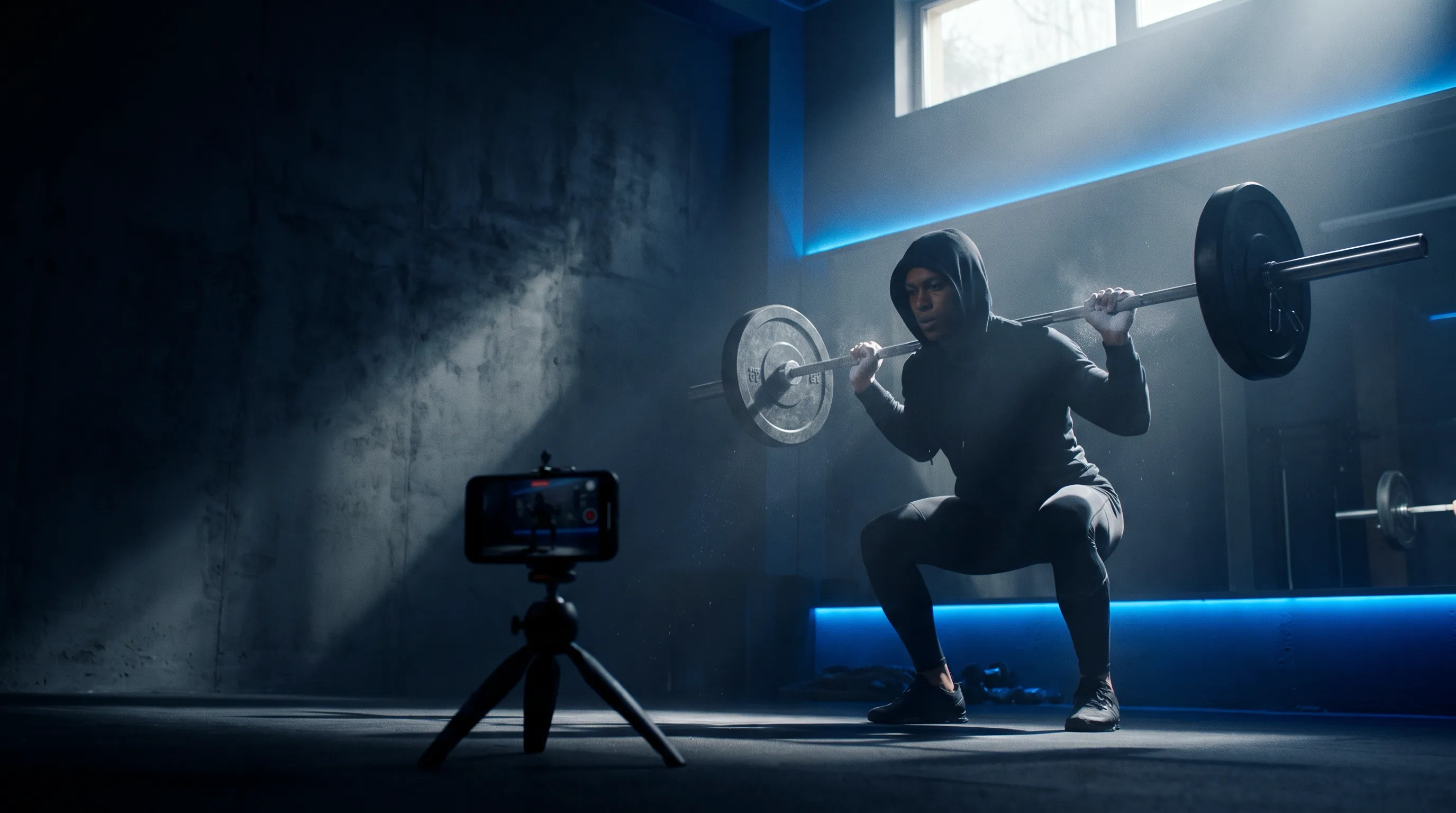
You prop your phone against a wall, step back, and the app watches you live.
Under the hood, these apps use markerless pose estimation: a model finds your joints in the video frame and tracks them as you move, building a 2D or 3D stick-figure of your body in real time. From that skeleton, the app counts reps, measures joint angles, and flashes cues mid-set — “knees caving,” “hips too high,” “go deeper.”
This is genuinely useful, and it’s getting better fast. But you should hold the accuracy claims loosely. Markerless capture from a single phone camera is not yet lab-grade for every joint and every plane of motion. A 2026 systematic review comparing 3D markerless systems to marker-based gold standards found accuracy good enough for gross movement screening but degrading in the transverse plane and under occlusion — the camera simply can’t always see what it needs to.3 A smartphone-based system validated against marker-based capture showed an overall joint-angle error around 5.8 degrees, fine for spotting a caving knee, less fine for the millimeters that separate a safe deadlift from a rounded one.4
Translation: live CV is excellent for catching the big, obvious form breaks in real time. Treat the precise numbers as a directional guide, not a verdict.
What an AI coach reviewing your form does differently
The second bucket doesn’t watch you live. You send it a photo after the set.
What you give up: the live skeleton and the mid-rep cue. What you get back: a critique from a conversational LLM coach that remembers. It knows you flagged a cranky left shoulder three weeks ago. It knows your program is in week 4 of a hypertrophy block. It knows you slept five hours last night because it reads your recovery data. So its feedback on your overhead press isn’t just “elbows flared” — it’s “elbows flared, and given that shoulder, let’s swap to a landmine press this week.”
This is the difference between measuring a movement and coaching a person. The science on why it works is solid: video and visual feedback reliably improve technique acquisition, and an external focus of attention — thinking about the movement’s effect rather than your body parts — produces better motor learning than internal cues.25 SensAI lives in this bucket, and we’ll be specific about what it does and does not do below.
The point of this section isn’t to crown a winner yet. It’s to get you to ask the right question: do I need a mirror that watches every rep, or a coach that understands my whole situation? Your answer decides which half of the list below matters.
TL;DR — Best AI Form Check Apps 2026
| App | Bucket | Best For | How It Checks Form | Loaded Barbell? | Platform | Price |
|---|---|---|---|---|---|---|
| AiKYNETIX | A: Real-time CV | Barbell lifters wanting velocity + 3D tracking | Single-camera 3D pose + lift velocity, live | Yes | iOS, web | $12.99/mo or $79.99/yr |
| Zing Coach | A: Real-time CV | Bodyweight/home users who want live rep tracking | Phone-against-wall live joint tracking + rep counting | No | iOS, Android | ~$18.99/mo, $59.99/yr |
| Strive | A: Real-time CV | Home exercisers wanting correction + adaptive plan | Live camera correction + auto rep counting | No | iOS, Android | Free download; $12.99/mo, $69.99/yr |
| FormCheck AI | A: Real-time CV | Quick between-set clip analysis across many lifts | 33-landmark pose on short clips, ~15s analysis | Yes | iOS | ~$12–13/mo or ~$90/yr |
| CueForm AI | A: Real-time CV | Budget squat/bench/deadlift checks | CV analysis of squat/bench/deadlift + chat | Yes | iOS, web | Free tier; ~$10/mo |
| SensAI | B: AI coach | Lifters wanting form tied to injuries, program & recovery | Photo to LLM coach with cross-session memory | Yes | iOS | Free 7-day trial; $6.99/mo, $69.99/yr |
| ChatGPT (generic) | B: AI coach | One-off, throwaway form questions | LLM critique of a single photo, no memory | n/a | Web, iOS, Android | Free tier; $20/mo |
The verdict in one sentence: if your problem is “is this single rep technically clean,” a dedicated CV app like AiKYNETIX (barbell) or Zing/Strive (bodyweight) is the better mirror — but if your problem is “is this exercise right for me given my shoulder, my program, and how I recovered this week,” that’s a coaching problem, and an AI coach like SensAI is the better answer.
How we evaluated these apps
We ranked these against the job each is actually hired to do, not against a single leaderboard. The criteria:
- Live vs. async — does it watch you in real time, or critique after the fact?
- Movements supported — bodyweight only, or loaded barbell too?
- Accuracy evidence — is there independent validation, or only vendor claims?
- Memory & program integration — does it remember you and fit feedback into a plan?
- Price and platform.
One honest disclaimer. This is an evidence-informed product benchmark, not a laboratory study. We did not run these apps against a marker-based motion-capture system ourselves. And the whole category has an accuracy-claims problem: nearly every CV app advertises a precision number with no peer-reviewed backing. Be skeptical of those numbers — including any you’ll see attributed to these apps below, and including ours. When a vendor says “95% accurate,” ask: accurate against what, measured by whom, in what plane?3
Bucket A — Best real-time CV form checkers
This is the bucket to buy if your job is live, rep-by-rep visual analysis. You want a mirror with eyes.
AiKYNETIX
What it does: single-camera 3D motion analysis plus bar-velocity tracking, built for barbell lifters. You set up one phone, and it reconstructs your movement in 3D and reports velocity on your squats, deadlifts, and Olympic lifts in real time.
Among the live-CV apps, this is the one that takes loaded barbell work seriously. AiKYNETIX points to validation work with the University of Houston biomechanics lab and Rice athletics, and the vendor advertises around 95% accuracy. Read that as a vendor claim, not an independent result — single-camera markerless capture still carries real plane-of-motion and occlusion limits versus lab systems, so treat the 3D output as a strong training aid rather than a clinical measurement.3
Strengths: Best-in-bucket for loaded barbell. Bar-velocity feedback is genuinely useful for autoregulation, and the visual feedback model it relies on has the strongest evidence base of any feedback type for lifting.6
Weaknesses: The premium accuracy claims outrun the independent evidence. Web tier is pricier than the mobile app.
Pick it if: you’re a barbell lifter who wants live 3D form and velocity data and you’ll treat the numbers as directional.
Price: $12.99/mo or $79.99/yr (7-day in-app / 14-day web trial).
Zing Coach
What it does: Zing’s “Zing Vision” feature uses your phone camera to track joints live and count reps, with on-screen corrective prompts during the set.
For Zing’s prices and how its workout planner compares with Fitness AI and Planfit, see our Fitness AI vs Zing vs Planfit comparison.
It’s a polished, game-like experience for bodyweight movement. The catch is in the scope.
Strengths: Clean live rep counting and form prompts; strong for guided bodyweight sessions.
Weaknesses: Bodyweight-focused — it isn’t built for loaded barbell analysis. Pricing is opaque until you finish the onboarding quiz.
Pick it if: you train mostly bodyweight or machine work at home and want a live counter and basic form prompts.
Price: ~$18.99/mo, $59.99/yr (promotional pricing around $39.99/yr appears periodically).
Strive
What it does: Strive (AI Home Workout) uses the phone camera for real-time form correction and automatic rep counting, wrapped in an adaptive bodyweight home-workout plan that adjusts as you improve.
It’s the most “complete home product” in this bucket — form correction plus programming in one app.
Strengths: Live correction and auto rep counting bundled with an adaptive plan; free to download so you can test the camera before paying.
Weaknesses: Bodyweight/home oriented, not a barbell tool. Real-time correction quality depends heavily on camera placement and lighting.
Pick it if: you train at home with bodyweight and want live correction and a plan that evolves, in one app.
Price: free download; ~$12.99/mo or ~$69.99/yr (7-day free trial).
FormCheck AI
What it does: tracks 33 body landmarks to measure joint angles across 30+ exercises, returning analysis on a short clip in roughly 15 seconds — fast enough to check between sets.
This sits between live and async: you film a set, get near-instant feedback, adjust on the next set.
Strengths: Broad exercise coverage including barbell lifts; the 15-second turnaround makes it practical between sets without standing around.
Weaknesses: Landmark-based joint-angle analysis inherits the usual single-camera limits — depth and out-of-plane motion are where these models struggle most.4
Pick it if: you want quick clip-based checks across a wide range of lifts and like fast between-set feedback.
Price: ~$12–13/mo or ~$90/yr (free tier with paid Pro options).
CueForm AI
What it does: real-time computer-vision analysis focused on the big three — squat, bench, deadlift — plus a conversational coach you can ask follow-up questions, with a usable free tier.
It’s the budget pick. Narrower scope, but it does the powerlifting trio and it’s cheap.
Strengths: Free tier with unlimited quick feedback; tight focus on squat/bench/deadlift variations; low entry price.
Weaknesses: Limited to its core lifts; full reviews are metered on the paid plan.
Pick it if: you mainly want squat/bench/deadlift checks on a budget and can live with a metered free tier.
Price: free limited tier; ~$10/mo.
Bucket B — Best AI-coach photo form feedback
This is the bucket to buy if your job isn’t “is this rep clean” but “is this exercise right for me, and what should I do about it.” Here the differentiator isn’t the skeleton overlay — it’s memory and context.
SensAI
What it does: you send a photo to a conversational LLM coach, and it critiques your position the way a coach would — then remembers it. SensAI keeps cross-session memory of your injuries, your form cues, and your constraints, and it layers in your HealthKit recovery data (HRV trend, sleep, resting heart rate) when it decides what to program next.
Let’s be precise about what this is and is not. SensAI does not do real-time camera computer vision. There’s no live skeleton, no rep-by-rep mid-set overlay, no on-screen “knees caving” the instant it happens. It’s async photo form feedback. If you want a live mirror, the Bucket A apps above are the right tool and we said so.
What SensAI does instead is connect the form check to everything else. The feedback isn’t a one-off. It’s a coach that explains why — and the explaining is the point. Visual feedback improves technique acquisition, and feedback that directs an external focus of attention produces better, more durable motor learning than telling someone to “squeeze your glutes.”25 A coach that remembers your last critique can deliver that consistently, session after session, instead of resetting every time.
It also threads form into the larger picture. One clean rep doesn’t mean the exercise belongs in your week. Progressive overload — not novelty — is what drives strength and hypertrophy, and managing training load is a bigger injury lever than any single rep’s geometry.78 A coach that sees your program and your recovery can tell you the overhead press looks fine but your HRV is suppressed and your shoulder volume is already high, so back off. That recovery read is meaningful only as a trend, not a single morning’s number — which is exactly how HRV-guided training research says it should be interpreted.9 A live skeleton can’t make that call.
Strengths: Cross-session memory of injuries and cues; form feedback integrated with your program and recovery data; explains its reasoning, which trains your own intuition over time.
Weaknesses: No live skeletal CV and no real-time rep-by-rep overlay — it’s async by design. If pure live visual analysis is your only goal, a dedicated CV app does that job better.
Pick it if: you want a coach that remembers your bad shoulder, ties form into your actual program, and adapts the whole week — not just grades one rep.
For more on checking your form safely without a coach in the room, see am I doing my exercises correctly and safely and our deeper guide to exercise form and safety.
Generic LLM screenshot tools (ChatGPT, etc.)
What it does: you paste a photo of your set into a general chatbot and ask “how’s my form?” It will give you a competent, often genuinely helpful one-shot critique.
Here’s the ceiling. It critiques that photo and nothing else. It doesn’t remember the photo you sent last week, it doesn’t know your program, it has no wearable data, and it can’t track whether you actually fixed the problem. It’s the difference between asking a knowledgeable stranger at the gym for a one-off opinion and having a coach who’s watched you for months. Useful in a pinch — but it’s a critique, not coaching, and that’s the gap SensAI is built to fill.
Which one should you actually use?
Match the tool to your problem, not to the highest spot on someone’s list:
- Loaded barbell, want live 3D + velocity → AiKYNETIX.
- Bodyweight or home training, want a live rep counter and prompts → Zing Coach or Strive.
- Wide range of lifts, want fast between-set clip checks → FormCheck AI.
- Budget squat/bench/deadlift checks → CueForm AI (free tier).
- A coach that remembers my injury and adjusts my whole program → SensAI.
- A quick, throwaway one-off check → generic ChatGPT (just don’t expect it to remember or to know your plan).
And keep the bigger frame in view. Form is one input. Whether you’re progressing safely depends far more on your injury history, your recovery, and how your load is built over weeks — progressive overload drives the adaptation, and load management drives the injury risk.78 A perfect-looking rep inside a badly managed program is still a problem. That’s exactly why, for many lifters, a coach that sees the whole picture beats a tool that grades one frame. If you’re weighing full coaching apps rather than just form tools, our best AI personal trainer apps of 2026 breakdown goes deeper.
The limits of AI form checking
No app on this list replaces everything, and the good ones admit it.
A live skeleton can’t feel tempo or control. It sees position, not the grind of a slowing eccentric or whether you’re actually bracing. It can tell you where your knees are; it can’t tell you that you let the bar crash because you stopped resisting it.
Single-camera CV has hard physical limits. Occlusion (a limb hiding a joint), depth ambiguity, and out-of-plane rotation are exactly where markerless models lose accuracy against lab systems — which is why the validation literature is honest that these tools are screening aids, not measurement instruments.310
And no app replaces a human coach with hands-on eyes for advanced or heavily loaded movements, or a physician for pain. If something hurts in a way that isn’t normal training discomfort, that’s a clinician’s call, not a chatbot’s. The best use of any AI form tool — CV or coach — is to catch the obvious stuff early and free up the expensive human attention for the things that actually need it. Our best AI workout app guide covers where AI fits into training overall.
Frequently asked questions
What is the best AI form check app in 2026? There’s no single winner because they do different jobs. For live, rep-by-rep barbell analysis, AiKYNETIX is the strongest. For form feedback tied to your injuries, program, and recovery, SensAI is the better fit.
Can an app really check my workout form? Yes, with limits. Real-time CV apps detect obvious form breaks like caving knees or shallow squats reliably, and AI-coach apps give context-aware critiques from photos. Neither matches an in-person coach for subtle technique on heavy lifts.3
Do AI form checkers work for barbell lifts like squats and deadlifts? Some do. AiKYNETIX, FormCheck AI, and CueForm AI handle barbell lifts; Zing and Strive focus on bodyweight. Treat any precise accuracy claim skeptically — single-camera capture has real plane-of-motion limits.4
Is ChatGPT good for form checks? For a quick one-off critique of a single photo, yes. But it has no memory of past checks, no knowledge of your program, and no recovery data — so it gives a one-shot opinion, not ongoing coaching.
Are AI form check apps accurate? Accurate enough for gross movement screening, not for clinical measurement. Independent reviews of markerless capture report joint-angle errors that work for catching big faults but exceed clinical limits for fine joint assessment.43
References
Footnotes
-
Colado JC, García-Massó X. “Technique and safety aspects of resistance exercises: a systematic review of the literature.” Physician and Sportsmedicine, 2009;37(2):104-111. https://pubmed.ncbi.nlm.nih.gov/20048516/ ↩
-
Wulf G. “Attentional focus and motor learning: a review of 15 years.” International Review of Sport and Exercise Psychology, 2013;6(1):77-104. https://doi.org/10.1080/1750984X.2012.723728 ↩ ↩2 ↩3
-
Chougule A, Dowsett R, Ekundayomi D, Machesney C, Mather J, Gompels B, McDonnell J. “Accuracy and Validity of 3D Markerless Motion Capture Compared to Marker-Based Systems for Lower-Limb Biomechanical Assessment: A Systematic Review.” Sensors, 2026;26(12):3956. https://doi.org/10.3390/s26123956 ↩ ↩2 ↩3 ↩4 ↩5 ↩6
-
Horsak B, Eichmann A, Lauer K, Prock K, Krondorfer P, Siragy T, Dumphart B. “Concurrent validity of smartphone-based markerless motion capturing to quantify lower-limb joint kinematics in healthy and pathological gait.” Journal of Biomechanics, 2023;159:111801. https://doi.org/10.1016/j.jbiomech.2023.111801 ↩ ↩2 ↩3 ↩4
-
Cochrane E, Miltenberger R, Concepcion A. “Evaluating peer-implemented video feedback to improve weight training form.” Journal of Applied Behavior Analysis, 2022;55(4):1144-1156. https://doi.org/10.1002/jaba.949 ↩ ↩2
-
Weakley J, Cowley N, Schoenfeld BJ, Read DB, Timmins RG, García-Ramos A, McGuckian TB. “The Effect of Feedback on Resistance Training Performance and Adaptations: A Systematic Review and Meta-analysis.” Sports Medicine, 2023;53(9):1789-1803. https://doi.org/10.1007/s40279-023-01877-2 ↩
-
Schoenfeld BJ, Ogborn D, Krieger JW. “Dose-response relationship between weekly resistance training volume and increases in muscle mass: A systematic review and meta-analysis.” Journal of Sports Sciences, 2017;35(11):1073-1082. https://doi.org/10.1080/02640414.2016.1210197 ↩ ↩2
-
Gabbett TJ. “The Training-Injury Prevention Paradox: Should Athletes Be Training Smarter and Harder?” British Journal of Sports Medicine, 2016;50(5):273-280. https://doi.org/10.1136/bjsports-2015-095788 ↩ ↩2
-
Plews DJ, Laursen PB, Stanley J, Kilding AE, Buchheit M. “Training Adaptation and Heart Rate Variability in Elite Endurance Athletes: Opening the Door to Effective Monitoring.” Sports Medicine, 2013;43(9):773-781. https://doi.org/10.1007/s40279-013-0071-8 ↩
-
Wade L, Needham L, McGuigan P, Bilzon J. “Applications and limitations of current markerless motion capture methods for clinical gait biomechanics.” PeerJ, 2022;10:e12995. https://doi.org/10.7717/peerj.12995 ↩