Calisthenics Progression Guide: How to Build Real Strength and Muscle With No Equipment (Beginner to Advanced)
Yes, calisthenics builds real muscle and strength. Five movement-pattern progression ladders plus how to apply progressive overload with zero equipment.

SensAI Team
16 min read
Get a training plan that adapts to your recovery — free on iOS

Here is the mental shift that makes calisthenics finally click: you don’t add weight, you make your bodyweight harder to move.
Think of a barbell lifter as someone who turns a dial — add five pounds, then five more. A calisthenics athlete works a different machine entirely. Instead of loading the bar, you reshape the leverage of your own body until a push-up becomes a one-arm push-up, and a hang becomes a muscle-up. The resistance was always there. You just learned how to point more of it at the muscle.
That reframe is the whole game. And it’s why “I don’t have a gym” stopped being an excuse years ago. The constraint was never the equipment. It was the system.
This guide gives you that system: why bodyweight training actually builds muscle, the five ways to overload without a single plate, and five movement-pattern ladders that take you from your knees to a planche. If you’d rather have that system run itself — advancing you to the next stage the moment your data says you’re ready — SensAI was built to do exactly that. But first, the science.
Can Calisthenics Really Build Muscle and Strength?
Yes — calisthenics builds real muscle and meaningful strength, because muscle growth is driven by mechanical tension and how close you train to failure, not by whether the load hangs off a barbell or comes from your own body.
Here is the principle most people miss. Your muscle fibers cannot tell the difference between a dumbbell and gravity. They respond to tension and to fatigue. Brad Schoenfeld, PhD — a leading hypertrophy researcher at CUNY Lehman College — laid out the framework in his foundational review: mechanical tension is the primary driver of growth, supported by metabolic stress and muscle damage.1 None of those mechanisms requires an external weight. They require a hard enough stimulus.
The clearest proof comes from load-equating research. When Morton and colleagues had trained men lift either heavy (75–90% of max) or light (30–50% of max) loads, taking every set to failure, both groups built the same amount of muscle and gained similar strength.2 Schoenfeld and Grgic’s meta-analysis confirmed the pattern across the literature: low-load and high-load training produce comparable hypertrophy when sets are taken near failure.3 The light loads of bodyweight movements are not a downgrade — they’re a valid path, as long as you push close to the limit.
And we have evidence specific to bodyweight movements, not just light dumbbells. When Kotarsky and colleagues ran men through a progressive calisthenic push-up program for four weeks, they gained strength comparable to a traditional bench press group.4 A separate study found low-load bench press and push-ups produced similar growth in the triceps and chest.5 The body is the barbell.
The honest nuance: maximal strength has specificity. Bodyweight training builds genuine, transferable strength — but if your goal is a 500-pound deadlift one-rep max, you eventually need to handle near-maximal external load, because that meta-analysis also found heavy lifting wins for pure one-rep strength.3 For building muscle and the kind of strength that shows up in real life, calisthenics holds its own. For more on the underlying mechanics, see our complete guide to building muscle.
Progressive Overload Without Weights: The 5 Levers
You can’t add plates, but you have five levers that make any bodyweight movement harder — and pulling them in sequence gives you years of progressive overload.
This is where most home trainees stall. They do the same push-ups forever and wonder why nothing changes. Progressive overload is non-negotiable; you simply apply it differently. Here are the five levers:
| Lever | How it adds difficulty | Example |
|---|---|---|
| Leverage | Change body angle or limb length so gravity acts harder | Incline → floor → decline → one-arm push-up |
| Range of motion | Increase the distance the muscle works through | Deficit push-ups; full-depth squats |
| Tempo / time under tension | Slow the lowering phase to extend the stimulus | 4-second eccentric on every rep |
| Unilateral / asymmetric load | Shift the work onto one limb | Archer push-ups; pistol squats |
| Reps & proximity to failure | Add reps and train closer to your limit | Stop with 1–2 reps in reserve, then push to failure |
A few of these deserve their evidence. Range of motion isn’t optional polish — Pallarés and colleagues found full ROM produced significantly greater strength and lower-body muscle growth than partial ROM across squats, presses, and more.6 Train through the full path. Proximity to failure is the dial that makes light loads work: Refalo and colleagues showed that training closer to failure yields a small hypertrophy advantage, which matters enormously when the load itself is light.7 If your push-ups feel easy at rep 20, you’re not close enough to failure to grow — change the leverage. (For learning to gauge that distance precisely, read our guide to training by effort with RPE and RIR.)
The art is sequencing these levers so the work always lands near failure inside a rep range you can recover from. That sequencing is exactly what SensAI automates — when your logged reps cross the top of a target range, it advances the lever for you rather than letting you coast.
The Five Movement-Pattern Progression Ladders
Every calisthenics goal lives inside one of five movement patterns: push, pull, squat, dip, and core. Master the ladder for each and you cover the whole body.
Treat each table as a staircase. Earn the “when to advance” criterion with clean, controlled reps — no kipping, no half-range — then step up. Rushing the ladder is the single most common reason people get stuck or hurt.
Push
The push ladder runs from your knees to a one-arm push-up, with each stage shifting more of your bodyweight onto the working arm.
| Stage | Exercise | When to advance |
|---|---|---|
| 1 | Incline / knee push-up | 3×12 clean reps |
| 2 | Full push-up | 3×15 clean reps |
| 3 | Archer push-up | 3×8 per side |
| 4 | Pseudo-planche push-up | 3×8 with forward lean |
| 5 | One-arm push-up progression | 3×5 per side |
This isn’t theoretical. Calatayud and colleagues found that push-ups and bench press, matched for muscle activation, produced similar strength gains over training8 — the push-up is a real strength exercise, not a warm-up. When floor push-ups get easy, don’t just chase rep 40; raise your feet or move to the archer to keep the stimulus near failure. These all work beautifully in a bodyweight home workout with zero gear.
Pull
The pull ladder builds from a passive dead hang to a strict pull-up and eventually a muscle-up, developing grip, scapular control, and back strength in order.
| Stage | Exercise | When to advance |
|---|---|---|
| 1 | Dead hang | 45-second hold |
| 2 | Scapular pull (active hang) | 3×10 controlled |
| 3 | Negative pull-up (slow lower) | 3×5 with 5-sec lower |
| 4 | Band-assisted / strict pull-up | First strict rep |
| 5 | Strict pull-up → muscle-up | 3×8, then transition work |
Pull-ups are the highest-skill ceiling in calisthenics, so we won’t cram the depth here — our dedicated beginner pull-up progression walks through every assistance method, rep scheme, and the negative-first protocol that gets people their first rep fastest. Bookmark it and run that ladder alongside this one.
Squat
The squat ladder loads one leg at a time until you can drive your full bodyweight out of the bottom of a pistol squat.
| Stage | Exercise | When to advance |
|---|---|---|
| 1 | Bodyweight squat | 3×20 full depth |
| 2 | Split squat | 3×12 per leg |
| 3 | Bulgarian split squat | 3×10 per leg |
| 4 | Assisted pistol squat | 3×5 per leg with support |
| 5 | Pistol squat | 3×5 per leg unassisted |
Unilateral work is the engine here, and it holds up: Speirs and colleagues found unilateral squat training matched bilateral training for lower-body strength gains.9 One leg at a time isn’t a compromise — it’s how you keep overloading without a barbell.
Dip
The dip ladder progresses from a chair-supported press to the deep instability of a ring dip, hammering the chest, triceps, and front delts.
| Stage | Exercise | When to advance |
|---|---|---|
| 1 | Bench / chair dip (feet down) | 3×15 clean reps |
| 2 | Parallel-bar dip | 3×10 full depth |
| 3 | Ring dip | 3×8 with stable rings |
The jump to rings adds a stability tax that recruits more stabilizers for the same range — a free difficulty bump once parallel-bar dips feel routine.
Core / Isometric
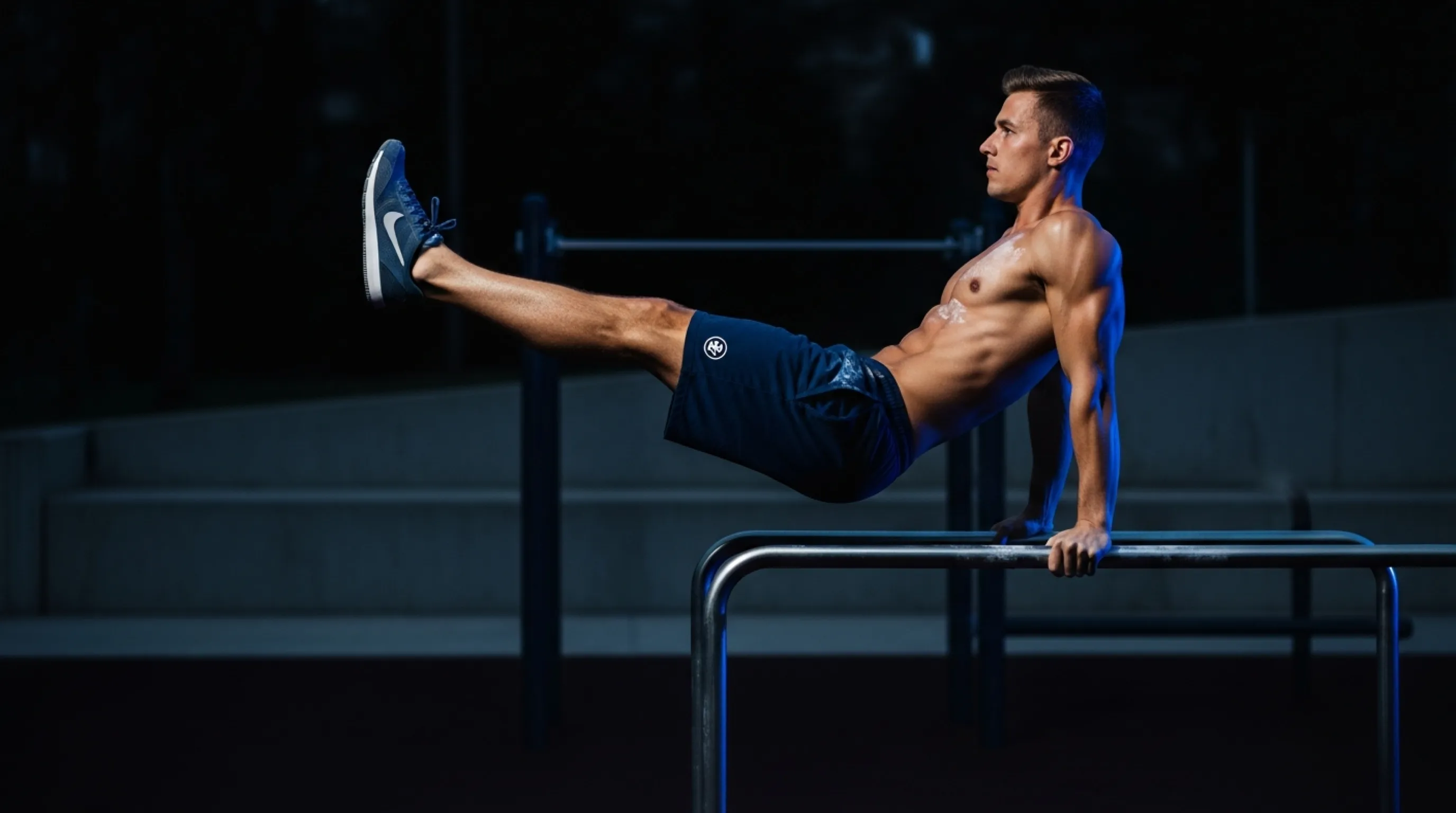
The core ladder builds from a plank to advanced straight-arm holds like the L-sit and the first front-lever and planche progressions.
| Stage | Exercise | When to advance |
|---|---|---|
| 1 | Plank | 60-second hold |
| 2 | Hollow body hold | 30-second hold |
| 3 | Tuck L-sit | 20-second hold |
| 4 | L-sit | 15-second hold |
| 5 | Tuck planche / front lever progressions | 10-second hold |
These isometrics are where calisthenics earns its reputation for gymnast-like control. They demand patience — progress is measured in seconds, not plates. A tool like SensAI is genuinely useful here, because it can track hold times across weeks and tell you when a five-second improvement means you’ve earned the next stage.
How to Program Calisthenics
Train each movement pattern 2–3 times per week, aim for 10–20 hard sets per muscle weekly, rest 2–3 minutes between hard sets, and advance the moment you hit the top of your rep range.
Frequency. Hitting a muscle twice a week beats once. Schoenfeld and colleagues’ frequency meta-analysis found training a muscle group at least twice weekly produced superior growth versus once.10 Since bodyweight work recovers fast, 2–3 sessions per pattern is the sweet spot.
Volume. The classic dose-response meta-analysis found more weekly sets drove more growth, with benefits accruing into the 10+ sets-per-muscle range.11 Most people thrive on 10–20 hard sets per muscle per week — see our deep dive on weekly training volume to dial in your number.
Rest. Don’t rush your sets. Grgic and colleagues’ systematic review found that resting two-plus minutes between sets better supports strength development, especially in trained lifters.12 Our guide to rest between sets covers the trade-offs in detail.
Progression. When you clean the top of a rep range across all sets, advance the lever — more reps, slower tempo, or the next stage on the ladder. Eric Helms, PhD — a researcher and coach known for evidence-based programming and a co-author on the proximity-to-failure work above — has long argued that the priority is consistent overload applied through autoregulation, letting daily readiness guide how hard you push.7
Recovery. Hard calisthenics sessions create soreness like any training. Don’t mistake soreness for progress, and don’t train a pattern into the ground — our DOMS and recovery guide explains when to push and when to back off. SensAI factors your sleep and HRV trends into this call, nudging the next session’s intensity based on how recovered you actually are.
Common Calisthenics Mistakes (and the Fix)
Most stalled calisthenics progress traces back to five fixable mistakes:
- Ego-jumping the ladder. Attempting a muscle-up before you own strict pull-ups builds bad habits and injuries. Fix: earn the advance criterion before you climb.
- Training too easy. If you can grind out 30 reps, the leverage is wrong and you’re nowhere near failure. Fix: change the angle or go unilateral so you’re working in a 5–15 rep range that ends near failure.
- Neglecting pull volume. Push movements are easy to do anywhere, so pulling gets skipped — wrecking posture and shoulder health. Fix: match your pull sets to your push sets, even if it means buying a doorway bar.
- Ignoring recovery between hard sessions. Stacking high-intensity hold and push days without rest stalls everyone. Fix: space hard sessions and respect soreness.
- No structured progression plan. Random workouts produce random results. Fix: follow the ladders and track when you cross each threshold.
That last one is where most self-directed trainees lose months. SensAI closes the gap by reading your logged performance and recovery and deciding, session by session, whether today is a push day or a hold day — recovery-timed advancement instead of guesswork.
The Bottom Line
Calisthenics builds real muscle and real strength because your muscles respond to tension and proximity to failure, not to the source of the load.
You overload by pulling five levers — leverage, range of motion, tempo, unilateral loading, and reps-to-failure — and you organize it with five movement-pattern ladders run two to three times a week, near failure, with full recovery.
The constraint was never the equipment. It was always the system. Build the system, follow the ladders, and the floor of your living room becomes a complete gym.
References
Footnotes
-
Schoenfeld BJ. “The Mechanisms of Muscle Hypertrophy and Their Application to Resistance Training.” Journal of Strength and Conditioning Research, 2010. https://pubmed.ncbi.nlm.nih.gov/20847704/ ↩
-
Morton RW, Oikawa SY, Wavell CG, et al. “Neither load nor systemic hormones determine resistance training-mediated hypertrophy or strength gains in resistance-trained young men.” Journal of Applied Physiology, 2016. https://pubmed.ncbi.nlm.nih.gov/27174923/ ↩
-
Schoenfeld BJ, Grgic J, Ogborn D, Krieger JW. “Strength and Hypertrophy Adaptations Between Low- vs. High-Load Resistance Training: A Systematic Review and Meta-analysis.” Journal of Strength and Conditioning Research, 2017. https://pubmed.ncbi.nlm.nih.gov/28834797/ ↩ ↩2
-
Kotarsky CJ, Christensen BK, Miller JS, Hackney KJ. “Effect of Progressive Calisthenic Push-up Training on Muscle Strength and Thickness.” Journal of Strength and Conditioning Research, 2018. https://pubmed.ncbi.nlm.nih.gov/29466268/ ↩
-
Kikuchi N, Nakazato K. “Low-load bench press and push-up induce similar muscle hypertrophy and strength gain.” Journal of Exercise Science and Fitness, 2017. https://pubmed.ncbi.nlm.nih.gov/29541130/ ↩
-
Pallarés JG, Hernández-Belmonte A, Martínez-Cava A, Vetrovsky T, Steffl M, Courel-Ibáñez J. “Effects of range of motion on resistance training adaptations: A systematic review and meta-analysis.” Scandinavian Journal of Medicine & Science in Sports, 2021. https://pubmed.ncbi.nlm.nih.gov/34170576/ ↩
-
Refalo MC, Helms ER, Trexler ET, Hamilton DL, Fyfe JJ. “Influence of Resistance Training Proximity-to-Failure on Skeletal Muscle Hypertrophy: A Systematic Review with Meta-analysis.” Sports Medicine, 2023. https://pubmed.ncbi.nlm.nih.gov/36334240/ ↩ ↩2
-
Calatayud J, Borreani S, Colado JC, Martin F, Tella V, Andersen LL. “Bench press and push-up at comparable levels of muscle activity results in similar strength gains.” Journal of Strength and Conditioning Research, 2015. https://pubmed.ncbi.nlm.nih.gov/24983847/ ↩
-
Speirs DE, Bennett MA, Finn CV, Turner AP. “Unilateral vs. Bilateral Squat Training for Strength, Sprints, and Agility in Academy Rugby Players.” Journal of Strength and Conditioning Research, 2016. https://pubmed.ncbi.nlm.nih.gov/26200193/ ↩
-
Schoenfeld BJ, Ogborn D, Krieger JW. “Effects of Resistance Training Frequency on Measures of Muscle Hypertrophy: A Systematic Review and Meta-Analysis.” Sports Medicine, 2016. https://pubmed.ncbi.nlm.nih.gov/27102172/ ↩
-
Schoenfeld BJ, Ogborn D, Krieger JW. “Dose-response relationship between weekly resistance training volume and increases in muscle mass: A systematic review and meta-analysis.” Journal of Sports Sciences, 2017. https://pubmed.ncbi.nlm.nih.gov/27433992/ ↩
-
Grgic J, Schoenfeld BJ, Skrepnik M, Davies TB, Mikulic P. “Effects of Rest Interval Duration in Resistance Training on Measures of Muscular Strength: A Systematic Review.” Sports Medicine, 2018. https://pubmed.ncbi.nlm.nih.gov/28933024/ ↩