Am I Doing My Exercises Correctly and Safely?
Learn proper exercise form, common mistakes to avoid, and how wearables and AI provide real-time feedback to prevent injuries and maximize results.

SensAI Team
9 min read
Get a training plan that adapts to your recovery — free on iOS

Most exercise injuries don’t happen during max effort lifts or athletic competitions. They happen on ordinary Tuesday mornings, during routine workouts with weights lifters have handled dozens of times before. A small form deviation accumulates across hundreds of reps until compensatory patterns become ingrained and joints start protesting.
The gap between safe training and injury isn’t dramatic. It’s often invisible: a few degrees of spinal rotation here, slight knee collapse there, tempo that’s 10% too fast to maintain control. These micro-errors feel normal because your body adapts around them until the adaptation itself becomes the problem.
Proper exercise technique isn’t just about maximizing results. It’s your primary defense against injury. Research shows that personalized training approaches can reduce injury risk by 40% while improving adherence by 73%. The difference often comes down to understanding what correct form looks like and catching mistakes before they become problems.
Recognizing Proper Exercise Form
Good form isn’t something you feel. It’s something you verify. Your body can adapt to compensatory patterns that feel normal but create long-term strain. Learning to recognize proper technique gives you objective checkpoints to assess each movement.
Neutral Spine Alignment
Your spine should maintain its natural curves during exercise, not flatten or exaggerate them. In a squat or deadlift, this means your lower back stays in a position similar to standing posture (not rounded forward or hyperextended backward). Neutral spine distributes load evenly across vertebrae and surrounding muscles, preventing concentrated stress on discs or ligaments1.
A quick check: place one hand on your lower back and one on your chest. As you move through an exercise, both should move together without one area collapsing or arching excessively.
Engaging the Right Muscles
The muscle you’re trying to work should be the one that fatigues first. If you’re doing biceps curls but your shoulders burn out, your form has drifted. Proper muscle engagement comes from correct joint positioning and controlled tempo. Rushing through reps often shifts work to secondary muscles or momentum.
For compound movements like squats, you should feel glutes and quads working together with core engagement for stability. If your knees take most of the load or your back compensates, adjust your stance width, depth, or the weight you’re using.
Controlled Range of Motion
Full range of motion (moving a joint through its complete functional arc) enhances muscle stimulus and joint health. But controlled is the key word. Bouncing at the bottom of a squat or hyperextending at the top of a shoulder press trades effectiveness for injury risk.
Perform one slow test rep at 3-5 times your normal speed. If you lose balance, can’t maintain alignment, or feel unstable, that’s feedback to reduce weight or work on mobility before loading the pattern.
Common Mistakes and How to Correct Them
Even experienced lifters develop form flaws over time. These errors appear across nearly every training environment and contribute to the majority of preventable exercise injuries.
| Mistake | What Happens | How to Fix It |
|---|---|---|
| Rounding the back | Spinal flexion concentrates force on discs rather than distributing it across muscles | Film yourself from the side. If your back rounds, reduce weight 10-15% and practice hip hinge drills |
| Knee misalignment | Knees caving inward stresses ligaments and cartilage, often from weak hip stabilizers | Knees should track over toes. Use a resistance band above knees to cue outward pressure |
| Overextending joints | Locking out shifts stress to ligaments and joint capsules, causing chronic pain | Maintain 5-10 degrees of bend at lockout. Pause just before full extension |
These mistakes often happen when you lift weight you can’t control or when fatigue sets in. If any pattern persists, scale back weight and rebuild the movement before adding load.
Using Wearables and AI for Real-time Feedback
Technology has transformed how you can verify and improve exercise technique. Wearable devices and AI-powered apps provide objective data that catches form breakdowns you might miss on your own.
Setting Up Wearable Devices
Modern fitness wearables track metrics that indicate readiness and recovery status, two critical factors for safe training. Start by ensuring your device accurately captures resting heart rate, heart rate variability (HRV), and sleep quality. Most devices require consistent wear for 1-2 weeks to establish your personal baseline.
Sync your wearable with your training app so recovery metrics inform workout intensity. Fitness wearables integration works with Apple Watch, Garmin devices, Oura Ring, and Fitbit to enable personalized adjustments based on your current state rather than a generic program.
Analyzing Metrics for Form Correction
Your wearable’s recovery signals tell you when to push and when to protect. If resting heart rate is 8+ beats above baseline or HRV is depressed, your system is under stress. Continuing with planned heavy lifting increases injury risk.
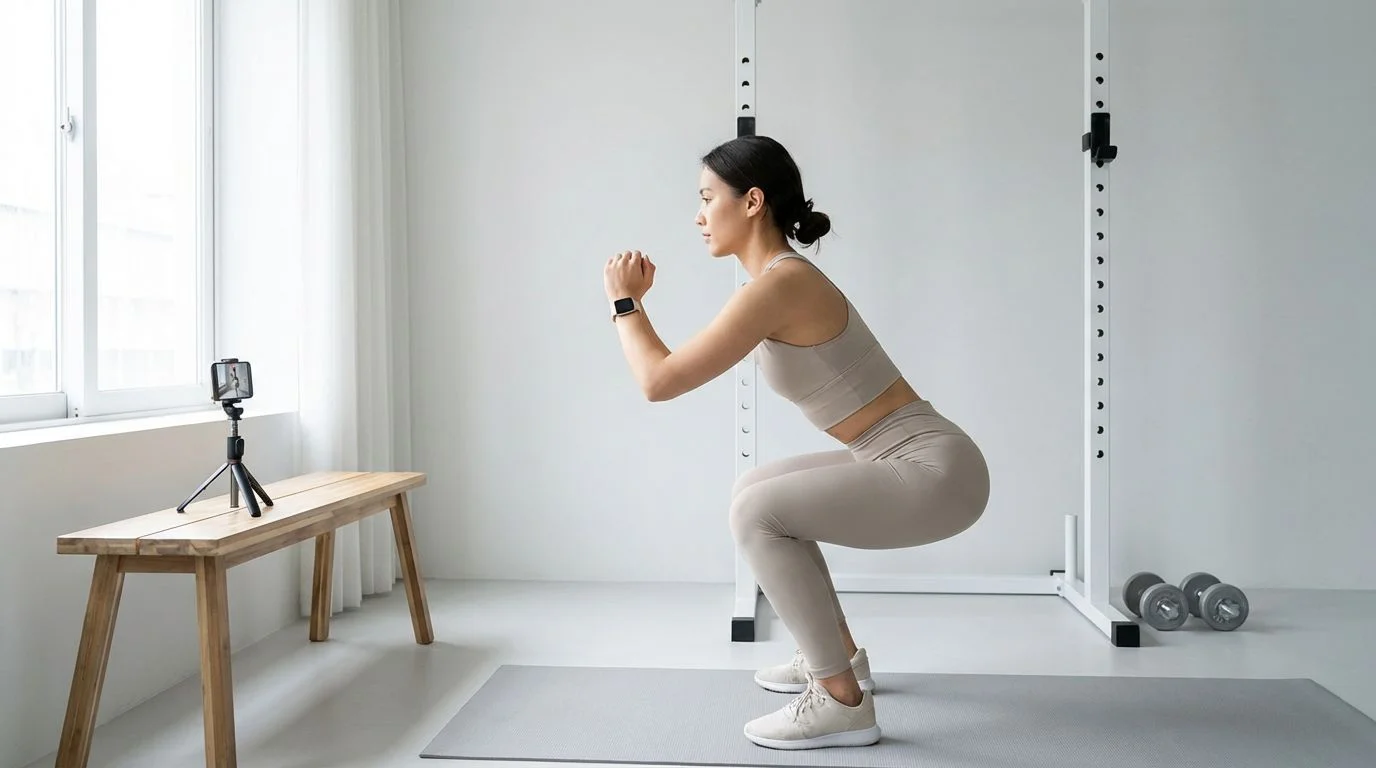
Use smartphone video or motion tracking to record sets from side and front angles. Review footage for the form checkpoints covered earlier: neutral spine, joint alignment, controlled tempo. AI personal training tools can analyze joint angles in real time and flag deviations like excessive forward lean or shortened range of motion.
Watch for these signs of form breakdown:
-
Faster cadence than intended
-
Reduced depth or range of motion
-
Compensatory movements (shifting weight, twisting)
When you notice these patterns, reduce load immediately. Quality reps at lighter weight build strength more safely than compromised technique at heavier loads.
Tips to Enhance Safety in Your Workout Routine
Injury prevention extends beyond exercise form to how you structure sessions and manage recovery. These practices create a foundation for sustainable progress.
Warm-ups and Cooldowns
Bookending your workouts properly prevents injury and supports recovery:
| Phase | Duration | What to Do | Why It Matters |
|---|---|---|---|
| Warm-up | 5-10 min | Dynamic stretching, movement-specific prep (leg swings before squats, arm circles before pressing) | Primes muscles, elevates heart rate, activates nervous system2 |
| Cooldown | 5-10 min | Light activity (walking, cycling) followed by static stretching | Clears metabolic byproducts, reduces next-day soreness |
Skipping warm-ups is one of the most common workout mistakes. Cold muscles are less pliable and more prone to strains, and your nervous system needs activation time to coordinate complex movement patterns safely.
Monitoring Fatigue Levels
Cumulative fatigue degrades form before you consciously notice. Track session-to-session performance metrics like reps completed, weights lifted, and perceived exertion. If performance drops across multiple sessions despite adequate rest, you may be accumulating training stress faster than recovery.
HRV monitoring provides an objective fatigue indicator. Consistent low readings signal the need for a deload week, active recovery session, or extra rest day, all of which prevent the overtraining that leads to injuries and setbacks.
Progress Tracking for Optimal Results
Structured tracking transforms subjective effort into objective feedback. This data reveals patterns, validates what’s working, and flags when adjustments are needed.
Setting Achievable Goals
Realistic goals maintain motivation while supporting safe progression. Define specific, measurable targets: add 5 pounds to your squat in 4 weeks, complete 10 consecutive pull-ups, or improve mile time by 30 seconds. Break larger goals into weekly milestones that allow technique refinement before increasing load.
Progressive overload should only advance when you complete target sets with acceptable form (generally 90% or better on technique checks). If form deteriorates, hold current weights and focus on quality execution before progressing3.
Adjusting Techniques Based on Feedback
Your training data (whether from a coach, wearable device, or recorded video) should directly inform technique modifications. If video shows knee valgus on rep 8 of 10, that’s your current capacity threshold. Work at rep ranges where form stays consistent, then gradually expand capacity.
AI workout personalization uses this feedback loop to adjust programming in real time. When algorithms detect tempo increases, shortened range, or elevated heart rate variability, they modify load or volume to keep you in a safe training zone.
Preventing Injuries with Correct Form
Long-term injury prevention requires balancing training stimulus with adequate recovery. Form perfection means nothing if you’re overtraining or ignoring early warning signals.
Incorporate Rest and Recovery
Muscle adaptation happens during rest, not during workouts. Schedule at least one full rest day weekly, and consider active recovery sessions (light movement that promotes blood flow without creating training stress).
Signs of insufficient recovery include:
-
Persistent joint soreness
-
Declining performance across sessions
-
Elevated resting heart rate
-
Mood changes or loss of motivation
If you notice these signals, add an extra rest day or replace a planned session with mobility work and light stretching.
Balance Training Load with Recovery
Your training load should match your recovery capacity. High-intensity sessions deplete resources more than moderate work, requiring proportionally more recovery time. Most programs benefit from a 2:1 or 3:1 ratio of moderate to high-intensity sessions.
Monitor cumulative load across the week. If you’re doing heavy squats Monday, deadlifts Wednesday, and leg presses Friday, you may not be giving lower body adequate recovery time. Distribute stress across muscle groups and movement patterns to prevent overuse injuries.
Integrating Technology in Safe Exercise Practices
Modern training technology offers tools that democratize access to personalized coaching and real-time form feedback. Apps with motion tracking can analyze joint angles during exercises, flagging deviations like excessive forward lean or asymmetrical movement patterns.
AI-powered platforms combine wearable data with video analysis to adjust workouts based on your current state. If recovery metrics indicate high stress, the system might substitute a planned heavy squat session with mobility work and lighter loads. This adaptive approach prevents pushing through when your body needs recovery.
The key is using technology as a feedback tool, not a replacement for body awareness. If wearable metrics look good but you feel sharp joint pain, stop the exercise and seek assessment. Technology provides data; you provide context and judgment.
FAQs about Correct Exercise Practices
How can SensAI help me correct my form in real time?
SensAI uses motion tracking and wearable data integration to monitor exercise technique as you train. The app can detect form breakdowns like shortened range of motion, tempo inconsistencies, or joint misalignment, then provide immediate coaching cues to correct the pattern. By combining video analysis with metrics like heart rate and HRV, SensAI adjusts workout intensity to match your current recovery state, reducing injury risk while maintaining progress.
What are the best wearables for fitness monitoring?
Apple Watch, Garmin devices, Oura Ring, and Fitbit all integrate with SensAI to provide recovery metrics and training data. Apple Watch offers comprehensive activity tracking and heart rate monitoring. Garmin excels at detailed performance metrics for endurance athletes. Oura Ring specializes in sleep and recovery analysis through HRV and resting heart rate. Fitbit provides accessible tracking with strong community features. The best choice depends on your training focus and which metrics matter most for your goals.
What should I do if I experience pain during a workout?
Sharp joint pain is a stop signal, not something to push through. Distinguish between muscle fatigue discomfort (expected during training) and joint or nerve pain (not normal and requiring attention). If you feel sharp, localized pain in a joint, stop the exercise immediately and assess whether the pain persists at rest4. Persistent pain, swelling, or pain that worsens over multiple sessions warrants evaluation by a healthcare professional. Never continue an exercise that produces sharp joint pain, even if you can technically complete the movement.
Are there signs that indicate I need to adjust my exercise routine?
Watch for declining performance across multiple sessions despite adequate sleep and nutrition. This suggests accumulated fatigue. Elevated resting heart rate (8+ beats above baseline), depressed HRV, persistent muscle soreness lasting beyond 72 hours, or loss of motivation all indicate your training load exceeds recovery capacity. Form deterioration on exercises you previously performed well signals either fatigue or a need to regress weight and rebuild technique. Any of these signs warrant reducing intensity, adding recovery time, or modifying your program to better match current capacity.
References
Footnotes
-
edayadmin. “Proper Form and Technique: The Best Defense Against Injuries.” precisionperformancept.com, 2025-01-30. https://precisionperformancept.com/proper-form-and-technique-the-best-defense-against-injuries/ ↩
-
Oryx Outdoors. “10 Common Workout Mistakes and How To Avoid Them.” oryx-outdoors.com, 2024. https://oryx-outdoors.com/blogs/news/10-common-workout-mistakes-and-how-to-avoid-them ↩
-
XTERRA Fitness. “Proper Form: Weight Training Errors to Prevent Injuries.” xterrafitness.com, 2024-02-27. https://www.xterrafitness.com/blog/proper-form-weight-training-errors-to-prevent-injuries/ ↩
-
Stacy Ruffing, PT. “5 Common Workout Mistakes and How To Avoid Them.” uhhospitals.org, 2020-09-24. https://www.uhhospitals.org/blog/articles/2020/09/5-common-workout-mistakes-and-how-to-avoid-them ↩