Sick or Under-Recovered? A Wearable-Based 48-Hour Observation Framework
How to use HRV, resting heart rate, temperature trends, symptoms, and a 24- to 48-hour recheck without treating a wearable as a diagnostic tool.

SensAI Team
12 min read
Get a training plan that adapts to your recovery — free on iOS

Short answer: a drop in heart rate variability (HRV) or a rise in resting heart rate (RHR) cannot tell you whether you are sick. Look at symptoms and several days of your own trends, check for ordinary confounders, and reassess over the next 24–48 hours. Treat the window as observation time, not as a diagnostic test or a validated exercise algorithm.
If you may have an infectious illness, do not use a reassuring wearable score to justify group training. Rest, avoid exposing other people, follow current public-health or clinician guidance on testing and return, and seek care promptly for red-flag symptoms.
Why One Low Recovery Score Is Not an Illness Test
Wearable metrics can change with hard training, short sleep, alcohol, menstrual-cycle physiology, travel, heat, stress, medication, measurement conditions, or infection. The same pattern can have different causes, and consumer devices do not establish a diagnosis.1
Several studies found physiological changes around COVID-19 or other respiratory infections, but their findings were specific to their devices, cohorts, outcomes, and models:
- A WHOOP study examined respiratory-rate changes around symptomatic COVID-19 in a particular sample.2
- COVI-GAPP used a sensor bracelet and a study-specific model to investigate changes before reported COVID-19 symptoms.3
- A Stanford cohort found smartwatch changes before or around symptom onset in some participants with COVID-19.4
- A controlled viral-challenge study assessed whether multimodal wearable signals could distinguish H1N1 influenza and rhinovirus infection in the study setting.5
- Continuous temperature research shows feasibility, not that a consumer temperature deviation identifies the cause of a fever.6
These studies support further research into pattern detection. They do not validate universal consumer cutoffs, prove that a wearable can distinguish infection from training fatigue, or tell an individual that exercise is safe. Even the HRV systematic review focused on COVID-19 studies and found heterogeneous methods; it cannot be converted into a general athlete illness threshold.1
What to Observe Over 24–48 Hours
Use four categories as notes, not gates in an algorithm:
- Symptoms: sore throat, cough, fever or feeling feverish, chills, body aches, unusual fatigue, gastrointestinal symptoms, breathing difficulty, chest symptoms, or neurologic symptoms.
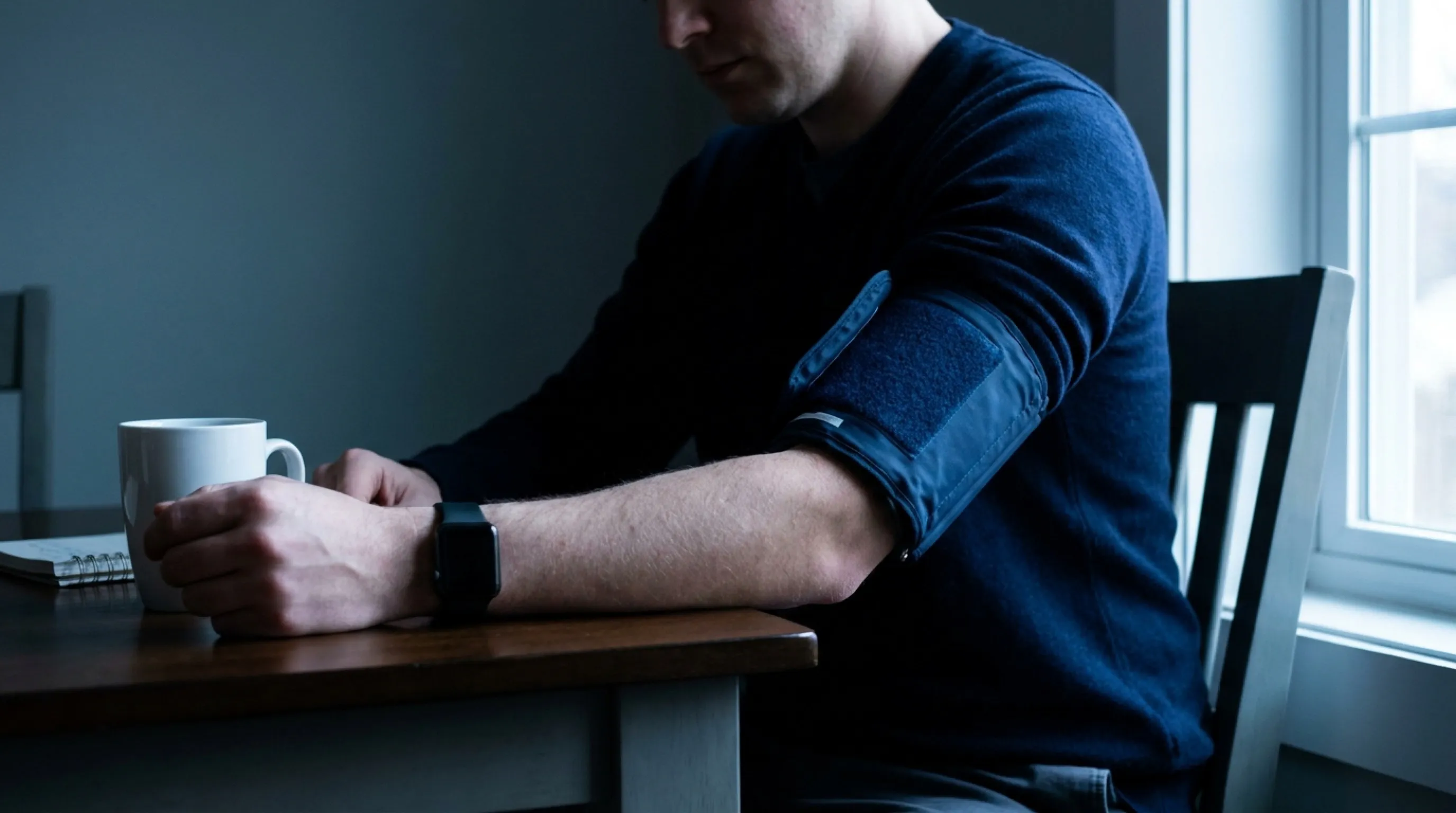
- Personal wearable trends: HRV, RHR, respiratory rate, and temperature relative to your normal pattern, using consistent measurement conditions where possible.
- Training and life context: recent hard sessions, soreness, poor sleep, travel, heat, stress, alcohol, medication, and menstrual-cycle context when relevant.
- Direction: whether symptoms and function are improving, stable, or worsening at the next check.
There is no evidence-based universal minimum baseline or fixed HRV or RHR cutoff that diagnoses illness or mandates rest. More consistent history can make personal trends easier to interpret, but no amount of consumer data converts those numbers into diagnosis.
Day 1: Pause and Record
- Write down symptoms and when they began.
- Review several days of metrics instead of reacting to one score.
- Note plausible confounders without assuming they explain symptoms.
- If infection is possible, skip group training and prioritize rest, hydration, and appropriate testing or medical advice.
- If there are red flags, seek care now rather than waiting for the 48-hour window.
Day 2: Reassess Direction
- Improving: a return toward baseline can be reassuring, but return to exercise should still follow symptoms, function, and any condition-specific medical guidance.
- Unchanged: continue conservative observation and do not use the device alone to decide the cause.
- Worsening or spreading symptoms: continue to avoid training and contact a healthcare professional as appropriate.
One case report described HRV and orthostatic changes during and after viral infection in a single elite endurance athlete.7 It is useful as an example of longitudinal monitoring, not as a protocol or a threshold for everyone.
When the Pattern Looks Like Training Fatigue
Under-recovery is more plausible when there is a clear recent training or sleep stressor, no infectious symptoms, no red flags, and both symptoms and performance improve with recovery. Even then, the wearable is one part of the picture.
A conservative training decision may include taking a rest day or, if you feel well and have no reason to suspect infection, choosing an easy session that is already appropriate for you. Do not prescribe a percentage reduction from an article, and stop if the warm-up feels unusually difficult or symptoms appear. Persistent fatigue, unexplained performance loss, or repeated abnormal readings deserve clinical review.
Our muscle soreness and DOMS guide can help you describe ordinary post-training soreness, but soreness and illness can coexist.
When Possible Illness Takes Priority
Possible infection is not an “indoor-only workout” category. Exercising alone indoors may protect training partners, but it does not make exercise physiologically appropriate. If symptoms suggest infection:
- Do not attend group practice, a gym, or a shared indoor session.
- Rest and follow current testing, isolation, treatment, and return-to-activity guidance for the suspected condition.
- Do not use a green readiness score to override fever, systemic symptoms, or clinical advice.
- Resume progressively only after symptoms and condition-specific guidance support it.
The traditional “neck check” — exercise with symptoms above the neck, rest for symptoms below it — is not a validated safety rule. A recent review argues that sport and exercise guidance during viral acute respiratory illness should be revisited rather than reduced to that shortcut.8
Red Flags: Avoid Exercise and Seek Medical Care
This framework is not a diagnosis. Seek urgent or emergency care as appropriate for:
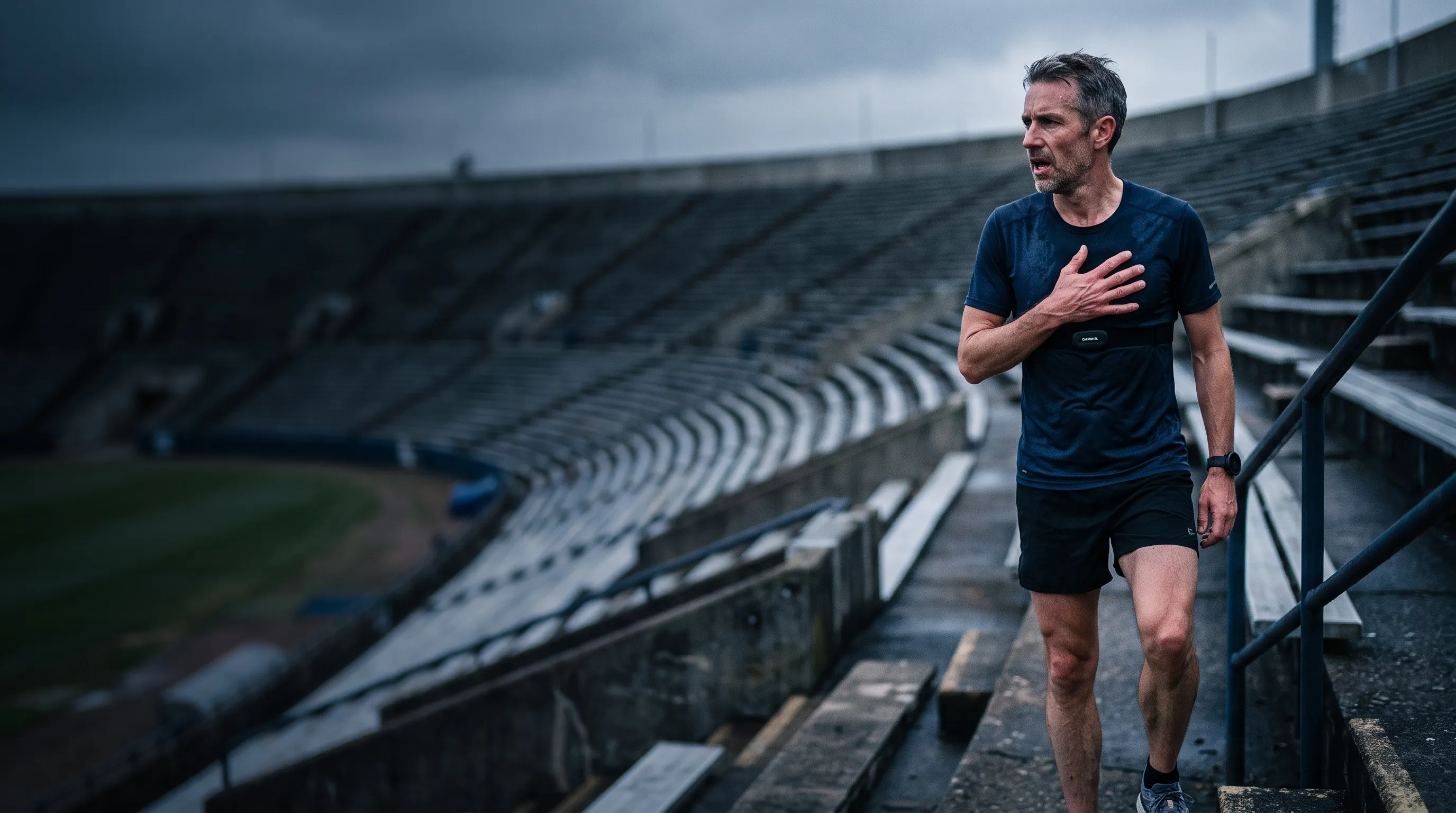
- Chest pain or pressure
- Severe or unexplained shortness of breath
- Fainting, near-fainting, new palpitations, or a sustained very fast or irregular heartbeat
- Blue or gray lips, confusion, severe weakness, or other neurologic symptoms
- Persistent or severe fever, dehydration, or rapidly worsening illness
- New cardiac symptoms during recovery from a viral illness
Return-to-play guidance after COVID-19 gives particular attention to cardiopulmonary symptoms and suspected myocardial involvement.9 Requirements vary with the illness, symptom severity, medical history, and sport, so use current clinical guidance rather than a generic countdown.
Confounders That Can Move Wearable Metrics
Confounders matter because they can explain some variation, not because they rule out illness.
- Training and sleep: hard training, accumulated fatigue, and disrupted sleep can shift HRV, RHR, and perceived readiness.
- Menstrual-cycle context: in a cohort of 11,590 participants, wrist-derived RHR and RMSSD varied systematically across the menstrual cycle. The reported mean cardiovascular amplitudes were 2.73 bpm for RHR and 4.65 ms for RMSSD among naturally cycling participants.10 These population findings should not be turned into a personal illness correction factor.
- Alcohol: a 2026 study analyzed 5,109,185 person-days from 20,968 participants. Its reported comparison was one drink more than a person’s own average versus one drink less, not simply “one extra drink.” In that contrast, nocturnal RHR was higher by 2.8 bpm in females and 2.4 bpm in males, while HRV was lower by 3.8 ms and 3.3 ms, respectively.11
- Travel, heat, medication, and stress: each can affect symptoms, sleep, and cardiovascular signals.
Record these factors, but do not dismiss a new cough, fever, or systemic symptoms because a confounder is present.
How to Read WHOOP, Garmin, and Oura Scores
Vendor scores are summaries built from different inputs and formulas. They are prompts to look closer, not interchangeable medical measurements.
- Garmin: Garmin’s own article describes how illness can affect heart metrics; it is useful product context, not independent validation of a diagnostic feature.12
- WHOOP: WHOOP’s respiratory-rate article likewise explains its platform’s metric and should be read as vendor guidance.13
- Oura and other devices: review the current manufacturer documentation for what the score includes, then apply the same symptom-first caution.
Do not translate a color or readiness number into “sick,” “not contagious,” or “safe to exercise.”
How SensAI Uses This Context
SensAI is a fitness coach powered by LLMs, not a medical diagnostic model. It can:
- Bring aggregated HRV trends, sleep quality, resting heart rate, and workout summaries into a daily recovery summary
- Remember self-reported constraints and context across conversations
- Use actual performance and recovery context when regenerating the program each week
- Respond when you ask to shorten a session, reduce volume, or swap an exercise
It does not run a validated four-output illness algorithm, diagnose infection, set adaptive medical thresholds, or automatically clear you to train. Raw HealthKit data stays on your device; aggregated recovery context is sent server-side for AI coaching, and SensAI does not sell that data to third parties.
When symptoms may reflect illness, use the coach to record context or modify future planning — not to replace testing, public-health guidance, or clinical care.
Five-Minute Check-In
- Symptoms: What is new, and is anything a red flag?
- Trend: What changed across several days, not just this morning?
- Context: Was there hard training, poor sleep, alcohol, travel, heat, medication, stress, or menstrual-cycle variation?
- Exposure: Could you expose teammates or gym users if this is infectious?
- Next review: What will you reassess in 24 hours, and what would trigger medical care sooner?
Example note:
Day 1: HRV lower and RHR higher than my recent pattern; new sore throat after travel; no chest symptoms. Skipping group training, resting, following current testing guidance, and reassessing tomorrow. Seeking care sooner if breathing, chest, fever, or neurologic symptoms develop.
Frequently Asked Questions
Should I train when HRV is low and resting HR is high?
Those two readings are not enough to decide. Check symptoms, recent training and life context, and the multi-day trend. If illness is possible, skip group training and rest rather than trying to hit a percentage-reduced workout.
How many beats above resting HR means I need a rest day?
There is no universal evidence-based number. Device, position, timing, temperature, sleep, medication, and individual baseline all matter.
Does HRV drop before illness?
Some COVID-19 cohorts, viral-challenge studies, and a single-athlete case report found changes before or around symptoms.3457 Those findings do not show that every HRV drop predicts infection or establish a consumer threshold.
My readiness score is low but I feel fine. What now?
Review what drove the score, consider known confounders, and look at the next day’s direction. If you remain symptom-free, an easy or usual session may be reasonable within your existing plan; a score alone should neither force rest nor justify maximal effort.
Is 48 hours enough to rule out illness?
No. Forty-eight hours is simply a practical reassessment window. Symptoms can appear or persist on different timelines, and testing or medical evaluation may be appropriate.
Is this a diagnostic tool?
No. It is a symptom-first observation framework for making conservative training decisions while information develops.
References
Footnotes
-
Sanches CA, Silva GA, Librantz AFH, Sampaio LMM, Belan PA. “Wearable Devices to Diagnose and Monitor the Progression of COVID-19 Through Heart Rate Variability Measurement: Systematic Review and Meta-Analysis.” Journal of Medical Internet Research, 2023;25:e47112. https://www.jmir.org/2023/1/e47112 ↩ ↩2
-
Miller DJ, Capodilupo JV, Lastella M, et al. “Analyzing changes in respiratory rate to predict the risk of COVID-19 infection.” PLOS ONE, 2020;15(12):e0243693. https://journals.plos.org/plosone/article?id=10.1371/journal.pone.0243693 ↩
-
Risch M, et al. “Investigation of the use of a sensor bracelet for the presymptomatic detection of changes in physiological parameters related to COVID-19: an interim analysis of a prospective cohort study (COVI-GAPP).” BMJ Open, 2022;12:e058274. https://bmjopen.bmj.com/content/12/6/e058274 ↩ ↩2
-
Mishra T, Wang M, Metwally AA, et al. “Pre-symptomatic detection of COVID-19 from smartwatch data.” Nature Biomedical Engineering, 2020;4:1208-1220. https://pubmed.ncbi.nlm.nih.gov/33208926/ ↩ ↩2
-
Grzesiak E, Bent B, McClain MT, et al. “Assessment of the Feasibility of Using Noninvasive Wearable Biometric Monitoring Sensors to Detect Influenza and the Common Cold Before Symptom Onset.” JAMA Network Open, 2021;4(9):e2128534. https://pmc.ncbi.nlm.nih.gov/articles/PMC8482058/ ↩ ↩2
-
Smarr BL, Aschbacher K, Fisher SM, et al. “Feasibility of continuous fever monitoring using wearable devices.” Scientific Reports, 2020;10:21640. https://www.nature.com/articles/s41598-020-78355-6 ↩
-
Hottenrott K, et al. “Utilizing Heart Rate Variability for Coaching Athletes During and After Viral Infection: A Case Report in an Elite Endurance Athlete.” Frontiers in Sports and Active Living, 2021;3:612782. https://www.frontiersin.org/journals/sports-and-active-living/articles/10.3389/fspor.2021.612782/full ↩ ↩2
-
Ruuskanen O, Valtonen M, Waris M, Luoto R, Heinonen OJ. “Sport and exercise during viral acute respiratory illness—Time to revisit.” Journal of Sport and Health Science, 2024;13(5):663-665. https://pmc.ncbi.nlm.nih.gov/articles/PMC11282332/ ↩
-
Gluckman TJ, Bhave NM, Allen LA, et al. “2022 ACC Expert Consensus Decision Pathway on Cardiovascular Sequelae of COVID-19 in Adults: Myocarditis and Other Myocardial Involvement, Post-Acute Sequelae of SARS-CoV-2 Infection, and Return to Play.” Journal of the American College of Cardiology, 2022;79(17):1717-1756. https://www.jacc.org/doi/10.1016/j.jacc.2022.02.003 ↩
-
Jasinski SR, Presby DM, Grosicki GJ, Capodilupo ER, et al. “A Novel method for quantifying fluctuations in wearable derived daily cardiovascular parameters across the menstrual cycle.” npj Digital Medicine, 2024;7:373. https://www.nature.com/articles/s41746-024-01394-0 ↩
-
Grosicki GJ, Robinson AT, Joyner MJ, et al. “Real-world effects of alcohol on heart rate, sleep, and physical activity by age and sex.” PLOS Digital Health, 2026;5(3):e0001284. https://journals.plos.org/digitalhealth/article?id=10.1371/journal.pdig.0001284 ↩
-
Garmin. “How getting sick might change your heart metrics.” Garmin Blog, 2025. https://www.garmin.com/en-US/blog/fitness/how-getting-sick-might-change-your-heart-metrics/ ↩
-
WHOOP. “What does an infection do to your respiratory rate?” WHOOP, 2022. https://whoop.com/en-gb/thelocker/what-does-an-infection-do-to-your-respiratory-rate ↩