Jet Lag and Training Readiness: A User-Led 72-Hour Wearable Checklist
A cautious, source-cited checklist for using symptoms and wearable trends to decide whether to train, modify, or recover after long-haul travel.

SensAI Team
14 min read
Get a training plan that adapts to your recovery — free on iOS

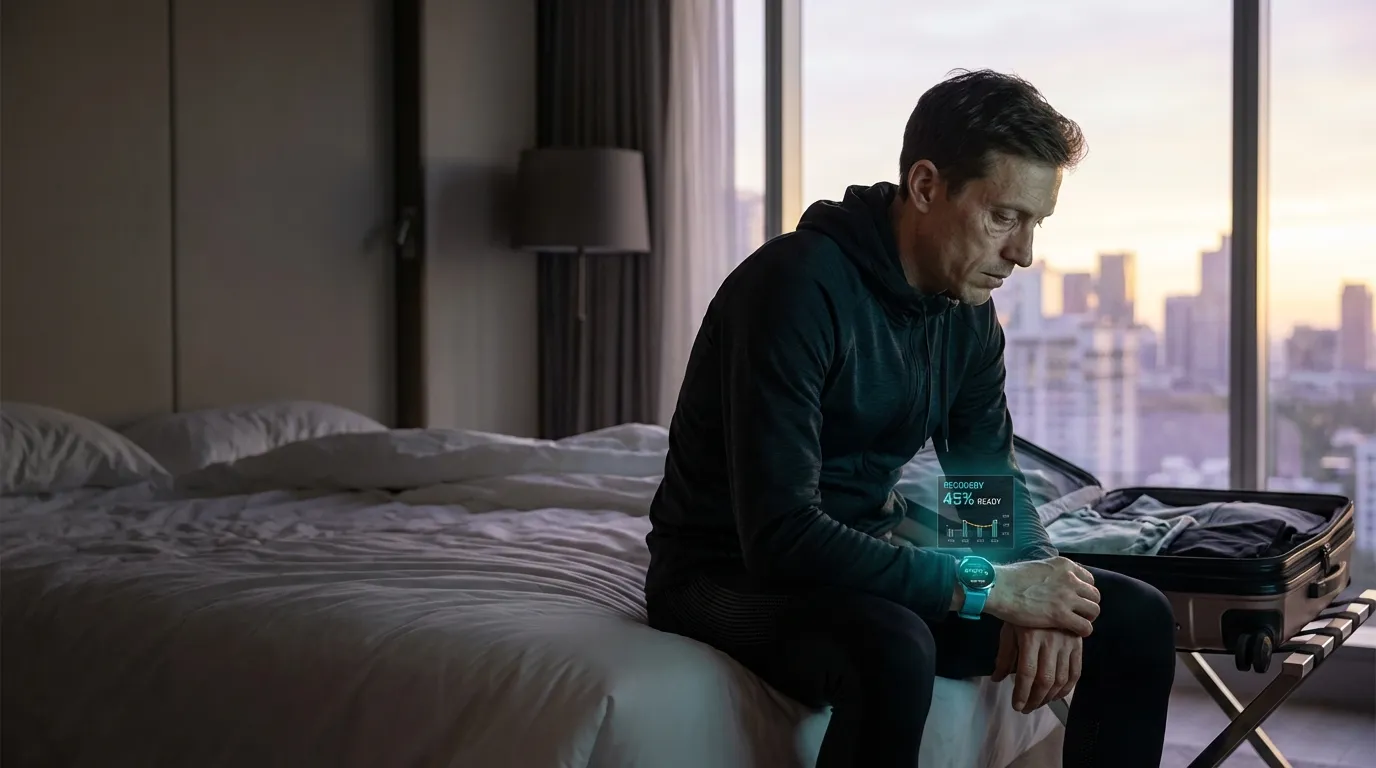
If you just landed after a red-eye, the useful question is not only “Can I train?” It is: “What training dose is reasonable while I recover from the trip?”
Travel fatigue, circadian misalignment, sleep loss, dehydration, and schedule pressure can overlap. A wearable can add context, but it cannot diagnose jet lag, dehydration, illness, overtraining, or readiness for intense exercise. The 72-hour windows below are conservative educational options, not a validated score or medical clearance protocol.
Why Travel Can Blunt Training Readiness
Travel stress is not one thing. It is a cluster of stressors that can affect how you feel and perform even when motivation is high.
A systematic review led by Janse van Rensburg found that athlete-specific jet-lag evidence was limited: only 12 athlete-specific studies were available.1 A later consensus statement and practical guide emphasized individualized planning around travel direction, time-zone change, sleep, light, and schedule.23
Performance data across major leagues also associates time-zone travel, especially eastward travel in some settings, with worse outcomes.4567 Those team-level associations cannot predict whether one person is ready to train on one morning.
Separate Travel Fatigue, Jet Lag, and Training Load
- Travel fatigue: load from logistics, prolonged sitting, disrupted meals, dehydration, and airport stress
- Jet lag: circadian misalignment after crossing time zones, often harder eastward because advancing the body clock can be more difficult
- Accumulated training load: fatigue from recent exercise and life stress that may exist independently of travel
Lemmer and colleagues reported jet-lag symptoms lasting to day 5-6 after westward travel and day 7 after eastward travel in their study.8 That is a group result, not a countdown for every traveler.
Acute sleep loss matters too. A 2022 meta-analysis estimated a mean exercise-performance decline of -7.56%, with about 0.4% additional decrement per extra hour awake across the included studies.9 The exact effect varies by task, timing, and person.
A Signal Checklist, Not a Readiness Score
Review several signals together rather than turning one number into a green, yellow, or red diagnosis:
- Sleep opportunity and continuity: how much sleep was possible, and how fragmented was it?
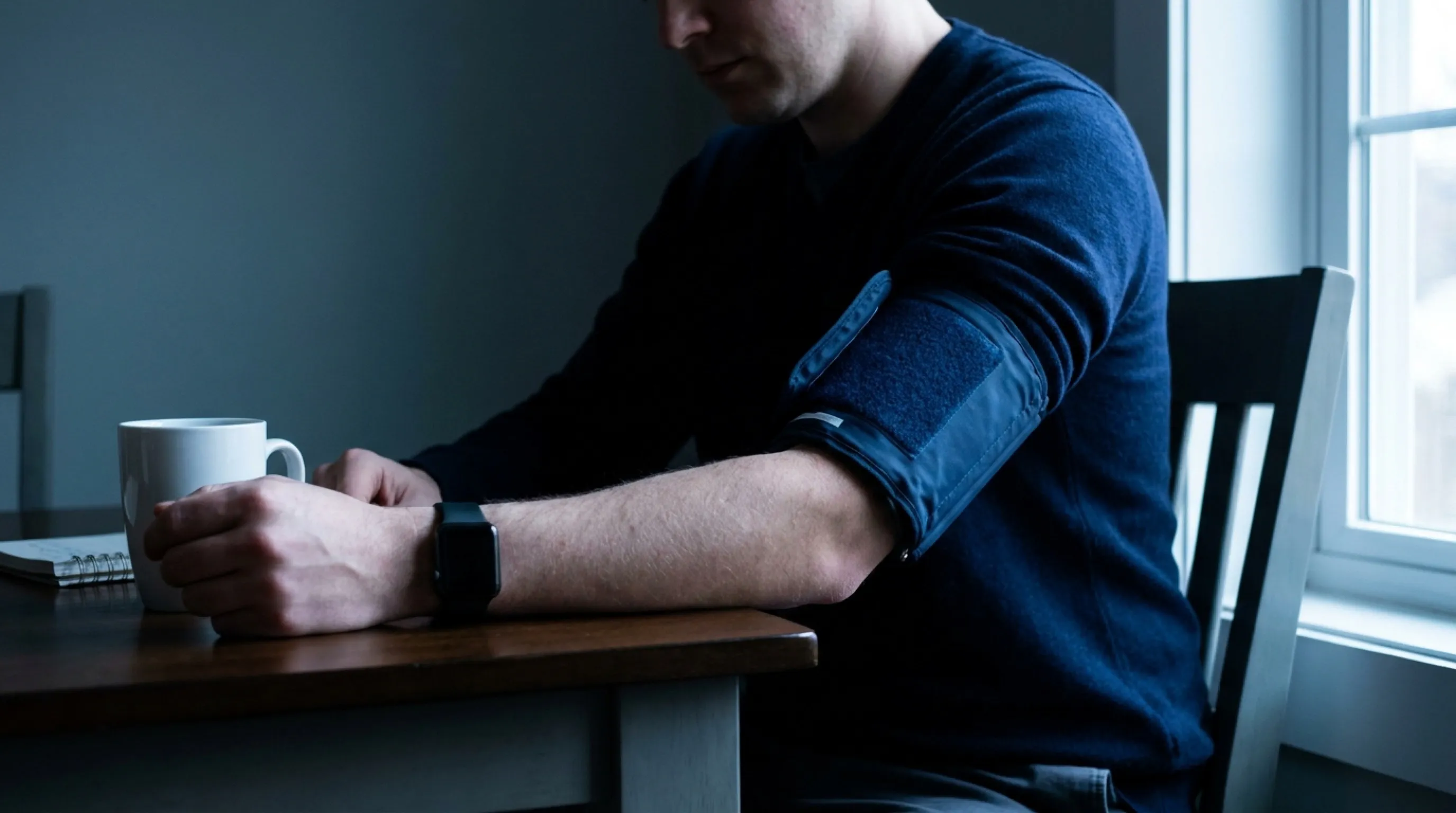
- HRV trend versus your own baseline: is the multi-day pattern typical, suppressed, or noisy?
- Resting heart-rate trend: is it meaningfully different from your normal range?
- Subjective symptoms: fatigue, dizziness, headache, gastrointestinal symptoms, soreness, illness signs, and mood
- Warm-up response: does easy movement feel normal, or unusually difficult?
Consumer wearables differ in sensors and algorithms. Skin temperature, proprietary readiness scores, and single-night HRV values should not be treated as interchangeable or diagnostic.
HRV-guided endurance research suggests that adapting training to repeated HRV measures may improve some submaximal physiological outcomes compared with predefined training, but it does not validate this jet-lag checklist or prove tissue readiness.10
Safety Overrides the Schedule
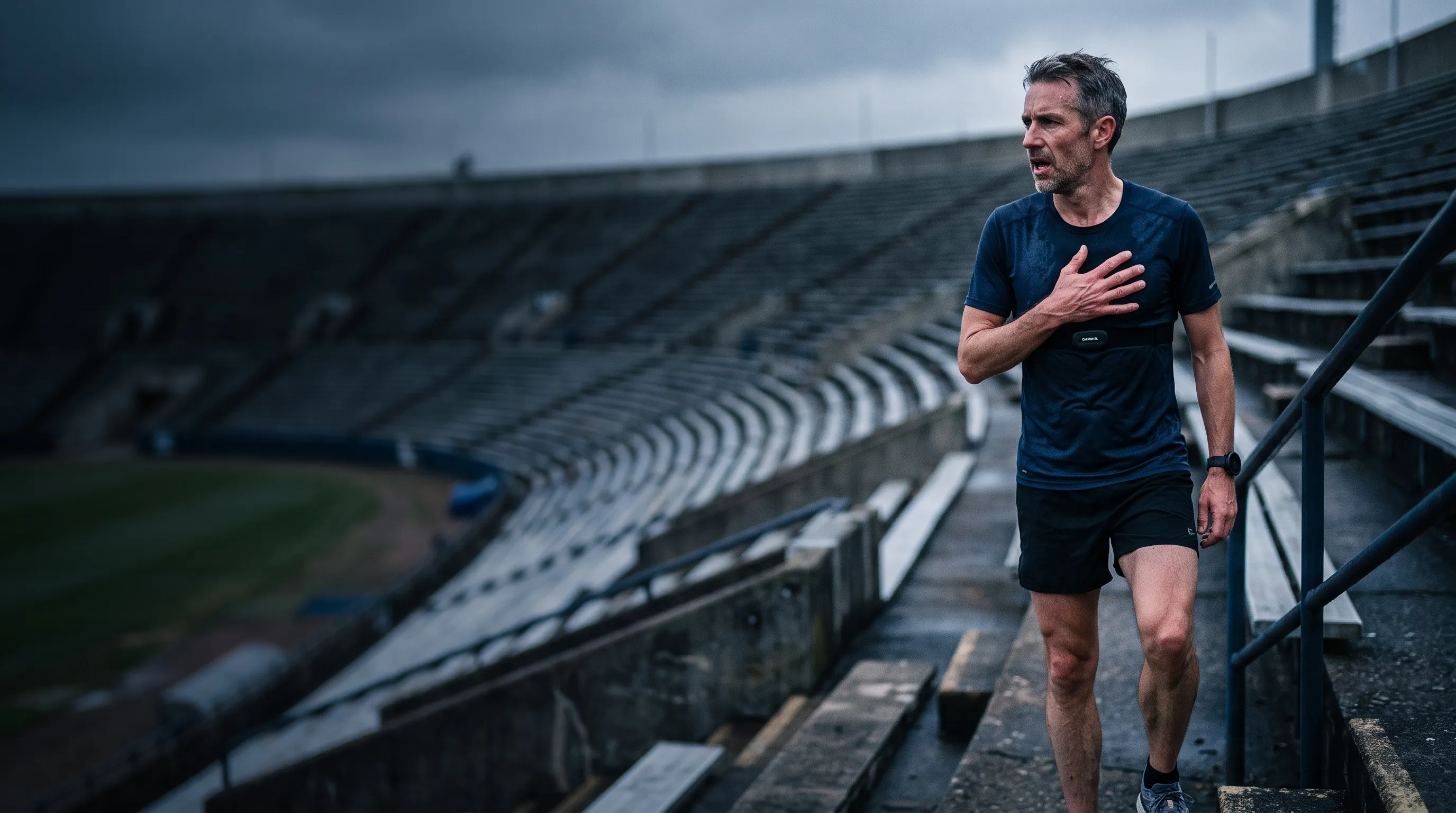
Do not train and seek urgent medical care for chest pain, fainting, severe shortness of breath, confusion, signs of a blood clot, or other emergency symptoms. Severe or persistent dizziness, vomiting, dehydration, fever, worsening illness signs, or concerning symptoms also warrant appropriate medical evaluation rather than a wearable-based decision.
Wearable values cannot rule out illness or a travel-related medical problem. If you have cardiovascular, metabolic, neurological, or other relevant medical conditions, get individualized advice before using a generic return-to-training plan.
0-24 Hours: Recover First or Keep It Easy
The first day is usually better used to re-establish local routines than to prove fitness.
Consider rest or very light movement when several of these are present:
- Major sleep loss or severe fragmentation
- HRV below your usual range alongside elevated resting heart rate
- Moderate or high fatigue, headache, dizziness, or gastrointestinal disruption
- Significant local-time misalignment, particularly after eastward travel
- Illness signs or an unusually difficult warm-up
Low-load options can include a walk, mobility, or an easy spin. If symptoms are minimal and your warm-up feels normal, 30-50 minutes of easy aerobic or technique work can be an illustrative ceiling, not a target. Stop if symptoms worsen. Avoid maximal efforts simply because one wearable metric looks normal.
Support recovery with destination-appropriate light exposure, regular meals, enough fluid for your needs, and an early wind-down for local bedtime. Individual fluid and electrolyte needs vary; more is not always better.
24-48 Hours: Use Direction, Not One-Day Noise
On day 2, look for a coherent direction across sleep, symptoms, resting heart rate, HRV, and warm-up response. One improved metric does not cancel several worsening ones.
If the overall picture is improving, conservative examples include:
- Endurance: roughly 60-75% of your usual session load, without a maximal finish
- Strength: roughly 20-30% fewer total sets while keeping technique and effort controlled
- Intervals: one reduced quality block instead of the normal high-intensity volume
These percentages are planning examples, not evidence-based pass marks. A shorter session, easier modality, or another recovery day may be more appropriate depending on training history and symptoms.
If the trend worsens, downgrade intensity, reduce volume, or move the demanding session. Reassess the next morning rather than forcing a normal calendar.
48-72 Hours: A Conservative Return-to-Intensity Review
By day 3, use a checklist rather than a pass/fail algorithm:
- Sleep opportunity is moving toward your baseline
- HRV and resting heart-rate trends are no longer worsening
- Fatigue is manageable and the warm-up feels normal
- The previous easy or modified session did not trigger a symptom rebound
- No illness or medical red flags are present
If several adverse trends remain, another 24-48 hours of modified training may be sensible. Larger eastward jumps often justify more caution, but there is no validated rule that a 3-, 6-, or 9-zone trip requires an exact delay.
Team-performance studies illustrate why caution is reasonable without creating an individual prescription. Super Rugby modeling associated eastward travel across 12 zones with 5.8 fewer points per match and 4.1 more losses per 10 matches.4 NBA analysis across 11,481 games associated eastward home jet lag with about 6.03% lower winning and a -1.29 point differential.5 NHL analysis across 17,088 games associated travel distance with worse goal differential (beta=-0.14, p=0.0007).6
Rugby sevens data also reported sleep falling from 6:52 to 6:09 during relocation phases, with poorer sleep quality during tournament windows.11 These findings describe groups and schedules; they do not clear or disqualify an individual workout.
Recovery Actions With Better Support
Light, Sleep, Caffeine, and Meals
- Use light exposure at times appropriate for the destination and travel direction; mistimed light can shift the clock the wrong way
- Protect sleep opportunity during the first 2-3 nights
- Avoid caffeine late enough in local time that it delays sleep
- Move meals toward the local schedule while still meeting energy and hydration needs
Melatonin Requires Individual Caution
A Cochrane review found that 9 of 10 included trials reported reduced jet lag after travel across five or more time zones, with a reported number needed to treat of 2.12 Timing matters, products vary, and melatonin can interact with medicines or be inappropriate for some people.
This article does not recommend a dose. Ask a clinician or pharmacist about suitability, timing, product quality, contraindications, and medication interactions, especially for children, pregnancy or breastfeeding, chronic conditions, or regular medication use.
How SensAI Fits Without Making the Decision for You
SensAI does not calculate a proprietary jet-lag score, diagnose travel fatigue, or automatically prescribe a 72-hour return-to-intensity sequence.
Apple Watch data connects directly through Apple HealthKit. Compatible Garmin, Oura, and WHOOP metrics can flow through HealthKit as well. SensAI can provide a daily recovery summary using available aggregated metrics such as HRV trends, resting heart rate, and sleep quality.
Your workout does not silently change because one metric moved. If you want to shorten or modify today’s session, ask the LLM-powered AI Coach in natural language or use an available quick action. Weekly program regeneration can then use actual performance and recovery context. The final training and medical decisions remain yours and, when appropriate, your clinician’s or coach’s.
FAQ
Should I train after a red-eye?
Maybe, but hard training is rarely the only option. Rest, walking, mobility, or an easy technique session may preserve routine with less cost during the first 24 hours. Symptoms and medical red flags override the schedule.189
How long does HRV stay low after travel?
There is no universal timeline. HRV can change with sleep, alcohol, illness, hydration, stress, measurement timing, and sensor noise. Use your multi-day trend as context rather than assuming a fixed 48-hour recovery window.
What is the best workout the day after long-haul travel?
There is no single best workout. When symptoms are mild and no red flags are present, easy aerobic work, mobility, or low-load technique practice are conservative options. Delay hard intervals or near-maximal strength work when sleep, symptoms, and warm-up response are still poor.123
Continue with SensAI
- SensAI FAQ
- Contact SensAI
- Wearable Readiness Score Conflicts: Training Decision Framework
- Data-Driven Deload Week (HRV, Sleep, and Training Load)
- Low HRV, Normal RHR: Train or Recover Framework
The bottom line: sequence recovery, easy movement, and harder training with judgment rather than an invented score. Wearable trends and SensAI can provide context, but they do not replace symptoms, a sensible warm-up, or medical evaluation when something is wrong.
References
Footnotes
-
Janse van Rensburg DC, et al. “How to manage travel fatigue and jet lag in athletes? A systematic review of interventions.” British Journal of Sports Medicine, 2020. https://pubmed.ncbi.nlm.nih.gov/32303523/ ↩ ↩2 ↩3
-
Janse van Rensburg DC, et al. “Managing Travel Fatigue and Jet Lag in Athletes: A Review and Consensus Statement.” Journal of Science and Medicine in Sport, 2021. https://pubmed.ncbi.nlm.nih.gov/34263388/ ↩ ↩2
-
Janse van Rensburg DC, et al. “Practical tips to manage travel fatigue and jet lag in athletes.” British Journal of Sports Medicine, 2021. https://pubmed.ncbi.nlm.nih.gov/33208347/ ↩ ↩2
-
Lo M, et al. “Out of your zone? 21 years of travel and performance in Super Rugby.” Journal of Sports Sciences, 2019. https://pubmed.ncbi.nlm.nih.gov/31104575/ ↩ ↩2
-
Leota J, et al. “Eastward Jet Lag is Associated with Impaired Performance and Game Outcome in the NBA.” Chronobiology International, 2022. https://pubmed.ncbi.nlm.nih.gov/35784873/ ↩ ↩2
-
Charest J, et al. “Time zone changes, travel distance and performance in NHL data.” Journal of Science and Medicine in Sport, 2022. https://pubmed.ncbi.nlm.nih.gov/36319561/ ↩ ↩2
-
Song A, et al. “How jet lag impairs Major League Baseball performance.” PNAS, 2017. https://pubmed.ncbi.nlm.nih.gov/28115724/ ↩
-
Lemmer B, et al. “Jet lag in athletes after eastward and westward time-zone transition.” Chronobiology International, 2002. https://pubmed.ncbi.nlm.nih.gov/12182501/ ↩ ↩2
-
Craven J, et al. “Effects of acute sleep loss on physical performance: systematic review and meta-analysis.” Sports Medicine, 2022. https://pubmed.ncbi.nlm.nih.gov/35708888/ ↩ ↩2
-
Düking P, et al. “HRV-guided endurance training via wearables: systematic review and meta-analysis.” Journal of Science and Medicine in Sport, 2021. https://pubmed.ncbi.nlm.nih.gov/34489178/ ↩
-
Leduc C, et al. “Travel demands of an elite rugby sevens team: effects on objective and subjective sleep.” International Journal of Sports Physiology and Performance, 2021. https://pubmed.ncbi.nlm.nih.gov/33540379/ ↩
-
Herxheimer A, Petrie KJ. “Melatonin for the prevention and treatment of jet lag.” Cochrane Database of Systematic Reviews, 2002. https://pubmed.ncbi.nlm.nih.gov/12076414/ ↩