Illness or Overreaching? A Non-Diagnostic 48-Hour Wearable Framework Using HRV, Resting HR, Temperature, and Respiratory Rate
Use a cautious 48-hour educational framework to interpret HRV, resting HR, temperature, and respiratory rate without treating wearable signals as a diagnosis.

SensAI Team
10 min read
Get a training plan that adapts to your recovery — free on iOS

Illness or Overreaching? A Non-Diagnostic 48-Hour Wearable Framework Using HRV, Resting HR, Temperature, and Respiratory Rate
If you want the practical answer first: one low-HRV day is not enough to decide whether to train, modify, or rest. A more cautious approach is a 48-hour observation window that combines four signals (HRV, resting HR, temperature, respiratory rate), symptom context, and training load history. This framework is educational, not a validated diagnostic tool.
Wearable trends can add context, but they cannot tell you whether you have an illness or replace medical care. The goal of this framework is narrower: avoid overreacting to one noisy reading, recognize when symptoms require escalation, and make conservative training choices under uncertainty.
Why one low-HRV day is not enough evidence
A single HRV drop can reflect many things: hard training, poor sleep, travel, alcohol, menstrual cycle effects, psychological stress, early illness, or plain measurement noise. Treating every low-HRV morning as “you are getting sick” creates avoidable undertraining.
Evidence supports multi-signal interpretation rather than HRV in isolation. In a meta-analysis on HRV-guided training, HRV-guided programs improved vagal-related HRV (SMD 0.50, 95% CI 0.09-0.91) but did not show the same effect for resting HR (SMD 0.04, 95% CI -0.34 to 0.43).1 Practical implication: HRV is useful, but only with context.
The practical rule is that one-day HRV suppression calls for a recheck, not an automatic diagnosis or training decision.
What overtraining science says about functional overreaching vs maladaptation
Functional overreaching can be part of good training when recovery is adequate; non-functional overreaching and overtraining syndrome are what you want to avoid. Meeusen and colleagues put the core principle clearly: “Successful training not only must involve overload but also must avoid the combination of excessive overload plus inadequate recovery.”2
That sentence is your decision anchor. If load recently increased and non-HRV signals are stable, low HRV may be planned stress. If load is not clearly elevated and multiple illness-linked signals rise together, your probability shifts toward infection or systemic strain.
Illness pattern vs overreaching pattern across 4 wearable signals
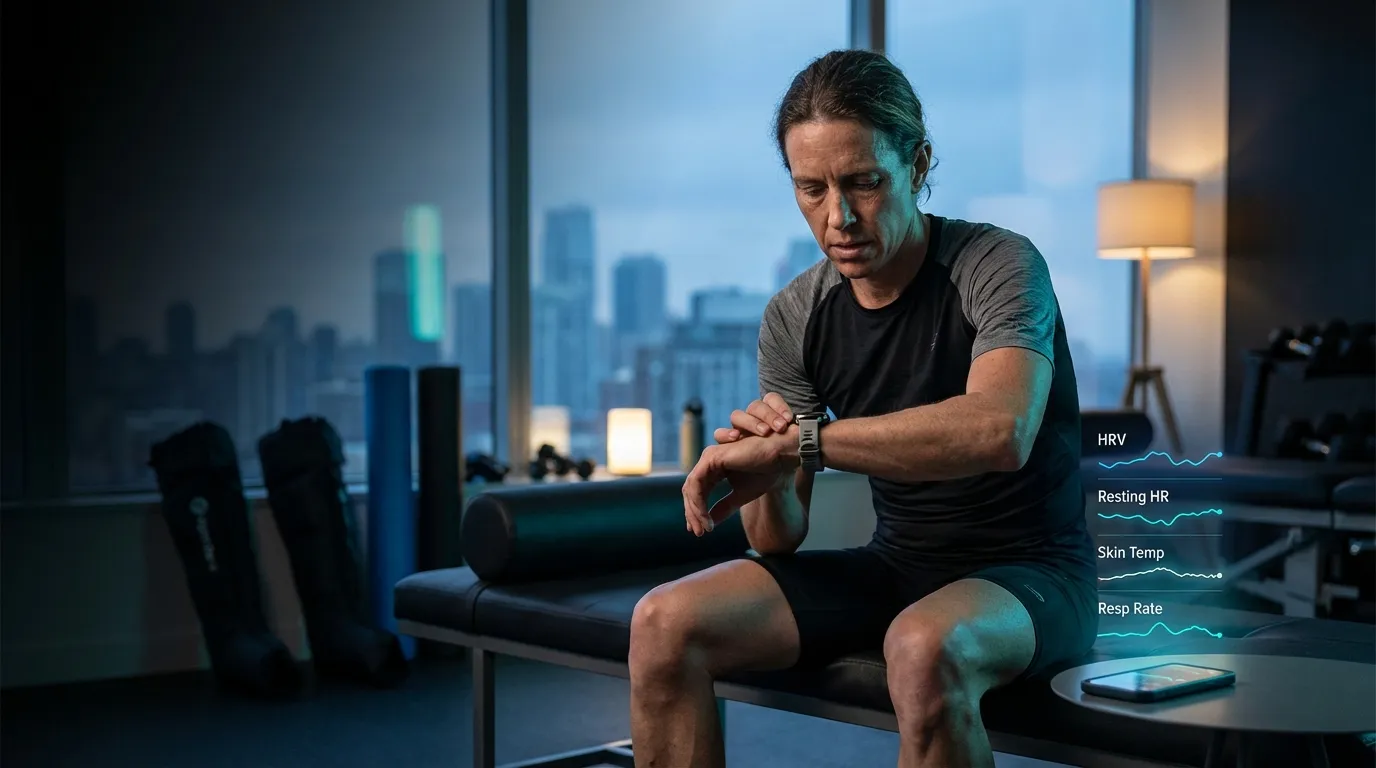
The useful clue is clustering. Illness may be more consistent with autonomic strain appearing alongside thermoregulatory and respiratory disturbance. Training strain may be more consistent with autonomic changes in a load-linked context without temperature or respiratory drift. Neither pattern can diagnose the cause.
Illness-leaning cluster (HRV down + resting HR up + temperature up + respiratory rate up)
Illness suspicion increases when these changes converge for 24–48 hours:
- HRV below recent baseline band
- Resting HR above baseline trend
- Temperature above personal overnight trend
- Respiratory rate above personal overnight trend
Why this cluster matters:
- In 30,529 participants (3,811 symptomatic), combining wearable data with symptoms improved COVID-positive vs COVID-negative discrimination to AUC 0.80 (IQR 0.73-0.86), versus AUC 0.71 (IQR 0.63-0.79) for symptoms alone.3
- In Fitbit-derived physiology-only modeling, detection reached AUC 0.77 ± 0.018 (sensitivity 0.437 ± 0.037 at 95% specificity), with 2,745 PCR-positive cases among 30,534 tests.4
- WHOOP respiratory modeling found low within-person variability (intraindividual SD 0.51 ± 0.20 rpm) and identified 20% of positives in the two days before symptoms and 80% by day 3.5
- TemPredict reported AUC 0.819 (95% CI 0.809-0.830); adding continuous dermal temperature raised AUC from 0.770 to 0.819 (+4.9%), with sensitivity 82% and specificity 63%.6
As Robert P. Hirten, MD, summarized from Mount Sinai’s wearable work, “subtle changes in a participant’s heart rate variability (HRV) measured by an Apple Watch were able to signal the onset of COVID-19 up to seven days before the individual was diagnosed.”7
Overreaching-leaning cluster (HRV down with stable temperature/respiratory rate and load-linked context)
Overreaching is more likely when:
- HRV is down, but temperature and respiratory rate are near baseline
- Resting HR is stable or only mildly elevated
- You can explain the shift with training dose (intensity block, volume spike, poor sleep after hard sessions)
- Symptoms are absent or limited to normal training fatigue
This is where load-linked interpretation helps. If the timeline fits the training block, symptoms are absent, and temperature and respiratory trends remain stable, a conservative modification may be more appropriate than a full stop. When symptoms or uncertainty are meaningful, favor rest and medical guidance over a wearable score.
A 48-hour educational train/modify/rest framework for athletes
The framework below is designed for a morning check. It is an illustrative decision aid, not a validated medical protocol, and it cannot rule illness in or out when signals disagree.
Hour 0 triage (symptoms + baseline deltas)
At first check (morning):
- Screen symptoms first.
- If chest pain, breathing difficulty at rest, confusion, persistent high fever, or other emergency signs are present, do not frame this as a training decision; seek medical care.8
- Check four wearable deltas vs personal baseline.
- HRV, resting HR, temperature, respiratory rate.
- Classify initial state.
- Green (consider planned training): 0–1 adverse signals, no meaningful symptoms, clear load context. Choose conservatively rather than treating the color as permission.
- Amber (consider modifying): 2 adverse signals or an uncertain symptom/load story. Reduce intensity and continue monitoring.
- Red (pause training and assess): 3–4 adverse signals and/or symptoms progressing. Rest, and seek medical guidance when symptoms are concerning or persistent.
A cautious Hour 0 response:
- Green: if you remain symptom-free, you may choose the planned session with conservative pacing.
- Amber: choose a low-to-moderate session or rest, then recheck in 24 hours.
- Red: rest rather than train and monitor symptoms; escalate to medical care when warning signs appear.
24-hour recheck rules when metrics disagree
Most hard calls happen here. Use these tie-breakers:
- HRV down only, others stable: likely training strain/noise -> train light to moderate.
- HRV + resting HR adverse, temp/resp stable: likely overreaching or sleep stress -> modify, avoid HIIT.
- Temp + respiratory rate rising (with or without HRV): higher illness concern -> rest, monitor symptoms, and seek medical guidance when appropriate.
- Symptoms worsening despite mixed metrics: treat as illness-leaning and de-load.
If disagreement persists, prioritize temperature + respiratory trend + symptom direction over app readiness color.
48-hour escalation thresholds and cautious return-to-training checks
Escalate away from normal training when either pattern appears by 48 hours:
- Persistent illness-leaning cluster across at least 3 signals
- Any meaningful symptom progression
Context from athlete illness literature supports caution. In IOC subgroup meta-analysis (54 studies, n=31,065 athletes), mean acute respiratory illness symptom duration was 7.1 days (95% CI 6.2-8.0), and time loss >1 day occurred in 20.4% (95% CI 15.3-25.4).9
General return-to-training checks, which do not replace medical clearance:
- Symptoms stable or improving for 24 hours
- Temperature and respiratory rate trending back toward baseline
- Resting HR normalizing and HRV no longer declining
- First session back is reduced-density (volume or intensity cut)
How to map WHOOP, Oura, and Garmin scores to raw physiology
Readiness scores are interfaces. Physiology is the real signal.
Use this translation layer:
- WHOOP Recovery (red/yellow/green) -> map to HRV trend, resting HR trend, and respiratory rate trend.5
- Oura Readiness -> map to temperature trend, resting HR trend, HRV trend, and sleep contributors.10
- Garmin status signals -> map to resting HR pattern, overnight HRV context, and illness-related metric shifts.11
Practical rule: do not compare score numbers across platforms. Compare directional changes vs your own baseline, then use the 4-signal cluster as context rather than a diagnosis.
If you want a simple check before training, ask: “Do I have autonomic strain only, or autonomic plus respiratory or temperature strain together?” It is a useful prompt for caution, not proof of what is causing the change.
Red flags that require medical evaluation (not training decisions)
Stop self-coaching and seek clinical evaluation if any of these are present:
- Shortness of breath at rest or worsening breathing symptoms
- Persistent high fever, chest pain/pressure, confusion, cyanosis, or severe weakness
- Rapidly worsening symptoms despite rest
- Cardiac symptoms during light activity
CDC emergency warning signs are the right safety floor here.8 This section exists because wearables support triage, but they are not diagnostic devices.11
How SensAI can support recovery context without diagnosing illness
Most athletes do not fail because they lack data. They fail because their data disagree and they still need to decide by 6 a.m.
SensAI can help with three bounded layers:
- Aggregated recovery summaries (Apple Watch data reaches SensAI directly through HealthKit, while compatible Garmin, Oura, and WHOOP metrics arrive via HealthKit)
- Uncertainty-aware conversation (a single-signal drop is context for monitoring, not a diagnosis)
- User-directed workout changes (the LLM coach changes the current session only when you ask; it does not issue an automatic train/modify/rest decision)
Michael Snyder, PhD, captured the opportunity well: “Smartwatches and other wearables make many, many measurements per day—at least 250,000… My lab wants to harness that data and see if we can identify who’s becoming ill as early as possible.”12
That is the bounded role of SensAI’s coaching context: summarize aggregated recovery trends and help you avoid overreacting to noise. It cannot diagnose illness, interpret a wearable as a medical device, or replace clinical care.
Continue with SensAI
- SensAI Home
- About SensAI
- SensAI FAQ
- Contact SensAI
- HRV Across Apple Watch, WHOOP, Oura, and Garmin
- Wildfire Smoke and Training Readiness
- Zone 2 Without 220-Age
Bottom line: in the first 48 hours, do not treat “low HRV means no training” as a diagnosis. Use HRV, resting HR, temperature, respiratory rate, symptoms, and load context as an educational framework for a conservative choice. SensAI can summarize aggregated recovery trends and discuss the context you provide, but it cannot diagnose illness or make the training decision automatically.
References
Footnotes
-
Manresa-Rocamora A, et al. “HRV-guided training for endurance performance: systematic review and meta-analysis.” International Journal of Environmental Research and Public Health, 2021. https://pubmed.ncbi.nlm.nih.gov/34639599/ ↩
-
Meeusen R, et al. “Prevention, diagnosis and treatment of overtraining syndrome.” Medicine & Science in Sports & Exercise, 2013. https://pubmed.ncbi.nlm.nih.gov/23247672/ ↩
-
Quer G, et al. “Wearable sensor data and self-reported symptoms for COVID-19 detection.” Nature Medicine, 2021. https://pubmed.ncbi.nlm.nih.gov/33122860/ ↩
-
Natarajan A, et al. “Assessment of physiological signs associated with COVID-19 measured using wearable devices.” npj Digital Medicine, 2020. https://www.nature.com/articles/s41746-020-00363-7 ↩
-
Miller DJ, et al. “Analyzing changes in respiratory rate to predict illness using wearable sensors.” PLOS ONE, 2020. https://journals.plos.org/plosone/article?id=10.1371/journal.pone.0243693 ↩ ↩2
-
Smarr BL, et al. “TemPredict: wearable temperature and multimodal data for COVID prediction.” Scientific Reports, 2022. https://www.nature.com/articles/s41598-022-07314-0 ↩
-
Mount Sinai. “Wearable devices can detect COVID-19 symptoms and predict diagnosis.” https://www.mountsinai.org/about/newsroom/2021/mount-sinai-study-finds-wearable-devices-can-detect-covid19-symptoms-and-predict-diagnosis-pr ↩
-
CDC. “COVID-19 Symptoms and Emergency Warning Signs.” https://www.cdc.gov/covid/signs-symptoms/index.html ↩ ↩2
-
Snyders C, et al. “Acute respiratory illness in athletes: IOC subgroup meta-analysis.” British Journal of Sports Medicine, 2022. https://pubmed.ncbi.nlm.nih.gov/34789459/ ↩
-
Oura. “What is the Oura Readiness Score?” https://ouraring.com/blog/readiness-score/ ↩
-
Garmin. “How Getting Sick Might Change Your Heart Metrics.” https://www.garmin.com/en-US/blog/fitness/how-getting-sick-might-change-your-heart-metrics/ ↩ ↩2
-
Stanford Medicine. “Could wearables be the key to detecting infectious disease early?” https://med.stanford.edu/news/all-news/2020/04/wearable-devices-for-predicting-illness-.html ↩