Blood Flow Restriction Training: What the Evidence Actually Says
ACSM's 2026 Position Stand reviewed 137 systematic reviews and found blood flow restriction did not consistently change training outcomes. Here's what BFR is genuinely good for, the real parameters, and the pressure problem nobody selling bands will tell you about.

SensAI Team
19 min read
Get a training plan that adapts to your recovery — free on iOS

Your knee has six weeks left before it tolerates an 85% squat again. There are cuffs on the wall at the physio’s office, and someone has told you they build muscle at a quarter of the load.
Here is the honest version, up front. For a healthy adult who can lift heavy, blood flow restriction training is not better than normal training — its real value is as a substitute for when you can’t load heavy.
That verdict is unsatisfying, because BFR is one of those rare techniques that is genuinely legitimate and routinely oversold, often on the same webpage.
In 2026 the American College of Sports Medicine published its first resistance-training Position Stand in seventeen years, updating the 2009 “Progression models” document. It synthesised 137 systematic reviews covering more than 30,000 participants.1 It has one specific, unglamorous thing to say about BFR — and the difference between what it says and what people claim it says is most of this article.
What Blood Flow Restriction Training Actually Is
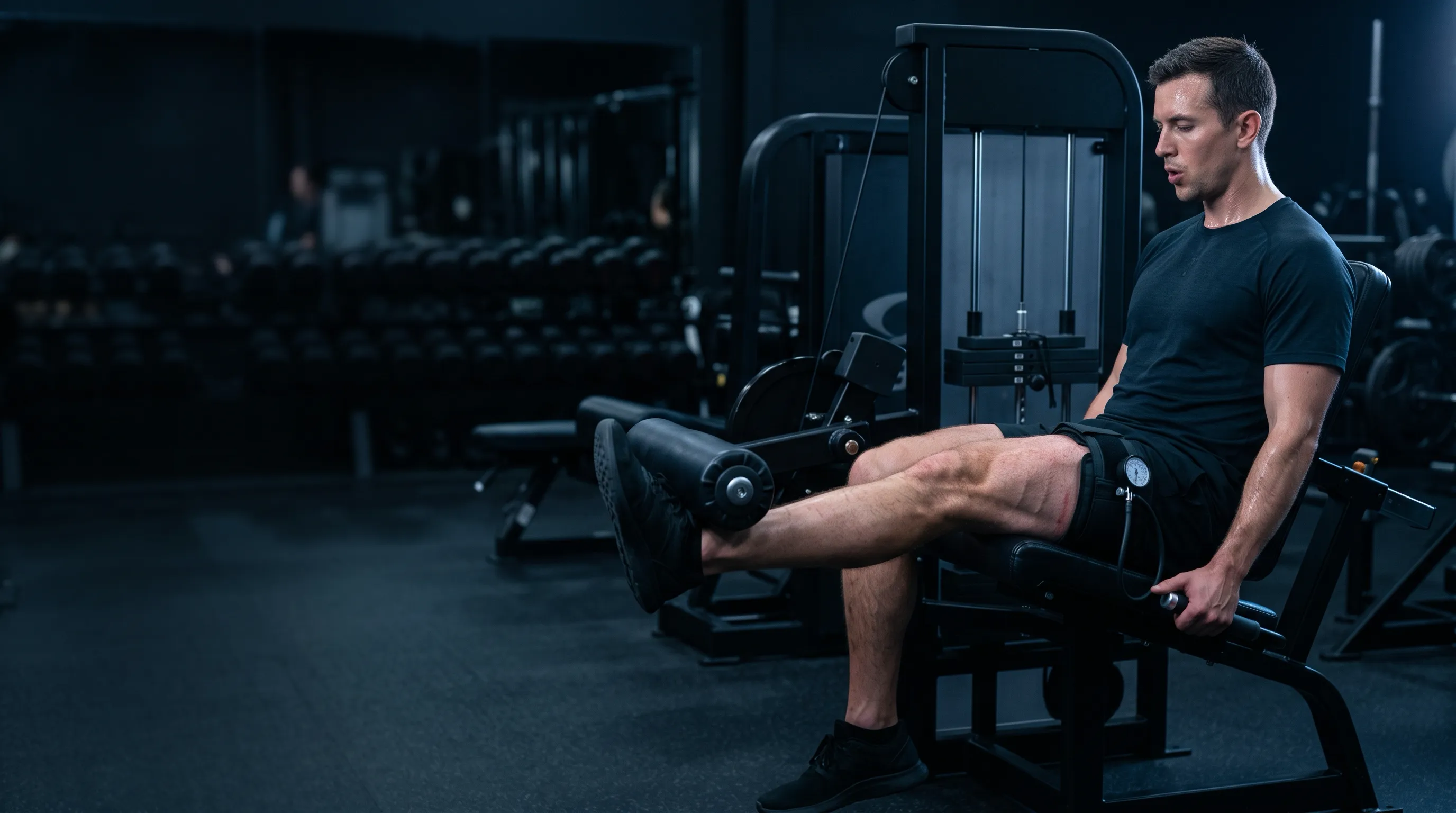
Blood flow restriction (BFR) training uses a cuff or band around the top of a limb to partially restrict arterial inflow and fully restrict venous outflow in the working muscle while you train that limb with light weight — typically 20–40% of your one-rep max.2
You’ll see it under other names. Occlusion training. KAATSU — the original Japanese method developed by Dr. Yoshiaki Sato, where kaatsu means “training with added pressure.”2 Same idea, different decade.
The mechanism, before any physiology: the cuff makes a light set behave like a hard one. Blood goes in slowly and struggles to get out, metabolites pool in the limb, and the muscle reaches the ragged end of a set far earlier than 30% of your max should allow.2
Which is a plausible story, and plausible stories are why things get studied — not evidence that they work.
Hold that distinction. It does most of the work below.
Does BFR Training Work?
Yes, for muscle size — BFR at light loads builds roughly as much muscle as heavy lifting does. For maximal strength it reliably loses to heavy loads. And as an addition to a program that is already loading heavy, ACSM found it did not consistently change outcomes.
That last clause is the one people mangle, so here is the actual sentence from the Position Stand:
“Training to momentary muscle fatigue, equipment type, exercise complexity, set structure, time under tension, blood flow restriction, and periodization did not consistently impact training outcomes.”1
Read what that is and isn’t. It is a finding about BFR as a prescription variable layered onto resistance training. The review’s eligibility criteria were healthy adults aged 18 and over completing at least six weeks of resistance training.1 It does not say BFR is ineffective, and it says nothing at all about rehab or load-restricted populations — which is exactly the population BFR is most indicated for and the one ACSM did not study.
Stuart M. Phillips, PhD, Professor of Kinesiology at McMaster University and the Position Stand’s senior author, and his co-authors found something broader and more deflating than a verdict on BFR: across 137 reviews, few prescription variables affected primary adaptations at all. What did move the needle was unglamorous — lifting heavier loads (≥80% 1RM) through a full range of motion for strength, and higher weekly volume (≥10 sets) for size.1
The direct-comparison literature is older and more favourable, and worth laying beside it:
| Evidence | Population | BFR vs heavy lifting |
|---|---|---|
| ACSM 2026 Position Stand (137 reviews, >30,000 participants) | Healthy adults | BFR among the variables that “did not consistently impact training outcomes”1 |
| Lixandrão et al., Sports Medicine 2018 | Mixed ages and capacities | Heavy loading superior for strength; hypertrophy similar3 |
| Centner et al., Sports Medicine 2019 (11 studies, N=238) | Older adults | Hypertrophy similar (ES 0.21, 95% CI −0.14 to 0.56); strength lower — ES −0.42, 95% CI −0.70 to −0.144 |
| Geng et al., Sports Medicine – Open 2024 | Trained vs untrained | Untrained get superior strength from heavy loading; trained may do better on BFR5 |
| Ferlito et al., BJSM 2026 (45 RCTs, 1,652 participants) | Musculoskeletal conditions | No clear strength difference vs high-load exercise — SMD 0.08, 95% CI −0.20 to 0.35, moderate certainty6 |
Four independent research teams, a decade apart, using different methods, all pointing the same way.
Lixandrão and colleagues were explicit that heavy loading beat BFR for strength regardless of occlusion pressure, cuff width, or how the pressure was prescribed — and that hypertrophy was similar under all the same conditions.3 You cannot dial the cuff to close the strength gap.
Where BFR reaches parity, it reaches it on hypertrophy, and in people who can’t load heavy. That’s the whole finding. Everything heavy lifting does for size, it is still doing better as a first choice — the fundamentals of how to build muscle are the baseline BFR is being measured against, not something it replaces.
BFR Bands vs Heavy Lifting: The Honest Comparison
Choose heavy lifting by default. Choose BFR when a joint, a surgery, a flare-up, or a lack of equipment makes heavy loading impossible or unwise — not because it’s more efficient.
| Factor | Heavy resistance training | Low-load BFR |
|---|---|---|
| Load | ≥80% 1RM for maximal strength1 | 20–40% 1RM2 |
| Muscle size | Strong, well established | Comparable34 |
| Maximal strength | Superior34 | Lower |
| Joint and tissue loading | High | Low — the entire point |
| Equipment | Barbell, rack, plates | Cuff plus light weight; a pressure device to do it properly |
| Setup complexity | Low | High — pressure must be individualised2 |
| Best for | Anyone who can load heavy | Post-op, joint-limited, deconditioned, load-restricted |
Now the part that separates this from every band advert you’ve read.
The reason to reach for BFR is a constraint, not an optimisation. If you can squat heavy and you’re strapping on cuffs instead, you have picked the harder path to the smaller result.
There is one nuance worth keeping. Geng and colleagues found training status moderates the effect: trained individuals may gain more muscle strength and size from BFR than from high-load training, while untrained individuals get superior strength gains from lifting heavy.5 Treat that as a hypothesis worth watching, not a recommendation — it’s a subgroup finding inside a meta-analysis, not a trial anyone has run on purpose.
Older adults are the clearer case. Centner and colleagues pooled 11 studies in older individuals and found BFR matched heavy training for hypertrophy and lost to it for strength.4 Which is a genuinely useful result when heavy loading is off the table, and a reason not to abandon it when it isn’t — the case for strength training after 40 still runs through load.
This is also the substitution a static template can’t make. A plan that knows your knee is flared this month should be replacing the load, not deleting the session — and it should still know next month. That’s the kind of constraint SensAI is built to hold across sessions rather than re-litigate every week.
The BFR Protocol: Every Parameter in One Table
The consensus BFR resistance protocol is 20–40% of 1RM, 40–80% of arterial occlusion pressure, four sets of 30-15-15-15 reps, 30–60 seconds of rest, 5–10 minutes of restriction per exercise, two to three times a week.
These values come from Table 1 of the 2019 international expert-consensus guidelines written by Stephen D. Patterson and thirteen co-authors — the closest thing the field has to an agreed prescription:2
| Parameter | Recommendation |
|---|---|
| Load | 20–40% 1RM |
| Pressure | 40–80% of arterial occlusion pressure (AOP) |
| Repetitions | 75 total across four sets — 30, 15, 15, 15 — or sets to failure |
| Sets | 2–4 |
| Rest between sets | 30–60 s |
| Restriction time | 5–10 min per exercise, with reperfusion between exercises |
| Frequency | 2–3×/week (programs >3 weeks), or 1–2×/day (short 1–3 week blocks) |
| Cuff width | 5 cm (small), 10 or 12 cm (medium), 17 or 18 cm (large) |
| Rep tempo | 1–2 s concentric and eccentric |
| Limbs | Small and large muscle groups; upper or lower; uni- or bilateral |
| Restriction form | Continuous or intermittent |
Note the one row that isn’t a number. The cuff comes off between exercises.2 Restriction is not something you leave on for a session — it’s something you apply, use, and release.
And note what the table quietly assumes: that you can measure AOP. That assumption is where consumer BFR falls apart.
BFR Training Pressure: Why It’s 40–80% of AOP (and the One Number Bands Can’t Measure)
The recommended pressure is 40–80% of your arterial occlusion pressure — a personal number that depends on your limb circumference, blood pressure, body position, and the width of the cuff. Which means an elastic band with no gauge cannot tell you whether you are at 40% or 100%.
Patterson’s group wrote those guidelines precisely because this was going wrong in the field. Practitioners were applying a wide range of pressures, with unintended consequences — notably a large incidence of numbness afterwards.2 Patterson, Professor in Applied Exercise Physiology and Performance at St Mary’s University, London, and his co-authors were not documenting best practice. They were correcting it.
Why Arterial Occlusion Pressure Is Individual
How individual is AOP? More than you would guess.
Wedig and colleagues measured lower-limb AOP by Doppler ultrasound in 116 seated participants across three cuff widths. Thigh circumference, systolic and diastolic blood pressure, age and sex together explained only 60–70% of the variance in AOP.7
The cuff-width interaction is what kills the idea of one right pressure. Thigh circumference uniquely accounted for 36%, 26% and 11% of AOP variance at 11 cm, 13 cm and 18 cm cuffs respectively — while systolic blood pressure mattered more as cuffs got wider.7 The same leg needs a different pressure depending on what you strap to it.
Even the purpose-built prediction equations Wedig’s team developed landed with limits of agreement of ±18.4 to ±28.6 mmHg against measured AOP.7 That is the residual error on a validated equation that already knows your blood pressure and your limb size.
An elastic wrap knows neither. The problem with bands isn’t that their error is large — it has not been well quantified against measured AOP — it’s that their error is unquantified.
Body position moves the target too. de Queiros and colleagues measured lower-limb AOP in 51 adults supine, sitting and standing, with medium and large cuffs. AOP was significantly lower lying down regardless of cuff, the large cuff needed less pressure to occlude in every position, and body position changed which variable best predicted the number.8 Measure seated, train standing, and the answer you measured is no longer the answer you need.
All of which makes “as tight as you can stand” exactly backwards. Higher relative restriction pressures produce larger cardiovascular responses and may raise the associated risk, which is why the consensus range stops at 80% AOP rather than climbing toward full occlusion.2
Practitioners largely understand this. In Brendan R. Scott’s survey of 397 allied health practitioners, 81.1% set cuff pressure relative to arterial occlusion pressure.9 Consumer content almost never mentions AOP at all.
Why BFR Feels Harder Than Your Log Says
There’s a second disconnect worth naming, because it will mislead your training log. Miller and colleagues put 29 participants through 30-15-15-15 at 30% 1RM with a clinical BFR cuff against 3×10 at 80% 1RM. Perceived exertion was significantly higher in the heavy condition. What matched was discomfort — the clinical BFR sets were as unpleasant as heavy lifting, without being as effortful.10
So a BFR session can feel awful at a load your log records as trivial. Effort-based and load-based readouts of the same session genuinely disagree, which is a real problem if you autoregulate by RPE and reps in reserve. It’s also why SensAI reads a session in the context of what it was prescribed to be, rather than ranking your week by tonnage.
How to Do BFR Training at Home
You can — but the honest version is: size the wrap to your limb circumference rather than to a feeling, keep a palpable pulse below the cuff, cap restriction at 5–10 minutes per exercise, and accept that without a pressure gauge you are estimating the one variable that governs both safety and effect.
Practical BFR — elastic knee wraps instead of pneumatic cuffs — is a published method dating to 2009, not an influencer shortcut.11 It exists because pneumatic devices are not a realistic option for people training in gyms, parks and sports centres.
Aniceto and da Silva Leandro reviewed every technique the literature has used to set elastic wrap tension: application by a single researcher, absolute and relative stretch of the elastic, perceived-tightness scales, and relative overlap based on limb circumference. Their conclusion was that limb circumference is the best available basis, because limb circumference is the strongest predictor of AOP.11
Which is worth sitting with, because the perceived-tightness scale — “wrap it to about a 7 out of 10” — is the weakest option on that list, and it is the one consumer content reaches for every time.
The practical version:
- Upper arm or upper thigh only. The cuff goes on the most proximal part of the limb. Never mid-limb, never the calf.2
- Size by limb circumference, using a published relative-overlap method — not by feel.11
- Light load: 20–40% 1RM.2
- 30-15-15-15, with 30–60 seconds of rest.2
- Remove the wrap between exercises. Five to ten minutes of restriction per exercise is the ceiling.2
- Stop for numbness, dizziness, or loss of a distal pulse. Numbness is the consequence most commonly reported when practitioners get the pressure wrong.2
Where does this legitimately fit? Accessory work on a light day, or holding a stimulus during a planned low week — light-load BFR is a defensible way to keep a limb working when the week is deliberately compressed. Deciding what a deload week should actually contain given what your body just did is the programming question SensAI regenerates the week around, and low-load work is one of the answers it has available.
What practical BFR is not is the right tool for post-surgical rehab. In a 2025 survey of US physical therapists, 64% used an automated Delfi unit12 — precisely because in that setting the pressure needs to be measured rather than approximated.
BFR for Knee Rehab: Best Use Case, Shakier Evidence Than You’d Expect
BFR is most often used after knee surgery because it lets a quadriceps that can’t tolerate load still get trained — but the pooled trial evidence in knee conditions is very low certainty and shows no significant advantage over conventional rehab for strength or function.
The logic is genuinely good. A knee eight weeks after ACL reconstruction cannot survive 80% 1RM, and the quadriceps wastes fast. BFR offers a hypertrophy stimulus at a load the joint can take.
The trials are less enthusiastic than the logic.
Zeitlin, Shepherd, Lack and Neal pooled 15 randomised controlled trials covering 418 participants with knee conditions — seven of them post-ACL reconstruction, plus cartilage surgery, knee osteoarthritis and patellofemoral pain. Adding BFR to resistance training produced a small effect on short-term pain (SMD 0.47, 95% CI 0.09 to 0.85) at very low certainty, and no significant effect on function or quadriceps strength. Their own conclusion: clinicians should exercise caution in offering BFR to people with knee conditions.13
The 2026 picture across all musculoskeletal conditions is more informative, because it compares BFR against both alternatives at once. Ferlito and colleagues pooled 45 RCTs and 1,652 participants and found low-certainty evidence that low-load BFR beats low-load exercise without restriction for strength (SMD 0.82, 95% CI 0.40 to 1.23), and moderate-certainty evidence of no clear difference against high-load exercise (SMD 0.08, 95% CI −0.20 to 0.35).6 Pain reductions favoured BFR but were small and, in the authors’ own words, unlikely to be clinically meaningful.6
Put those together and the conclusion is precise:
BFR beats doing light exercise without it, and does not beat lifting heavy — so it is the right tool exactly when heavy is off the table.
Luke Hughes, PhD, co-author of both the 2019 consensus guidelines and the 2026 meta-analysis, is one of the researchers behind that framing. Worth knowing while you weigh it: Hughes acts in a scientific advisory capacity for Delfi Medical Innovations, and co-author Nicholas Rolnick founded a BFR education company — disclosed conflicts in a field where the researchers and the equipment vendors overlap.6 The finding is unflattering to the equipment, which is a point in its favour.
The earlier optimism traces to Hughes and colleagues’ 2017 review in the British Journal of Sports Medicine, which helped drive clinical adoption.14 Read it as the field’s origin point, not its current best evidence.
If your reason for looking at BFR is a knee that hurts rather than a knee that’s been operated on, the load-management and knee pain exercise options are a more reasonable first stop than a cuff.
One practical note from rehab that has nothing to do with cuffs. A rehab phase is a moving target, and what usually fails isn’t the protocol — it’s the handoff. The plan forgets on week seven that week three had a surgery in it. SensAI’s coach carries stated constraints forward across sessions rather than asking you to restate them every time the program regenerates.
Is Blood Flow Restriction Training Safe?
For screened people using measured pressure, yes — serious adverse events are rare in the published literature and in practitioner surveys: exertional rhabdomyolysis incidence is estimated at 0.07–0.2%, and a 2025 survey of 134 US physical therapists reported no major adverse effects and minor, transient ones in 8%. But that safety record belongs to screened populations using measured pressures, not to unscreened people guessing with bands.
The numbers, each attributable:
- Exertional rhabdomyolysis: analysis of incidence from the published BFR literature puts the risk at 0.07–0.2%. Japanese KAATSU survey data suggests 0.008%.2
- US physical therapists: across 134 licensed PTs in 20 states, no major adverse effects were reported — no thrombosis, no rhabdomyolysis, no nerve damage. Minor effects (dizziness, numbness, nausea, delayed-onset soreness) were reported by 8%, or 11 respondents.12
- Allied health practitioners: among 397 responders, minor side effects were common, with muscle soreness at 65.8%. 68.2% screen for contraindications.9
- Randomised trials: Ferlito’s meta-analysis found no difference in adverse events between BFR and low-load exercise (RR 0.92) or high-load exercise (RR 1.08).6
Three caveats belong in the same breath as those numbers, not in a footnote.
First, these are practitioner datasets. They describe screened patients under supervision, at pressures set relative to measured AOP. That is not the same population as someone following a video with a knee wrap.
Second, “no signal” is partly “not measured.” Ferlito and colleagues flag it themselves: adverse-event monitoring and reporting were inconsistent across the trials they pooled.6
Third, deep vein thrombosis is the theoretical concern that drives the whole contraindication list. It is why the screening below isn’t optional.
So the accurate sentence is not “BFR is safe.” It’s that the evidence does not show a meaningful excess risk in screened populations using measured pressures.
Who Should Not Do BFR Training
Anyone with a history of blood clots, a clotting disorder, cancer, recent major surgery, pregnancy or the post-partum period, or a recent period of immobility should not use BFR without clinician clearance — and the screen matters more than the protocol.
Patterson and colleagues built their safety guidance around the established risk factors for venous thromboembolism, since that is the mechanism of concern:2
| Category | Examples |
|---|---|
| Clotting history | Prior VTE, family history of VTE, genetic conditions affecting blood clotting |
| Current medical | Cancer |
| Recent events | Major orthopaedic surgery, major general surgery, pelvic/hip/long-bone fracture, poly-trauma, lower-extremity paralysis from spinal cord injury |
| Situational | Pregnancy and the post-partum period, obesity, physical inactivity, immobility |
| Medication | Oral contraceptives (a listed VTE risk factor) |
This is not a complete medical clearance, and it isn’t meant to be. The point is that BFR is one of the very few training methods where a screening conversation genuinely precedes the first session — closer in kind to starting a medication than to trying a new exercise.
Note that only 68.2% of surveyed practitioners screen for contraindications.9 Among self-directed band users, the figure is presumably far lower.
And if something on that list applies to you, the answer isn’t a looser cuff. It’s a different exercise. Talk to your physician before you start, not after something goes wrong.
So Should You Use BFR?
Use BFR if you have a joint, injury, or surgical restriction that blocks heavy loading. Skip it if you can already lift heavy and are looking for an edge.
| Situation | Verdict |
|---|---|
| Post-op or rehab, cleared by a clinician | Reasonable — with measured pressure and supervision613 |
| Joint pain that blocks heavy loading | Reasonable substitute while the constraint lasts3 |
| Older adult, deconditioned, limited load tolerance | Supported for hypertrophy; heavy loading still better for strength4 |
| Travelling, minimal equipment, want to hold muscle | Defensible accessory use |
| Healthy lifter chasing faster gains | No — ACSM found no consistent effect1 |
| Anyone on the contraindication list | No, without clearance2 |
Look at what every “reasonable” row has in common. BFR is a temporary substitution keyed to a constraint — a programming decision, not an equipment purchase.
Frequently Asked Questions
How tight should BFR bands be? Forty to eighty percent of your arterial occlusion pressure.2 “As tight as you can stand” is wrong in both directions: it’s unrelated to your actual AOP, and higher relative pressures drive larger cardiovascular responses and may raise the associated risk.2 Numbness and loss of a pulse below the cuff are stop signals, not signs it’s working.
Does BFR build muscle without weights? It can, in the right population. Centner and colleagues found that adding BFR to walking increased muscle mass compared with walking alone in older individuals (ES 1.82, 95% CI 1.32 to 2.32).4 Set the expectation honestly: this matters enormously for someone who cannot train, and very little for someone who can.
How long until BFR works? The consensus prescription covers two windows — short blocks of one to three weeks at one to two sessions per day, or programs longer than three weeks at two to three sessions per week.2 Pick one; don’t stack them.
Is BFR better for hypertrophy than normal training? No. Comparable at best. Lixandrão’s meta-analysis found similar hypertrophy between BFR and high-load training regardless of pressure or cuff width,3 and ACSM found BFR did not consistently affect outcomes as a prescription variable.1 “Not worse” is the ceiling here, and it’s a real result — it just isn’t an upgrade.
Can you do BFR every day? Only inside the short high-frequency block the consensus describes: one to two sessions per day for one to three weeks. Beyond three weeks the recommendation drops to two or three times a week.2
Do you need an expensive cuff? For rehab, effectively yes — 64% of surveyed US physical therapists use an automated pressure unit.12 For accessory work in a healthy adult, a wrap sized by limb circumference is a defensible compromise,11 as long as you know you’re estimating rather than measuring.
The Bottom Line
The strongest evidence available on resistance training prescription — 137 systematic reviews, more than 30,000 participants — put blood flow restriction on the list of variables that did not consistently change training outcomes in healthy adults.1 That is not a takedown. It is a finding about a specific population that most BFR marketing quietly borrows credibility from without ever qualifying for.
Where BFR earns its place is on the other side of that line: knees that can’t take load, quads wasting after surgery, older adults who need a hypertrophy stimulus their joints can survive, travel weeks with nothing but a wrap and a light dumbbell.
Which reframes the whole thing. BFR isn’t a hack, it’s a workaround — and workarounds are valuable in exact proportion to how stuck you are.
If you’re not stuck, go lift something heavy.
References
Footnotes
-
Currier BS, D’Souza AC, Singh MAF, Lowisz CV, Rawson ES, Schoenfeld BJ, Smith-Ryan AE, Steen JP, Thomas GA, Triplett NT, Washington TA, Werner TJ, Phillips SM. “American College of Sports Medicine Position Stand. Resistance Training Prescription for Muscle Function, Hypertrophy, and Physical Performance in Healthy Adults: An Overview of Reviews.” Medicine & Science in Sports & Exercise, 2026;58(4):851-872. https://pubmed.ncbi.nlm.nih.gov/41843416/ ↩ ↩2 ↩3 ↩4 ↩5 ↩6 ↩7 ↩8 ↩9
-
Patterson SD, Hughes L, Warmington S, Burr J, Scott BR, Owens J, Abe T, Nielsen JL, Libardi CA, Laurentino G, Neto GR, Brandner C, Martin-Hernandez J, Loenneke J. “Blood Flow Restriction Exercise: Considerations of Methodology, Application, and Safety.” Frontiers in Physiology, 2019;10:533. https://pubmed.ncbi.nlm.nih.gov/31156448/ ↩ ↩2 ↩3 ↩4 ↩5 ↩6 ↩7 ↩8 ↩9 ↩10 ↩11 ↩12 ↩13 ↩14 ↩15 ↩16 ↩17 ↩18 ↩19 ↩20 ↩21
-
Lixandrão ME, Ugrinowitsch C, Berton R, Vechin FC, Conceição MS, Damas F, Libardi CA, Roschel H. “Magnitude of Muscle Strength and Mass Adaptations Between High-Load Resistance Training Versus Low-Load Resistance Training Associated with Blood-Flow Restriction: A Systematic Review and Meta-Analysis.” Sports Medicine, 2018;48(2):361-378. https://pubmed.ncbi.nlm.nih.gov/29043659/ ↩ ↩2 ↩3 ↩4 ↩5 ↩6
-
Centner C, Wiegel P, Gollhofer A, König D. “Effects of Blood Flow Restriction Training on Muscular Strength and Hypertrophy in Older Individuals: A Systematic Review and Meta-Analysis.” Sports Medicine, 2019;49(1):95-108. https://pubmed.ncbi.nlm.nih.gov/30306467/ ↩ ↩2 ↩3 ↩4 ↩5 ↩6
-
Geng Y, Wu X, Zhang Y, Zhang M. “Potential Moderators of the Effects of Blood Flow Restriction Training on Muscle Strength and Hypertrophy: A Meta-analysis Based on a Comparison with High-Load Resistance Training.” Sports Medicine - Open, 2024;10(1):58. https://pubmed.ncbi.nlm.nih.gov/38773002/ ↩ ↩2
-
Ferlito JV, Rolnick N, Kamiş O, de Queiros VS, Lopez P, Hughes L. “Do blood flow restriction exercises offer additional benefits when compared to conventional exercises in musculoskeletal rehabilitation? A systematic review and meta-analysis.” British Journal of Sports Medicine, 2026 (online ahead of print). https://pubmed.ncbi.nlm.nih.gov/42399091/ ↩ ↩2 ↩3 ↩4 ↩5 ↩6 ↩7
-
Wedig IJ, Lennox IM, Petushek EJ, Durocher JJ, McDaniel J, Elmer SJ. “Predictors of lower-limb arterial occlusion pressure across commonly used cuff widths.” Frontiers in Physiology, 2025;16:1658744. https://pubmed.ncbi.nlm.nih.gov/41141853/ ↩ ↩2 ↩3
-
de Queiros VS, Rolnick N, Kamiş O, Formiga MF, Rocha RFC, Alves JCM, Vieira JG, Vianna JM, Wilk M, Fostiak K, Cabral BGAT, Dantas PMS. “Body position and cuff size influence lower limb arterial occlusion pressure and its predictors: implications for standardizing the pressure applied in training with blood flow restriction.” Frontiers in Physiology, 2024;15:1446963. https://pubmed.ncbi.nlm.nih.gov/39189031/ ↩
-
Scott BR, Marston KJ, Owens J, Rolnick N, Patterson SD. “Current Implementation and Barriers to Using Blood Flow Restriction Training: Insights From a Survey of Allied Health Practitioners.” Journal of Strength and Conditioning Research, 2024;38(3):481-490. https://pubmed.ncbi.nlm.nih.gov/38088873/ ↩ ↩2 ↩3
-
Miller RM, Galletti BAR, Koziol KJ, Freitas EDS, Heishman AD, Black CD, Larson DJ, Bemben DA, Bemben MG. “Perceptual responses: Clinical versus practical blood flow restriction resistance exercise.” Physiology & Behavior, 2020;227:113137. https://pubmed.ncbi.nlm.nih.gov/32798570/ ↩
-
Aniceto RR, da Silva Leandro L. “Practical Blood Flow Restriction Training: New Methodological Directions for Practice and Research.” Sports Medicine - Open, 2022;8(1):87. https://pubmed.ncbi.nlm.nih.gov/35763185/ ↩ ↩2 ↩3 ↩4
-
Weatherholt AM, VanWye WR, Patel N, Humphrey L. “Blood Flow Restriction Use by U.S. Physical Therapists: A Survey on Settings, Equipment, and Adverse Effects.” International Journal of Exercise Science, 2025;18(5):736-746. https://pubmed.ncbi.nlm.nih.gov/40909299/ ↩ ↩2 ↩3
-
Zeitlin C, Shepherd M, Lack SD, Neal BS. “Blood flow restriction training compared to conventional training in people with knee pain: a systematic review with meta-analysis.” Physical Therapy in Sport, 2025;74:65-74. https://pubmed.ncbi.nlm.nih.gov/40435680/ ↩ ↩2
-
Hughes L, Paton B, Rosenblatt B, Gissane C, Patterson SD. “Blood flow restriction training in clinical musculoskeletal rehabilitation: a systematic review and meta-analysis.” British Journal of Sports Medicine, 2017;51(13):1003-1011. https://pubmed.ncbi.nlm.nih.gov/28259850/ ↩