Unlock Your Best Self: Your Personalized Workout Guide
Learn how personalized workout plans account for goals and constraints, and how LLM coaching and wearable context can support structured training reviews.

SensAI Team
11 min read
Get a training plan that adapts to your recovery — free on iOS

The reason your fitness progress has stalled may have nothing to do with effort. A meta-analysis of 2,230 participants found that while average fitness gains from exercise are consistent, the apparent variation between individuals may largely reflect measurement error and lifestyle factors rather than true differences in training response.1 The workout that transformed your friend might be wrong for your body.
This gap between generic programs and individual needs explains why so many dedicated exercisers hit walls. Your physiology and recovery capacity combine with your goals to create a unique equation that cookie-cutter plans cannot solve. Tools like SensAI address this by combining your goals, equipment, schedule, constraints, training history, and aggregated HealthKit recovery context. Apple Watch data is available directly through HealthKit; compatible Garmin, Oura, and WHOOP data also flows through HealthKit.
This guide walks through what personalized training means in practice, how to build a plan that fits your life, and why technology now makes true individualization accessible rather than exclusive to elite athletes.
Understanding the Need for Personalized Workout Plans
Generic workout programs assume average responses from average bodies. You are not average. Research shows that training adaptations vary greatly between individuals, making testing and monitoring essential for adjusting programs that do not yield expected results.2
Consider two people following the same twelve-week strength program. One might add thirty pounds to their squat while the other adds five. Neither is doing anything wrong. Their bodies simply respond differently to the same stimulus.
Why one-size-fits-all fails:
- Your recovery capacity differs from the program’s assumptions
- Your schedule conflicts with prescribed training days
- Your goals do not align with the program’s priorities
- Your injury history requires modifications the program ignores
- Your response rate to certain stimuli differs from the average
Personalization addresses these gaps by treating your training as a dynamic system rather than a static prescription. Instead of forcing your life into a rigid template, an individualized approach shapes the template around your constraints and capabilities.
| Generic Programs | Personalized Programs |
|---|---|
| Fixed schedule regardless of recovery | Uses recovery context during scheduled reviews |
| Same progression rate for everyone | Adapts to your response speed |
| Assumes average recovery capacity | Can consider connected sleep trends and reported stress |
| Static exercises regardless of limitations | Modifies movements for your body |
| One goal fits all | Prioritizes your specific objectives |
The shift from generic to personalized training is not about complexity. It is about relevance. A simpler program designed around your goals and constraints may be easier to execute than a sophisticated program designed for someone else.
Benefits of AI in Fitness Personalization
Traditional personalization required expensive coaches who manually tracked your progress and adjusted plans based on observation and experience. AI changes the economics and scale of individualization.
Modern LLM-based systems can combine workout history, connected recovery trends, and conversational context to generate and explain recommendations. The complete guide to AI personal training explains how that differs from a fixed template or a traditional prediction model.
What AI brings to personalization:
- Context synthesis - Places goals, constraints, performance, and recovery trends together
- Conversational adjustment - Responds when you ask for a shorter session, more volume, or an exercise swap
- Persistent memory - Retains reported injuries, preferences, and constraints across sessions
- Weekly review - Uses actual performance and recovery when regenerating the next program
- Explanation - Lets you ask why a workout or exercise was selected
Apple researchers reported that subject-specific encoding improved VO2max prediction in their hybrid modeling work compared with demographic information alone.3 That study illustrates the value of individual history for a particular prediction task; SensAI does not use that machine-learning model or claim to predict VO2max.
Researchers are also studying adaptive digital goal setting that changes goals using participant behavior and feedback.4 A protocol is evidence that an approach is being tested, not proof that every AI-personalized plan improves adherence. User control remains important because the person, not the model, decides whether to accept a change.
| Traditional Coaching | AI-Powered Personalization |
|---|---|
| Limited by coach availability | Available for conversation in the app |
| Based on periodic check-ins | Uses context during summaries and program regeneration |
| Relies heavily on self-reported metrics | Combines reported context with aggregated wearable trends |
| Cost depends on the coach and service | Product access depends on current app options |
| Human attention does not scale indefinitely | Software can support many users, within product limits |
The goal is not to replace human judgment but to add context synthesis and conversation while you retain control over priorities and preferences.
Steps to Create Your Tailored Workout Plan
Building a personalized plan follows a logical sequence. Researchers have proposed a six-step evidence-informed approach that balances scientific rigor with practical implementation.
Step 1: Assess your current state
Before designing where to go, establish where you are. This includes:
- Fitness testing for strength and endurance baselines
- Movement screening for limitations or asymmetries
- Recovery capacity assessment (sleep quality, stress levels)
- Schedule analysis (available training time, constraints)
Step 2: Define specific goals
Vague goals produce vague results. Transform general desires into measurable targets. “Get stronger” becomes “add 20 pounds to deadlift in 12 weeks.” “Improve cardio” becomes “complete 5K in under 25 minutes.” The specificity forces clarity about what success actually looks like.
Step 3: Select appropriate methods
Match training approaches to your goals and constraints. Evidence-informed personalization uses testing, monitoring, and iterative adjustment rather than assuming one intensity formula fits everyone.5 The right method depends on your goal, starting point, and what you can sustain consistently.
Step 4: Structure progressive overload
Design a progression system that challenges your body without exceeding recovery capacity. The four variables you can manipulate are volume (sets and reps), intensity (weight and effort level), frequency (sessions per week), and complexity (exercise difficulty). Effective programs adjust one or two of these at a time rather than all four simultaneously.
Step 5: Implement and track
Execute the plan while collecting data on performance and recovery. Tracking transforms training from guesswork into informed iteration. The data you gather here feeds directly into Step 6.
Step 6: Review and adapt
Regularly analyze results against expectations. Adjust the plan based on actual response rather than theoretical predictions. Most programs benefit from a formal review every four to six weeks, with smaller tactical adjustments happening between cycles.
| Step | Focus | Key Question |
|---|---|---|
| 1. Assess | Current state | Where am I now? |
| 2. Define | Goals | Where do I want to go? |
| 3. Select | Methods | What approaches fit my situation? |
| 4. Structure | Progression | How do I advance systematically? |
| 5. Implement | Execution | Am I doing what I planned? |
| 6. Review | Adaptation | Is it working? What needs to change? |
Integrating Wearable Technology for Better Results
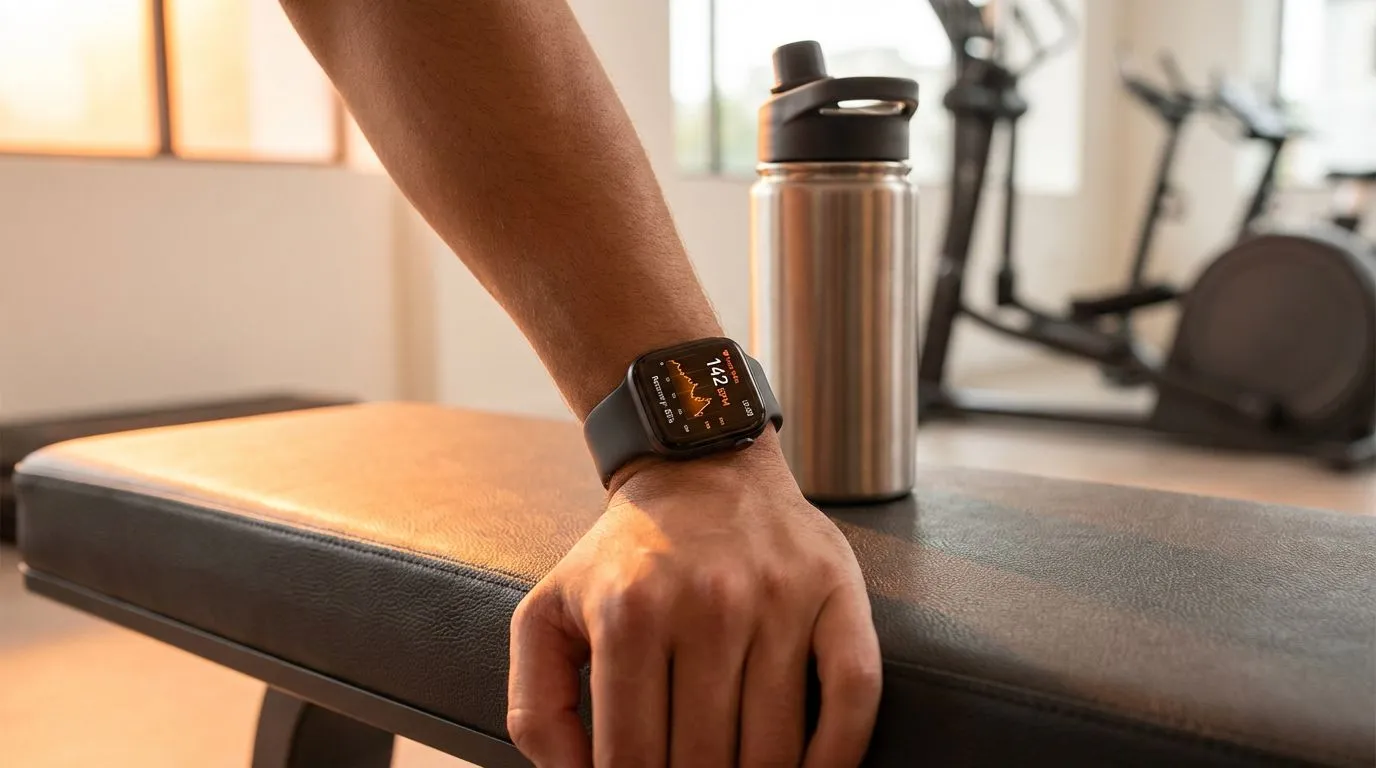
Your fitness wearable collects estimates that can add context to subjective perception. Baseline-relative heart rate variability, resting heart rate, sleep quality and duration, and completed workouts can help you review recovery, but none measures readiness perfectly.
The challenge is translating metrics into context without pretending they reveal a cause. Understanding how HRV functions as a recovery signal helps put abstract numbers beside measurement quality, symptoms, sleep, and recent training. A downward HRV trend can coincide with training fatigue, illness, stress, alcohol, travel, or other factors; it does not diagnose any of them.
Key metrics for training decisions:
- Resting heart rate - Baseline-relative changes can add context
- Heart rate variability - Personal trends are more useful than a single absolute value
- Sleep summaries - Estimated quality and duration can help explain how a session feels
- Training load - Week-over-week comparisons reveal accumulating stress
Your wearable data becomes fitness insight when analyzed in context rather than isolation. A single low HRV reading cannot prescribe a workout. A sustained change is a reason to review measurement quality, symptoms, sleep, and training, not a diagnosis.
SensAI shows a Zone 0-5 heart-rate breakdown after a workout and tracks planned versus performed work. It does not automatically change remaining sets from heart-rate recovery. During a session, you can request a modification through chat or supported quick actions.
Practical integration tips:
- Wear your device consistently, including during sleep
- Review trends over weeks rather than fixating on daily fluctuations
- Correlate subjective energy levels with objective metrics
- Treat readiness scores as summaries, not commands
- Let symptoms, unusual pain, and medical red flags outrank a wearable score
Adjusting Your Plan Based on Progress
Static plans fail because you are not static. Your fitness improves, your life circumstances change, your interests evolve. The plan that worked three months ago may no longer fit the person you are today.
Regular progress reviews catch misalignments before they become plateaus. Schedule formal assessments every four to six weeks to evaluate:
- Are you hitting performance targets?
- How does subjective effort compare to objective output?
- Which exercises or sessions feel productive versus draining?
- Has your schedule, stress, or recovery situation changed?
Honest answers to these questions reveal whether your current plan still serves you. Sometimes the data confirms you are on track. Other times it surfaces a mismatch worth addressing before frustration sets in.
Signs your plan needs adjustment:
- Performance stagnates despite consistent effort
- Motivation drops without obvious external cause
- Recovery feels inadequate even with prescribed rest
- Goals have shifted but training has not followed
- Life circumstances have changed (job, travel, family demands)
Adjustment does not mean abandonment. Small tweaks often restore progress without requiring wholesale program changes. Consider modifying:
- Exercise selection within the same movement patterns
- Rep ranges to vary the stimulus
- Training frequency to match current recovery capacity
- Intensity distribution (more easy days, fewer hard days, or vice versa)
The goal is responsive evolution rather than reactive overhaul. Track enough data to make informed changes while avoiding analysis paralysis that prevents action.
Overcoming Common Fitness Hurdles with Personalization
Every fitness journey encounters obstacles. Personalized approaches address common hurdles with targeted solutions rather than generic advice.
Plateau breaking
When progress stalls, a structured review helps you examine possible contributors without pretending to diagnose one cause. Is the plan being completed? Has sleep, schedule, nutrition, health, or training load changed? The answers may suggest an adjustment or a need for qualified help.
Motivation maintenance
Motivation fluctuates. Personalized programs adapt to these fluctuations rather than demanding consistent enthusiasm. On low-motivation days, shorter sessions or preferred exercises maintain the habit without forcing heroic effort.
The path to staying motivated and maintaining workout consistency runs through alignment between your training and your life rather than willpower alone.
Time constraints
When available training time shrinks, personalization can prioritize the movements most relevant to the current goal. Instead of compressing every planned element, you can explicitly request a shorter session.
Injury management
Some injuries and pain episodes allow modified training; others require rest, examination, or urgent care. A personalized plan can remember a reported limitation and offer an alternative when you request one, but it cannot diagnose the injury or guarantee that training around it is safe. New severe pain, major trauma, chest pain, fainting, progressive weakness, new neurological symptoms, or rapidly worsening symptoms require appropriate medical assessment.
| Hurdle | Generic Approach | Personalized Approach |
|---|---|---|
| Plateau | “Push harder” | Review possible contributors and tracked execution |
| Low motivation | “Discipline over motivation” | Adapt session to current state |
| Time crunch | “Something is better than nothing” | Prioritize highest-impact elements |
| Injury or pain | “Use one rule for every case” | Seek clinical guidance and modify only when appropriate |
| Inconsistency | “Build better habits” | Align training with life patterns |
Embark on Your Fitness Journey with SensAI
SensAI represents one practical application of the ideas in this guide. It integrates with Apple HealthKit: Apple Watch data is available directly, while compatible Garmin, Oura, and WHOOP data flows through HealthKit. Raw HealthKit data stays on-device; aggregated recovery metrics are sent server-side for AI coaching.
What distinguishes SensAI from a one-off prompt is persistent context. The LLM coach can use tracked workout history, connected recovery summaries, and reported injuries, preferences, and constraints. It does not infer facts you have not provided or diagnose why a metric changed.
SensAI capabilities:
- HealthKit integration for connected recovery context
- Daily recovery and readiness summaries
- Planned-versus-performed workout tracking
- Conversational interface for questions and adjustments
- Weekly program regeneration using actual performance and recovery
The gap between knowing what you should do and actually doing it can shrink when the plan reflects your reality. You can tell the coach that travel changed your schedule, use the daily summary as context after poor sleep, and request a shorter or different session through chat. The next weekly regeneration can use what you actually completed.
Your fitness journey is uniquely yours. The tools to support that journey should be equally personal.
FAQs about Personalized Workout Plans
How long does it take to see results from a personalized workout plan?
There is no reliable universal timeline. Training age, goal, program, adherence, sleep, nutrition, measurement method, and health all affect when a meaningful change becomes visible.
Can I create a personalized plan without expensive equipment or a trainer?
Yes. A useful plan can start with your goals, available time, equipment, constraints, and consistent workout tracking. A wearable can add recovery context but is not required to define every training decision. Check the app for current access options.
How often should I adjust my workout plan?
Review after enough consistent training to interpret the trend, and sooner when goals, constraints, symptoms, or schedule change. SensAI regenerates programs weekly. Changes during the week happen when you request them through chat or supported quick actions, not through an automatic daily mutation.
What if my goals change mid-program?
Adapt the plan to match your new priorities. Personalized approaches handle goal shifts better than rigid programs because the underlying framework remains while specific targets evolve. The key is updating your plan rather than abandoning structure entirely.
Is AI personalization as effective as working with a human coach?
They serve different roles, and current evidence does not support a universal equivalence claim. An LLM can synthesize connected context and remain available for conversation; a qualified human can observe movement directly, provide hands-on assessment, exercise judgment, and deliver interpersonal accountability.
How does SensAI differ from using ChatGPT for workout advice?
SensAI maintains product-specific context about tracked workouts and reported preferences, injuries, and constraints, and can use aggregated HealthKit recovery metrics. A general-purpose chat experience depends on the context and integrations available in that product. The durable distinction is SensAI’s fitness workflow: plan generation, workout tracking, daily recovery summaries, weekly regeneration, and in-workout requests.
References
Footnotes
-
Hutchinson A. “The Case Against Personalized Workout Plans.” Outside Online, October 2024. https://www.outsideonline.com/health/training-performance/personalized-training-advice/ ↩
-
Wackerhage H, Schoenfeld BJ. “Personalized, Evidence-Informed Training Plans and Exercise Prescriptions for Performance, Fitness and Health.” Sports Medicine, 2021. https://pmc.ncbi.nlm.nih.gov/articles/PMC8363526/ ↩
-
Apple Machine Learning Research. “Personalizing Health and Fitness with Hybrid Modeling.” March 2024. https://machinelearning.apple.com/research/personalized-heartrate ↩
-
Caro JC, Nguyen PH, Lipman S. “Automated Personalized Goal Setting for Individual Exercise Behavior: Protocol for a Web-Based Adaptive Intervention Trial.” JMIR Research Protocols, November 2025. https://www.researchprotocols.org/2025/1/e73766 ↩
-
Dalleck LC, Brinsley J. “An Evidence-based Guide to Creating Personalized Exercise Programs for Your Clients.” ACE Fitness, December 2018. https://www.acefitness.org/continuing-education/certified/december-2018/7154/an-evidence-based-guide-to-creating-personalized-exercise-programs-for-your-clients/ ↩