I'm New to Working Out and Don't Know Where to Start
A complete beginner's guide to fitness: learn exercise types, build your first routine, use wearables for feedback, and stay motivated.

SensAI Team
9 min read
Get a training plan that adapts to your recovery — free on iOS

The fundamentals of fitness have not changed in decades. Your body responds to movement and progressive challenge the same way it always has. What has changed is how accessible guidance has become. Tools like SensAI can build a personalized plan from your goals, equipment, schedule, and constraints, then regenerate the program each week using your completed training and recovery context. You do not need a gym membership to start. You do not need expensive equipment. You need a plan that meets you where you are and grows with you.
This guide breaks down exactly what that looks like. From choosing exercises that match your goals to tracking your progress with wearable technology, you will find actionable steps you can use today.
Introduction to Basic Exercise Types
Before building your first routine, understand the four categories of movement that form a complete fitness foundation.
Exercise Type
What It Does
Examples
Aerobic (Cardio)
Strengthens heart and lungs, burns calories
Brisk walks/jogging; swimming; bike rides
Anaerobic (Strength)
Builds muscle, increases metabolism
Weight lifting, bodyweight exercises, resistance bands
Flexibility
Improves range of motion, reduces stiffness
Yoga, static stretches, foam rolling, dynamic mobility
Stability
Enhances balance and core control
Planks, single-leg stands, stability ball work
A balanced program touches all four. Most beginners benefit from prioritizing aerobic and strength training while incorporating flexibility and stability work as warm-ups and cool-downs.
Getting Started: Fundamental Steps for Newbies
Choose the Right Type of Exercise
Your ideal starting point depends on three factors: your current physical condition, your goals, and what you actually enjoy doing.
If your goal is general health and weight management, start with 20-30 minutes of walking or cycling 3-4 times per week and add two strength sessions focusing on major muscle groups. If you want to build muscle, prioritize three full-body strength sessions per week with one or two lighter cardio sessions for recovery and heart health. For stress relief and flexibility, begin with yoga or Pilates 3-4 times weekly and add walking or swimming for cardiovascular benefit.
The U.S. Department of Health and Human Services recommends 150-300 minutes of moderate aerobic activity weekly plus strength training on 2 or more days1. That breaks down to roughly 30 minutes of movement most days with two resistance sessions.
Ensure Proper Form and Technique
Good technique can reduce injury risk and help you train the muscles you intend to target. Poor technique, excessive load, or progressing too quickly can make an otherwise useful exercise less effective or increase risk.
Learning good form takes intention. Watch instructional videos from qualified trainers rather than random social media clips. Use mirrors to check your positioning during movements, and consider recording yourself to compare against reliable demonstrations. Starting with bodyweight or light resistance gives you room to practise technique with less load, although no exercise is risk-free. A few sessions with a qualified trainer can establish fundamentals that serve you for years.
SensAI does not continuously watch your movement through a phone or smartwatch. You can submit a photo in the AI Coach for form feedback, or use the coach to discuss technique and suitable regressions. Treat that guidance as educational, especially when pain, injury, or complex movement limitations call for a qualified professional. This makes support around proper exercise form easier to access between workouts.
Sample Beginner-Friendly Workout Routine
Full-Body Workouts
A simple full-body routine hits every major muscle group in one session. This approach works well for beginners because it allows adequate recovery between sessions while building balanced strength.
Sample beginner full-body workout (no equipment needed):
-
Bodyweight Squats - 3 sets of 10-12 reps
-
Push-ups (modified on knees if needed) - 3 sets of 8-10 reps
-
Lunges - 3 sets of 10 reps per leg
-
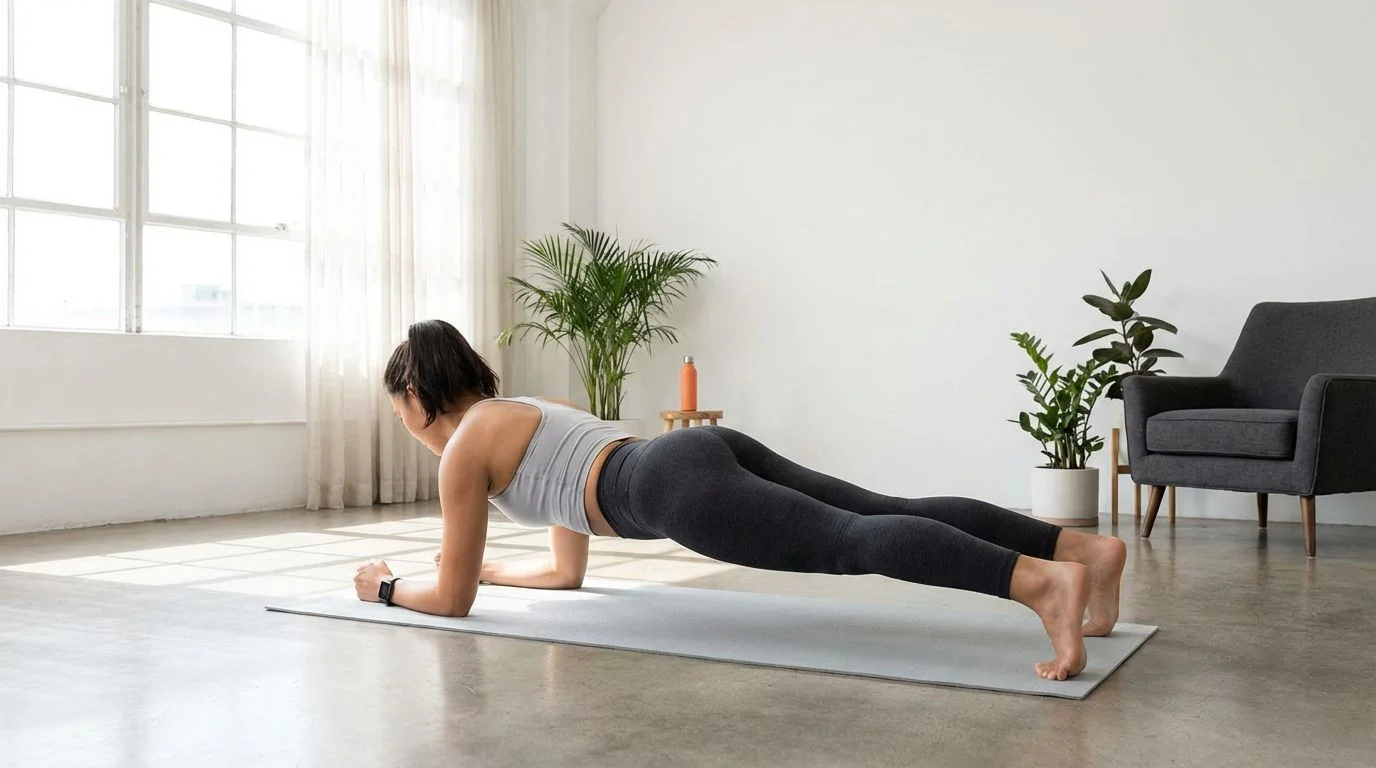
Plank - 3 holds of 20-30 seconds
-
Glute Bridges - 3 sets of 12 reps
Perform this routine 3 times per week with at least one rest day between sessions. Research supports full-body training 2-3 times weekly for beginners to build strength effectively while allowing proper recovery2.
For more equipment-free home workouts, explore bodyweight progressions that scale with your improving fitness.
Cardio Integration
Cardio does not require running unless you want it to. Brisk walking for 30 minutes at a pace where you can talk but not sing counts as effective cardiovascular training. Cycling, whether stationary or outdoor, works well at 20-30 minutes of moderate intensity. Swimming offers low-impact full-body cardio and works particularly well for those with joint issues. Even dancing qualifies if it keeps you moving continuously.
The key is elevating your heart rate into a moderate zone and maintaining it. Most fitness trackers define this as 50-70% of your maximum heart rate.
Progress Monitoring
What gets measured gets managed. Tracking your workouts ensures progressive overload, helps you identify patterns in energy and performance, and lets you spot plateaus before they stall your progress.
Tracking Method
Best For
Effort Level
Workout journal
Logging sets, reps, and how you felt
Low (pen and paper)
Fitness apps
Automated tracking with trend analysis
Medium (data entry)
Wearable devices
Heart rate, recovery, daily activity
Low (passive capture)
Wearables add another layer of context by measuring HRV and recovery signals that can help you assess whether a day supports hard training or a lighter option.
Integrating Wearable Tech for Personalized Fitness
Using Devices for Real-Time Feedback
Fitness trackers and smartwatches do more than count steps. Modern wearables capture metrics that can inform your training decisions:
-
Heart rate zones for understanding intensity
-
Sleep quality scores that add recovery context
-
Daily readiness indicators that summarize device signals
-
Calorie expenditure estimates that require cautious interpretation
Real-time heart rate feedback can help you understand workout intensity, but it cannot prevent undertraining, overtraining, or injury on its own. If your wearable shows a lower-than-expected heart rate during cardio, consider pace, sensor accuracy, medications, heat, and how you feel before deciding to push harder. An elevated resting heart rate is one signal that may support an easier day, not a diagnosis or automatic instruction.
Understanding your wearable data and fitness insights transforms raw numbers into actionable decisions.
AI-Powered Planning and User-Requested Adjustments
Static workout programs cannot account for everything that changes around you. Energy levels shift, stress accumulates, recovery varies, and your schedule moves. SensAI generates a program from your personal context and regenerates it weekly using actual performance and recovery data. Its daily recovery summary can help you understand how sleep, HRV, and resting heart rate compare with your baseline.
SensAI does not silently replace Tuesday’s workout because of one poor night of sleep. If you want to change today’s session, ask the AI Coach in natural language or use a quick action such as “Make it shorter.” You remain in control of the modification.
AI-powered personal training can combine personal context with an LLM-powered conversation in ways generic programs cannot. Your weekly plan evolves with completed training and recovery context rather than expecting you to fit a predetermined mold.
Staying Motivated and Progress Tracking
Setting Realistic Goals
Vague goals produce vague results. Effective fitness goals have clear targets and deadlines.
Weak goal: “I want to get in shape.”
Strong goal: “I will complete three 30-minute workouts per week for the next 8 weeks.”
Even stronger: “I will increase my push-up count from 5 to 15 and walk 10,000 steps daily for 60 days.”
Start with process goals (what you will do) rather than outcome goals (what you want to achieve). You control showing up to workout; you cannot directly control how fast your body responds.
Research supports that consistent training over weeks produces measurable adaptations3. Trust the process.
Celebrating Milestones
Motivation fades when progress goes unacknowledged. Build recognition into your journey by marking weekly wins when you complete all planned workouts, tracking monthly measures like strength gains or endurance improvements, and celebrating personal records such as your first unassisted push-up or longest plank hold.
Small celebrations reinforce the habit loop. They remind your brain that exercise produces rewards beyond distant future outcomes.
For strategies on staying motivated with workout consistency, explore how habit stacking and accountability structures keep beginners on track.
Next Steps in Your Fitness Journey with SensAI
Personalized Evolving Plans
Generic programs work until they do not. Your body adapts, your schedule shifts, and your goals evolve. SensAI creates workouts from scratch around your goals, equipment, schedule, and constraints. Each week it can regenerate the program using completed workouts and aggregated recovery metrics such as HRV trends and sleep quality.
This creates a program that grows with you rather than one you outgrow.
Continue with SensAI
SensAI combines an LLM-powered coach with personal health context to create individualized workout and wellness support. Apple Watch data connects through Apple HealthKit, and compatible Garmin, Oura, and WHOOP metrics can flow through HealthKit as well. During a workout, you can ask for a change in plain language instead of waiting for the app to make an automatic decision.
The goal is a plan built for your real starting point, with guided tracking and a coach you can ask when your needs change.
FAQ
What should I wear for my workouts?
Choose breathable, moisture-wicking fabrics that allow full range of motion. Proper athletic shoes matter most. Running requires cushioned shoes designed for forward motion. Cross-training benefits from flatter, more stable footwear.
How can I prevent burnout when starting an exercise routine?
Start easier than you think necessary. Many beginners quit because they went too hard too fast, skipped rest days thinking more is better, or chose exercises they hated. Begin with 2-3 sessions weekly at moderate intensity. Add volume and intensity gradually over weeks, not days. Rest days are not optional4.
Should I focus more on cardio or strength training as a beginner?
Both matter. Current guidelines recommend a combination of 150 minutes weekly moderate cardio plus 2 strength sessions. If forced to choose, strength training offers broader benefits including metabolic improvement, bone density, and functional movement. Cardio supports heart health and recovery capacity. A balanced approach serves most beginners best.
References
Footnotes
-
U.S. Department of Health and Human Services. “Physical Activity Guidelines for Americans, 2nd edition.” health.gov, 2018. https://health.gov/our-work/nutrition-physical-activity/physical-activity-guidelines ↩
-
NCBI/National Library of Medicine. “Exercise Prescription for Healthy Populations With Special Considerations and Environmental Considerations.” ncbi.nlm.nih.gov, 2022. https://www.ncbi.nlm.nih.gov/books/NBK585062/ ↩
-
PMC/National Institutes of Health. “Exercise and Physical Activity Guidelines.” pmc.ncbi.nlm.nih.gov, 2019. https://pmc.ncbi.nlm.nih.gov/articles/PMC6536904/ ↩
-
National Center for Health Research. “Beginner’s Guide to Developing an Exercise Routine.” center4research.org, 2018. https://www.center4research.org/beginners-guide-developing-exercise-routine/ ↩