Fitbod vs Strong vs Hevy vs SensAI: $24 to $96 a Year — Which Workout App Wins in 2026?
Hevy is $23.99/yr, Strong $29.99, SensAI $69.99, Fitbod $95.99. Verified 2026 pricing plus which workout app fits your training style — fast logging, auto-programming, community, or recovery-aware AI coaching.

SensAI Team
9 min read
Get a training plan that adapts to your recovery — free on iOS

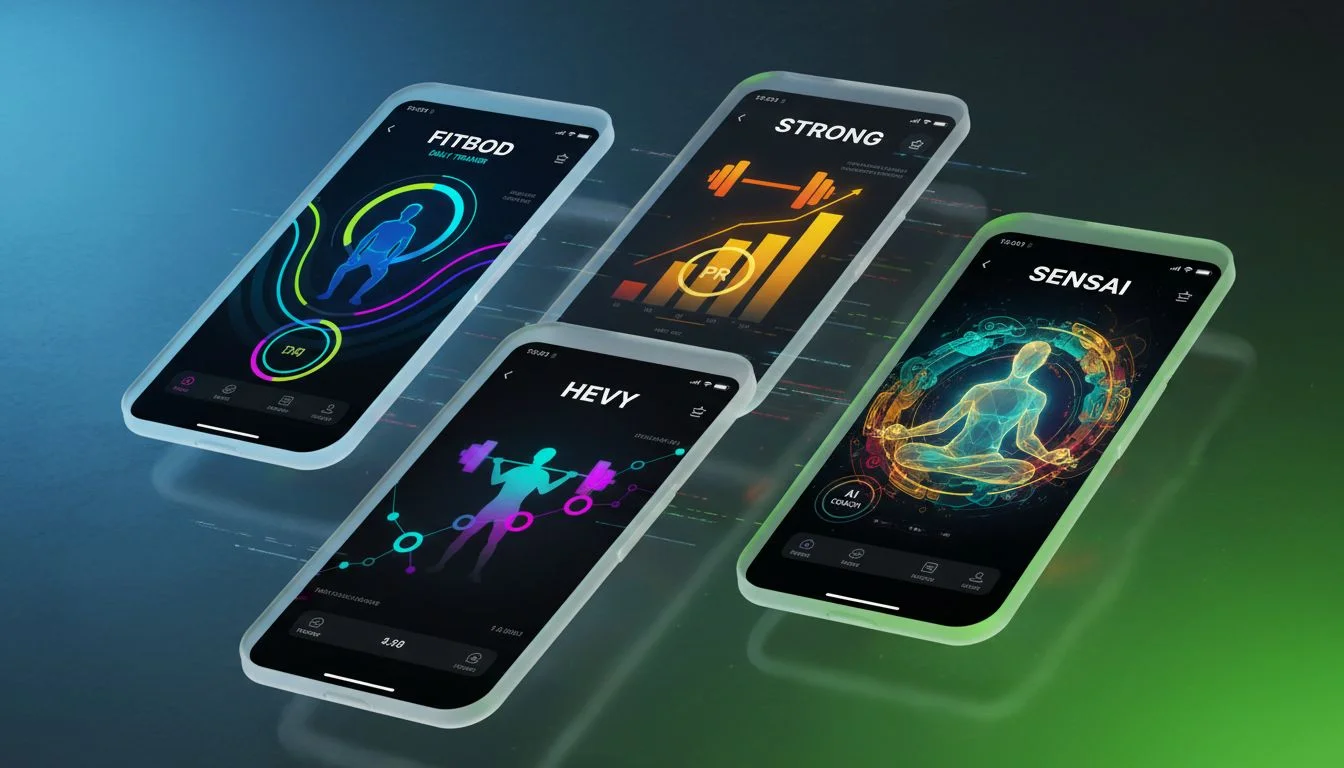
Here’s the 30-second verdict:
- Strong is the fastest pure logger — you bring the program, it stays out of the way ($29.99/yr, $99.99 lifetime), and its free tier logs indefinitely.
- Hevy is the best value and the strongest community ($23.99/yr), with a permanent free tier.
- Fitbod has the best automated programming if you want the app to plan every session ($95.99/yr).
- SensAI is the only one that coaches off your wearable recovery data ($69.99/yr).
The mistake is picking by feature count. Pick by training style instead — the wrong match is what gets an app deleted by February.
All pricing below verified July 2026.
At-a-Glance: Fitbod vs Strong vs Hevy vs SensAI
| Fitbod | Strong | Hevy | SensAI | |
|---|---|---|---|---|
| Programming approach | Algorithm-generated workouts (over 1,000 exercises) | Manual — you bring the program | Templates + Hevy Trainer AI | LLM coach builds plans from your goals + recovery data |
| Wearable analysis | Activity syncing only | None | Basic logging | Deep — HRV, sleep, resting heart rate feed programming |
| Free tier | No (7-day trial) | Yes, permanent — unlimited logging, charts are Pro-gated | Yes, permanent — 4 routines, 3 months of graphs | No (7-day trial) |
| Annual price | $95.99 | $29.99 | $23.99 | $69.99 |
| Lifetime option | — | $99.99 | $74.99 | — |
| Best for | Hands-off guided training | Experienced lifters with a plan | Value + community | Data-driven adaptive coaching |
What Changed in 2026
- Strong added a $19.99 six-month plan, slotting between its $4.99 monthly and $29.99 annual options.
- Everything else held steady — we re-verified all four apps’ pricing in July 2026 and found no changes since our last update. In a market that hiked prices for two straight years, stability is itself information.
- Hevy Trainer, Hevy’s AI workout generator, remains included with Pro at no extra charge.
Pick by Training Style, Not Feature List
Would you hire a coach based on how many certifications they list, or based on whether their style fits how you actually train? Apps work the same way. A feature you’ll never use is worth exactly nothing — the question is which app’s core loop matches yours.
Strong: You Already Have a Program
Strong is a precision instrument for one job: logging sets faster than anything else on the market. If your program comes from a coach, a spreadsheet, or a decade of your own experience, Strong records it without ever suggesting you do something different.
That restraint is the product. No algorithm second-guesses your programming, CSV export keeps your data portable, and the interface is optimized for the ten seconds between sets. The $99.99 lifetime purchase is increasingly rare in a subscription-saturated market.
The trade-off is total silence: no workout generation, no recovery awareness, no guidance of any kind. Strong assumes you know what you’re doing — and if you do, that’s precisely what you want.
Full head-to-head: Hevy vs Strong in 2026.
Hevy: Best Value, Real Free Tier, Community
Hevy has the cleanest free tier here — unlimited logging with no ads, capped at 4 routines and a rolling 3 months of progress graphs — and at $23.99/yr, Pro is the cheapest paid plan of the four. You also get the strongest social layer: a feed of workouts from people you follow, PR celebrations, and the quiet accountability of lifting in public.
That social layer isn’t fluff. A 2024 meta-analysis of 36 randomized trials found gamified fitness apps produced a measurable step-count increase over non-gamified ones — modest, but real.1
Hevy Trainer adds AI-generated workouts at no extra cost, though it’s lighter-touch than Fitbod’s engine or SensAI’s coaching.
Go deeper: our full Hevy review and Hevy vs Fitbod.
Fitbod: The App Does the Programming
Fitbod answers the question that stops most beginners cold: “What do I actually do at the gym today?” Tell it your equipment and experience, and its algorithm generates each session — rotating muscle groups, tracking its internal model of fatigue, and pulling from a library of over 1,000 exercises with video demos.
For guided, hands-off programming, it’s the most mature engine in this comparison. The catch is the price ($95.99/yr, the most expensive here) and the ceiling: Fitbod’s fatigue model is built from your logged workouts, not from your body. It doesn’t see your sleep, HRV, or resting heart rate, so a brutal night’s sleep and a perfect one produce the same recommendation.
Go deeper: our Fitbod review and Hevy vs Fitbod.
SensAI: Coaching That Reads Your Recovery
SensAI is the only app in this lineup that uses your wearable’s recovery data — HRV, sleep quality and duration, resting heart rate — to shape the training it writes you. Apple Watch connects directly; Garmin, Oura, and WHOOP flow in through HealthKit. The program regenerates weekly against what you actually performed and how you actually recovered, and you get a daily readiness summary on top.
The coach itself is an LLM with memory: it remembers your injuries and preferences across sessions, and you can modify a workout mid-session in plain language — “make it shorter,” “my shoulder’s acting up” — and it rebuilds on the spot.
Honest framing on the science: HRV-guided training shows small group-level advantages over fixed plans, but its clearest benefit is fewer people who get worse — reduced downside risk, not magic.2 For anyone who struggles to know when to push and when to back off, that’s the point.
Go deeper: best AI personal trainer apps in 2026.
Device Integration and Offline Use
| Device | Fitbod | Strong | Hevy | SensAI |
|---|---|---|---|---|
| Apple Watch | ✓ | ✓ | ✓ | ✓ |
| Wear OS | ✗ | ✓ | ✓ | ✗ |
| Garmin | ✗ | ✗ | ✗ | ✓ (via HealthKit) |
| Oura Ring | ✗ | ✗ | ✗ | ✓ (via HealthKit) |
| WHOOP | ✗ | ✗ | ✗ | ✓ (via HealthKit) |
The column that matters is not “works with your watch” but “uses your data to coach you.” Fitbod, Strong, and Hevy log workouts from your wrist; none of them changes your programming because of what your wearable measured overnight.
| App | Offline support |
|---|---|
| Strong | Fully functional, syncs when reconnected |
| Hevy | Fully functional, syncs when reconnected |
| Fitbod | Logs workouts offline after session starts |
| SensAI | Offline-first — full workout tracking without internet; AI coaching features need connectivity |
2026 Pricing: $24 to $96 a Year
Hevy costs $2.99/month or $23.99/year for Pro; the free tier runs permanently with limits, and a $74.99 lifetime option exists.
| App | Monthly | Annual | 6-month / Lifetime | Free tier / Trial |
|---|---|---|---|---|
| Fitbod | $15.99 | $95.99 | — | 7-day trial, no free tier |
| Strong | $4.99 | $29.99 | $19.99 6-mo, $99.99 lifetime | Minimal |
| Hevy | $2.99 | $23.99 | $74.99 lifetime | Permanent free tier with limits (Trainer included with Pro) |
| SensAI | $6.99 | $69.99 | — | 7-day trial |
For context: a human personal trainer runs $200–400 per month. Even the priciest app here costs less per year than two coaching sessions — so the real question isn’t Fitbod’s $96 versus Hevy’s $24, but whether the extra features change how you train. SensAI’s $69.99/yr works out to about $5.83/month for coaching that reads your recovery data and programs around it.
Full breakdown: fitness app pricing and free tiers compared.
Does the Technology Actually Matter? What the Research Says
The dirty secret of fitness apps isn’t bad software. It’s abandonment.
A 2024 scoping review covering 18 studies and over 525,000 users found a median of 70% abandon lifestyle apps within the first 100 days.3 A 2026 study of one fitness app’s user base measured a 69% drop-off in training activity by the end of the first month — though paying subscribers stuck around nearly twice as long as free users.4 The counter-signal: a 2025 pilot of an AI-biomarker wellness app held weekly engagement at 43.5% a month in, roughly triple industry norms.5 Whatever app you pick, the feature that matters most is the one that keeps you opening it in March.
Social and gamified features measurably help. The 36-trial meta-analysis found gamified apps added roughly 489 steps per day over non-gamified equivalents,1 and the Columbia Moves cluster trial found teams with gamification kept up their self-monitoring habits better months after the intervention ended.6
What about AI coaching and recovery-guided training? The evidence is real but bounded. In a Johns Hopkins randomized trial led by Ahmed Hassoon, MD MPH, an AI voice coach drove an increase of roughly 3,600 steps per day over control — a striking effect, measured in cancer survivors rather than lifters, so translate with care.7 A scoping review of AI-driven activity apps found positive effects on behavior, with certainty ranging from moderate to very low.8 And on the recovery side, Agustín Manresa-Rocamora’s group at Universidad Miguel Hernández found HRV-guided training’s standout result was the responder rate: in the reviewed trials, half of runners on fixed plans lost aerobic capacity, versus about one in nine trained by HRV.2 A separate systematic review in the Journal of Science and Medicine in Sport reached a similar conclusion for wearable-measured HRV in endurance training.9
Marco Altini, PhD — founder of HRV4Training and author of more than 50 papers on the subject — frames HRV the way the research supports: a day-to-day readiness signal that only means something against your own baseline, telling you when to ease off, not how fit you are.
Be clear about the limitation: these are activity and endurance studies, not studies of lifting apps. No RCT has pitted Fitbod against SensAI. But personalization that responds to your actual physiology is where exercise science is heading10 — and that is the bet SensAI makes: reading the recovery signals your wearable already collects and adjusting your training before you dig a hole.
Quick Head-to-Head Answers
Fitbod vs Hevy: which is better?
Fitbod if you want the app to program every workout for you; Hevy if you want value, community, and control. Fitbod plans each session automatically but costs four times as much; Hevy gives you templates, a social feed, and light AI generation for $23.99/yr with a real free tier. Beginners who want zero decisions lean Fitbod; everyone else keeps more money and more say with Hevy. Full comparison: Hevy vs Fitbod.
Hevy vs Strong: which should you pick?
They’re the two best pure loggers, and Hevy wins on value while Strong wins on speed. Hevy is cheaper ($23.99 vs $29.99/yr), has a community feed and Wear OS support, and both run permanent free tiers — Hevy caps you at 4 routines and 3 months of graphs, Strong logs without limit but gates charts behind Pro. Strong’s logging flow is slightly faster and its $99.99 lifetime option rewards commitment. If social features do nothing for you, Strong; if you’d rather pay less and see friends’ PRs, Hevy. Full comparison: Hevy vs Strong.
Fitbod vs Strong: programming or logging?
This is the cleanest split in the roundup: Fitbod decides your workouts, Strong records them. If you have a program you trust, Fitbod’s $95.99/yr buys you an algorithm you’ll be fighting; Strong’s $29.99 buys a faster notebook. If you’d otherwise wander the gym improvising, Fitbod’s structure is worth the premium.
FAQ
How much does Hevy cost?
Hevy Pro costs $2.99/month, $23.99/year, or $74.99 for lifetime access, and includes Hevy Trainer AI workouts. The free tier works indefinitely with limits on routines and analytics.
Is there a free version of these apps?
Hevy and Strong both run permanent free tiers you can train on indefinitely; Fitbod and SensAI are trial-based (7 days each, then paid). Hevy free allows unlimited logging with no ads but caps you at 4 routines and a rolling 3 months of progress graphs. Strong free logs without limit and never locks your data — Strong’s help centre states your workout data is always available whether or not you are a Pro user — but charts are Pro-gated. If “free forever” is the requirement, take Hevy for the cleanest experience or Strong if you run three or fewer routines. Full breakdown: fitness app pricing and free tiers compared.
Can I switch apps without losing my workout history?
Mostly, yes. Strong offers straightforward CSV export; Fitbod and Hevy support export, though some export features sit behind their paid tiers. SensAI pulls your historical health and activity data in through HealthKit, so your training context follows you.
What’s the best workout tracking app in 2026?
There is no single best — there’s a best match for your training style. Self-programmers should use Strong or Hevy; people who want the app to plan everything should use Fitbod; people with a wearable who want training that adapts to their recovery should use SensAI.
The Bottom Line
- If you have a program and want speed → Strong.
- If you want maximum value, community, or a permanent free tier → Hevy (or Strong, if you run three or fewer routines).
- If you want the app to do all the programming → Fitbod.
- If you want coaching that responds to your body’s recovery signals → SensAI.
One honest note: when people quit a workout app, the usual failure mode is a mismatch between the app and how they train — not bad software. All four of these are good at what they’re built for.
If what you’re missing is a coach that knows you slept badly before you tell it, SensAI has a 7-day free trial — connect your Apple Watch, Garmin, Oura, or WHOOP and see what recovery-aware training feels like.
Comparing against JEFIT too? See Hevy vs Strong vs Fitbod vs JEFIT.
References
Footnotes
-
Nishi SK, et al. “Effect of digital health applications with or without gamification on physical activity and cardiometabolic risk factors: a systematic review and meta-analysis of randomized controlled trials.” eClinicalMedicine, 2024. https://pmc.ncbi.nlm.nih.gov/articles/PMC11701442/ ↩ ↩2
-
Manresa-Rocamora A, Sarabia JM, Javaloyes A, Flatt AA, Moya-Ramón M. “Heart Rate Variability-Guided Training for Enhancing Cardiac-Vagal Modulation, Aerobic Fitness, and Endurance Performance: A Methodological Systematic Review with Meta-Analysis.” International Journal of Environmental Research and Public Health, 2021. https://pmc.ncbi.nlm.nih.gov/articles/PMC8507742/ ↩ ↩2
-
Kidman PG, Curtis RG, Watson A, Maher CA. “When and Why Adults Abandon Lifestyle Behavior and Mental Health Mobile Apps: Scoping Review.” Journal of Medical Internet Research, 2024. https://www.jmir.org/2024/1/e56897 ↩
-
Fuente-Vidal A, Prat R, Arribas-Marin JM, Bastidas-Jossa O, Guerra-Balic M, Garcia-Zapirain B, Montane J, Jerez-Roig J. “Analysis of Training Behavior in Users of a Fitness App: Cross-Sectional Study.” JMIR mHealth and uHealth, 2026. https://mhealth.jmir.org/2026/1/e72201 ↩
-
Leslie-Miller CJ, Goltz SR, Barrios PL, Cushing CC, Badshah T, Ungaro CT, Qu S, Berezhnaya Y, Brisbois TD. “Evaluating the Acceptability and Utility of a Personalized Wellness App (Aspire2B) Using AI-Enabled Digital Biomarkers: Engagement Enhancement Pilot Study.” JMIR Formative Research, 2025. https://formative.jmir.org/2025/1/e63471 ↩
-
Monroe CM, Cai B, Edney S, Jake-Schoffman DE, Brazendale K, Bucko A, Armstrong B, Yang CH, Turner-McGrievy G. “Harnessing technology and gamification to increase adult physical activity: a cluster randomized controlled trial of the Columbia Moves pilot.” International Journal of Behavioral Nutrition and Physical Activity, 2023. https://pmc.ncbi.nlm.nih.gov/articles/PMC10623775/ ↩
-
Hassoon A, Baig Y, Naiman DQ, et al. “Randomized trial of two artificial intelligence coaching interventions to increase physical activity in cancer survivors.” npj Digital Medicine, 2021. https://www.nature.com/articles/s41746-021-00539-9 ↩
-
Gabarron E, Larbi D, Rivera-Romero O, Denecke K. “Human Factors in AI-Driven Digital Solutions for Increasing Physical Activity: Scoping Review.” JMIR Human Factors, 2024. https://humanfactors.jmir.org/2024/1/e55964/ ↩
-
Düking P, Zinner C, Trabelsi K, Reed JL, Holmberg HC, Kunz P, Sperlich B. “Monitoring and adapting endurance training on the basis of heart rate variability monitored by wearable technologies: A systematic review with meta-analysis.” Journal of Science and Medicine in Sport, 2021. https://pubmed.ncbi.nlm.nih.gov/34489178/ ↩
-
Gao Z, Yu F. “Personalized Fitness Plans via Mobile Health Technology.” American College of Sports Medicine, 2024. https://acsm.org/personalized-fitness-mobile-technology/ ↩