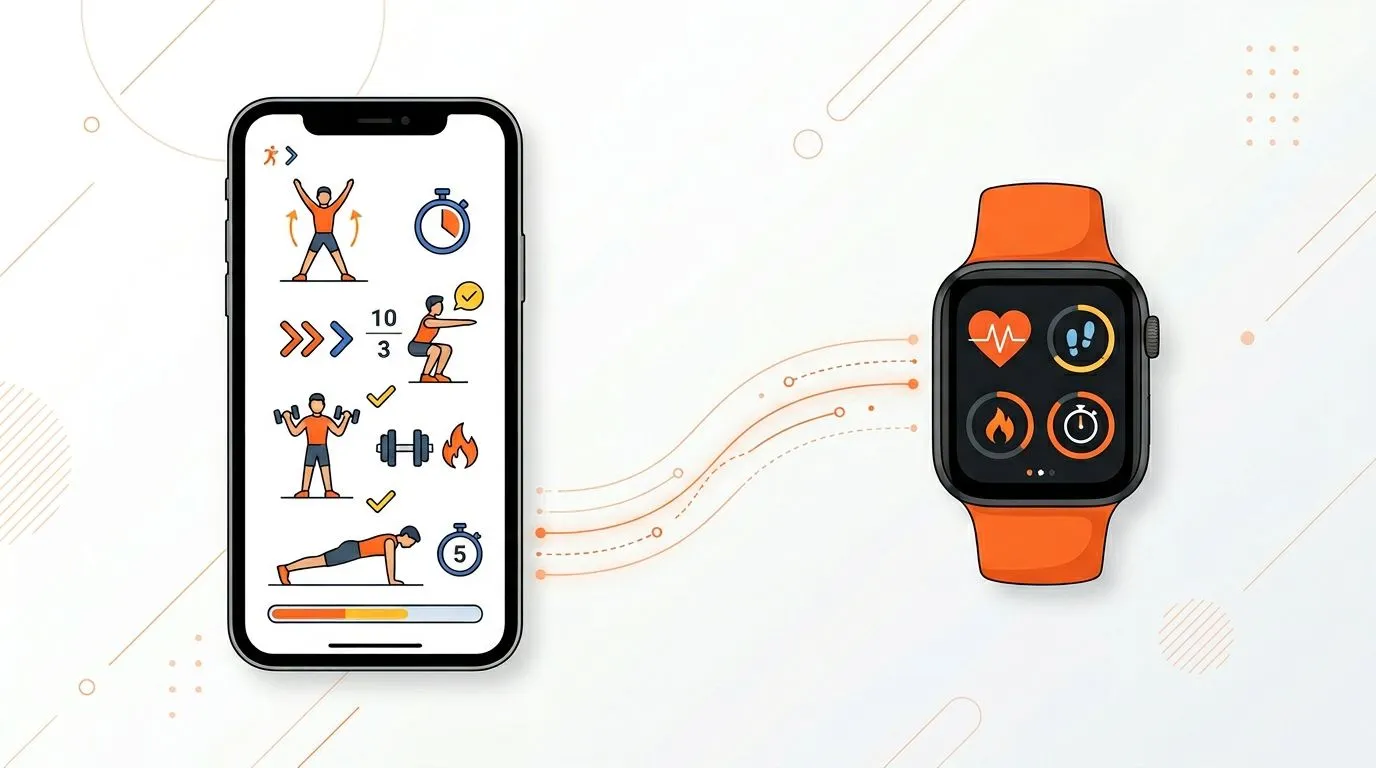
How AI Creates Truly Personalized Workout Plans
Explore the science behind AI-generated workout plans and discover how artificial intelligence is making fitness more personalized than ever before.

SensAI Team
7 min read
Get a training plan that adapts to your recovery — free on iOS

Gone are the days of one-size-fits-all workout programs. Artificial intelligence is changing how we approach fitness by creating workout plans that are as unique as you are. The strongest evidence for digital coaching is not a single magic percentage; it is the repeated finding that app-based programs, feedback loops, and wearable data can help people move more when the intervention is designed well.12 But how exactly does AI accomplish this level of personalization?
The Limitations of Traditional Workout Plans
Traditional fitness programs often rely on broad categories:
- Beginner, intermediate, or advanced levels
- Goal-based programs (weight loss, muscle gain, endurance)
- Generic age and gender considerations
While these approaches provide a starting point, they miss the nuanced factors that make each person’s fitness journey unique.
The AI Difference: Multi-Dimensional Personalization
LLM-powered workout planning can combine several kinds of context when those inputs are available and intentionally provided:
1. Physiological Factors
- Current training level, goals, and tracked performance
- Completed versus planned sets and sessions
- Connected HRV, resting-heart-rate, and sleep trends
- Injuries and movement limitations you report
2. Lifestyle Integration
- Available workout time and schedule constraints
- Equipment access and space limitations
- Schedule changes you report
- Connected sleep quality and duration
3. Behavioral Patterns
- Exercise preferences you share
- Past adherence visible in tracked workouts
- Feedback and constraints from conversation
The Science Behind AI Workout Creation
Large Language Models (LLMs)
Modern AI fitness platforms leverage the same technology that powers ChatGPT and other conversational AI systems:
Contextual Reasoning: LLMs can place goals, schedule, equipment, reported constraints, workout history, and aggregated recovery trends in one conversation. They cannot diagnose a health condition or determine why a wearable metric changed.
Conversational Understanding: AI coaches can interpret your feedback, preferences, and goals in natural language, making interactions intuitive and personal.
Requested Adaptation: LLMs can respond when you ask to shorten a session, add volume, or swap an exercise. SensAI also uses actual performance and recovery when regenerating the next weekly program; it does not mutate today’s workout automatically.
Data Integration
SensAI combines supported data from several sources:
- Aggregated HealthKit recovery metrics (HRV trends, resting heart rate, sleep quality and duration)
- Workout-tracker data (planned versus performed work and heart-rate-zone summaries)
- Manual input (goals, equipment, schedule, preferences, symptoms, and constraints)
- Conversation history retained by the coach’s memory system
Weekly Regeneration And Explicit In-Workout Changes
Unlike a static document, an LLM-supported plan can change at clear, user-visible points:
Progressive Overload Optimization
SensAI uses evidence-based volume and recovery guardrails when it generates a plan. Tracked performance informs the next weekly regeneration, but no system can guarantee the perfect challenge or recovery dose.
Recovery Integration
The daily recovery and readiness summary places connected metrics beside your baseline. It provides context rather than a diagnosis or an automatic intensity change. You decide whether to request a modification.
Preference Learning
The coach’s memory can retain exercise preferences you share. This is persistent conversational context, not a machine-learning model training itself on your data.
The Personalization Process
Here’s how AI creates your unique workout plan:
- Initial Assessment: Comprehensive analysis of your current state
- Goal Setting: AI helps refine and prioritize your objectives
- Program Generation: Creates initial workout structure
- Workout Tracking: Records planned versus performed work
- Weekly Review: Regenerates the next program from performance, recovery, and feedback; in-week changes remain user-requested
Benefits of AI-Personalized Workouts
Potential Adherence Support
Personalized programs may support adherence when they align with individual preferences and capabilities. In app-based physical activity research, stronger outcomes tend to come from systems that combine tracking, feedback, goal setting, and ongoing engagement rather than simply displaying data.1
A Better Fit, Not A Faster-Results Promise
Personalization can make a plan fit goals and constraints more closely, but it cannot promise faster results. In endurance research, HRV-guided prescriptions have improved some physiological outcomes compared with fixed plans, while other pooled performance outcomes remain mixed.3
Risk-Aware Guardrails
Programming guardrails can avoid reckless jumps in volume or intensity, but an LLM cannot identify an injury, predict who will be injured, or guarantee prevention. New severe pain, major trauma, chest pain, fainting, progressive weakness, new neurological symptoms, or rapidly worsening symptoms require appropriate medical assessment.
User Control
Conversation, exercise swaps, and plan explanations can make it easier to express preferences. Whether that improves motivation or adherence varies by person.
The Human Element
While AI excels at understanding context and providing personalized guidance, the human element remains crucial:
- Emotional support and motivation
- Form correction and technique guidance
- Accountability and goal refinement
- Life coaching and mindset work
The future lies in AI-human collaboration, where LLMs provide the intelligence and personalization while humans provide the emotional support and hands-on guidance.
Choosing the Right AI Fitness Platform
When evaluating AI-powered fitness solutions, look for:
- Comprehensive data integration
- Clear explanations of what the LLM considered
- User control and customization options
- Strong privacy and security measures
- Explicit memory controls and a clear update cadence
What Not To Assume About Personalized Fitness
Current product claims should stay bounded. An LLM fitness coach should not be assumed to provide:
- A medical diagnosis from a photo, symptom, or wearable trend
- Genetic or predictive health insights
- Automatic decisions from weather, location, or unreported life events
- A replacement for qualified hands-on coaching or clinical care
Getting Started
The journey to truly personalized fitness begins with:
- Honest self-assessment of your current state and goals
- Consistent data collection through wearable devices
- Open communication with your AI coach about preferences and feedback
- Patience while enough tracked and reported context accumulates for useful review
Personalized workout plans can make technology fit the user more closely. The useful version is explicit about its inputs and limits: LLM coaching, connected context, weekly regeneration, tracked execution, and changes the user can inspect and request.
References
Footnotes
-
Romeo A, Edney S, Plotnikoff R, et al. “Can Smartphone Apps Increase Physical Activity? Systematic Review and Meta-Analysis.” Journal of Medical Internet Research, 2019. https://www.jmir.org/2019/3/e12053/ ↩ ↩2
-
Ferguson T, Olds T, Curtis R, et al. “Effectiveness of wearable activity trackers to increase physical activity and improve health: a systematic review of systematic reviews and meta-analyses.” The Lancet Digital Health, 2022. https://pubmed.ncbi.nlm.nih.gov/35868813/ ↩
-
Düking P, Zinner C, Trabelsi K, Reed JL, Holmberg HC, Kunz P, Sperlich B. “Monitoring and adapting endurance training on the basis of heart rate variability monitored by wearable technologies: A systematic review with meta-analysis.” Journal of Science and Medicine in Sport, 2021. https://pubmed.ncbi.nlm.nih.gov/34489178/ ↩